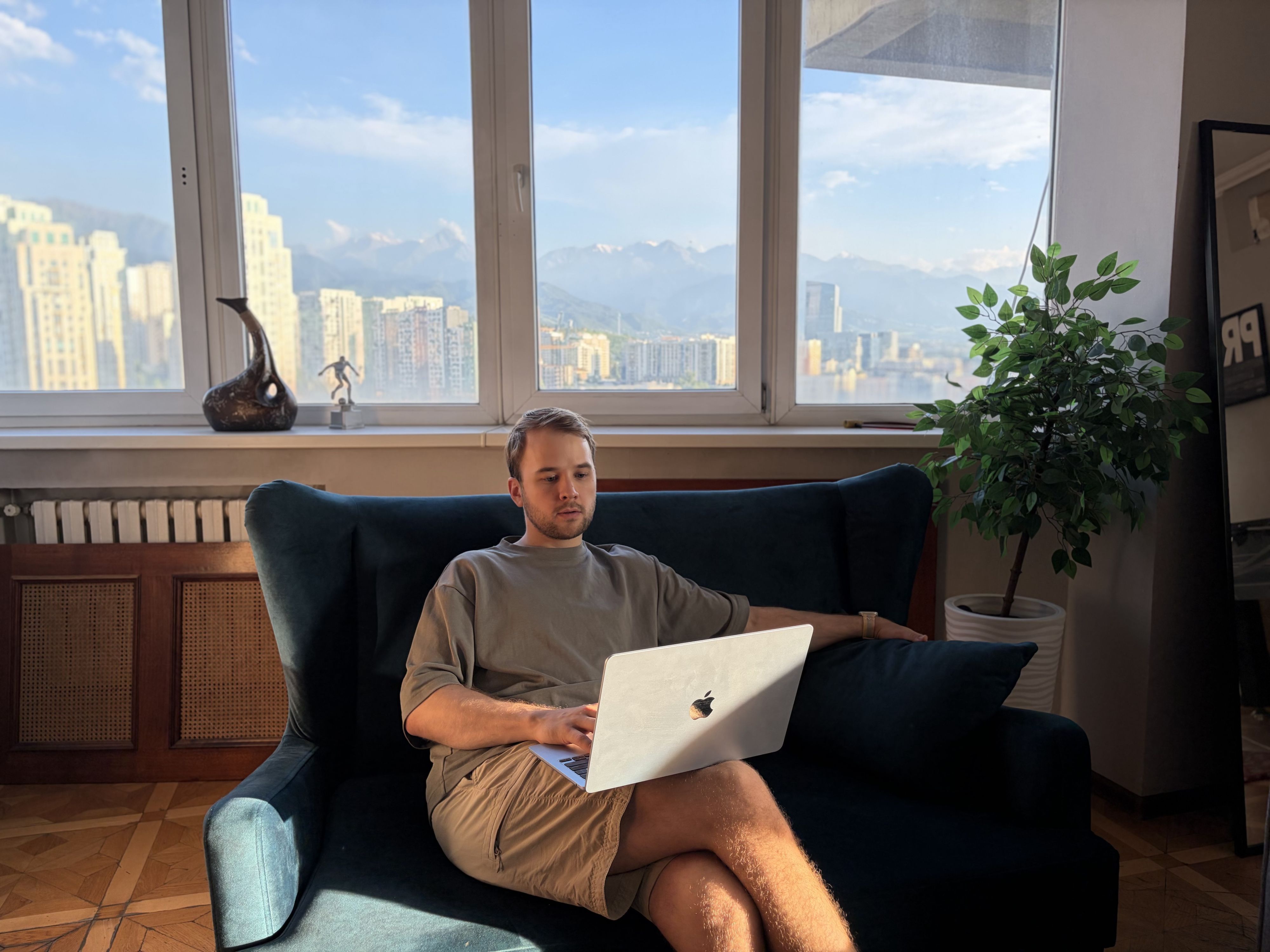
An iOS Engineer at inDrive who takes part in the company's social and educational projects talks about what children in rural schools are being taught, and why a good product starts with understanding who it's for and why it exists.
This summer, inDrive Kazakhstan launched an emotional ad campaign for Intercity, its intercity ride service. The video opens like a typical travel ad: beautiful roads, appealing destinations, a sense of carefree adventure. Then that image gives way to the real stories behind intercity trips. The people in it are traveling to say goodbye to a loved one, to support family, to leave home and start a new life, to work through personal hardship, or to pick up a dog from a shelter.
"People can't always choose the circumstances that send them on the road, but with inDrive they can choose their own price and driver, so that whatever the journey, it's a little more comfortable," says Viktor Gordienko, Senior iOS Engineer at inDrive, who works on the Intercity module that the campaign is built around. The idea of choice at the heart of the ad reaches beyond the product itself: inDrive also tries to create opportunities for people through its social initiatives. Viktor takes part in these as a volunteer too, running STEM career-guidance sessions in rural schools, helping organize IT camps for children, and serving on the jury for educational and business initiatives.
In an interview with Inkl, he talked about why an engineer should talk to kids about technology, how DJing connects to IT, and why curiosity is the single most important skill of the future.
— Viktor, when you joined inDrive, did you already know about the company's social mission and want to be part of it, or was there a moment when you realized it mattered to you?
inDrive values the ability to work efficiently with resources, to look for effective solutions, and to keep learning and adapting to new technologies. That's where I saw an overlap with my own personal mission: promoting productivity and efficiency, and developing critical thinking, curiosity, and a genuine interest in exploring new tools. That was one of the things that drew me to join the team.
Once I'd actually joined the company, I learned much more about its social and educational projects. Overall, I really connect with inDrive's philosophy of building products around people's real needs.
— For the past five years you've worked on Intercity, the product the current emotional campaign is built around. Behind the ad, we see people's stories and their journeys, but what does this product look like from an engineering standpoint? What kinds of technical challenges come up in making Intercity work for people in such different life situations and different countries?
A big part of the work is adapting the product for different countries, and that's not just about language. It's about local habits, cultural specifics, and the conditions people actually use the app in. In some places the internet connection is unstable or coverage is noticeably weaker, so we have to factor that in when designing the product and choose data transfer and processing approaches accordingly.
Technically, it can look like a set of discrete engineering tasks: architecture, protocols, performance, testing, localization. But I try not to lose sight of who all of it is actually for. When you're working on Intercity, it helps to picture not just an abstract "user" in the system, but an actual person traveling to another city for some reason that matters deeply to them. Without that understanding, I don't think it's possible to build a genuinely good product. A technical solution is never the end goal in itself; what matters is understanding what human problem it solves. In that sense, the idea behind the ad campaign really resonates with me: there's a real story behind every single trip.
— And what about you personally? In what situations do you use ride-hailing services?
The most common one for me is airport trips, when I need to plan the timing carefully and can't risk relying on public transport. And, like probably any developer, I'm a somewhat "difficult" customer in my own way.
When I get into the car as a passenger, I make a conscious effort to switch off the engineer in me. In that moment I'm not analyzing how the data protocol works or how the route-matching algorithm is optimized. What matters to me is experiencing the product the way an ordinary user would: how quickly a driver is found, how smoothly the route is built, whether payment goes through without a hitch, whether it's clear what's happening at each stage of the trip. Only afterward do I step back into the engineer role and think about what could be improved. If it's inDrive, I bring that back into my work; if it's another app, I carry the experience over to our own products.
I think switching between these roles really helps. When I teach IT sessions, I always tell the kids that a good engineer isn't just someone who can write code. It matters to be able to look at a problem from different angles: as a developer, as a user, and as the person the product is ultimately being built for. Technology isn't an end in itself. What matters is understanding what problem it solves, and why anyone should care in the first place.
— You take part in inDrive's volunteer projects, traveling with colleagues to rural schools and teaching classes there. What made you want to get involved, and what's the most memorable lesson you've taught?
For me, the core idea here is expanding access to opportunity. A kid in a big city can grow up around IT courses, hackathons, meetups, can talk to people already working in the industry, and get a sense of what career paths even exist. In a rural school, that kind of information can be almost entirely absent. Sometimes all it takes is showing up, talking about your own work, and demonstrating that these opportunities actually exist.
The most memorable project for me was one where we talked to high schoolers about STEM, meaning the fields at the intersection of science, technology, engineering, and math, and about the possibility of building a career in tech. And these visits weren't limited to IT: colleagues also ran sessions on other subjects, including creative ones.
— Right, and as part of one of those trips you ran a DJing workshop yourself. Why that, specifically?
I've been DJing myself for more than 10 years. In these sessions, I wanted to show the students that technology connects to all kinds of interests: music, design, art, content creation. Music today runs on digital tools, audio software, controllers, and the result depends heavily on how willing someone is to experiment and find their own solutions. Someone might discover an interest in technology through creativity first, or the other way around.
Like I said, development for its own sake rarely means much; there's almost always a real problem behind it, whether that's a user need, a business need, or a creative one. So I think it matters to give kids the chance to develop more than just technical skills: also curiosity, the ability to come up with new ideas, and the habit of looking at a problem from more than one angle.
— You also ran a business simulation game at a summer IT camp, where students went through the whole process from idea to pitch, similar to how a real product actually gets built. How was the game structured, and what ideas did the kids come up with?
Each session had about 10 to 15 students. The business game was part of the program: we split the kids into small teams and gave them a task tied to growing a service, like coming up with a new product direction or a solution for a specific group of users.
From there, each team had to work through almost the entire process. First, define the problem and propose a solution, then estimate the scope of work, right down to what specialists would be needed and roughly what budget it would take. After that, the teams worked out a business model and prepared a pitch. Some teams went further and thought through a marketing strategy, scaling options, and potential risks.
At the end, each team defended its idea: presented the solution, answered questions, and explained why they believed it could actually work. What struck me was that some of these ideas could easily have come up in an ordinary work discussion with colleagues. It really shows how creative and capable kids in rural areas can be. They just need someone to point them in the right direction.
— Viktor, if you could teach kids just one thing, one idea that would stay with them for life, what would it be?
I'd teach them not to fear the unknown, and to see it as an invitation to explore rather than a threat.
You know, whenever I visit rural schools for these sessions, the kids often ask the same question: "What's the point of learning any of this if everything's going to be different in five years? New AI, new robots, and whatever we learn now will be useless." And there's some truth in that fear. Technology really is changing at a dizzying pace. Programming languages become outdated, frameworks get rewritten, and even the problems we're solving today might be solved in a completely different way tomorrow.
But I always tell them: "You're not learning a specific programming language or tool. You're learning to think. You're learning to break a huge, intimidating problem down into small, manageable pieces. You're learning to ask the right questions, test your assumptions, and not give up the moment something goes wrong."
Critical thinking, adaptability, and an open mind toward the unknown aren't skills you can learn from a textbook. They're a state of mind. It's the ability to look at a constantly changing world and, instead of clinging to yesterday's answers, stay curious enough to keep searching for new ones. If I can instill that in these kids, I'll consider my mission accomplished.