
Get all your news in one place.
100's of premium titles.
One app.
Start reading
Windows Central
Windows Central
Technology
Cale Hunt

Valve says it's working on Steam Deck 2, but that probably doesn't mean what you think — Could it have an ARM-based future?

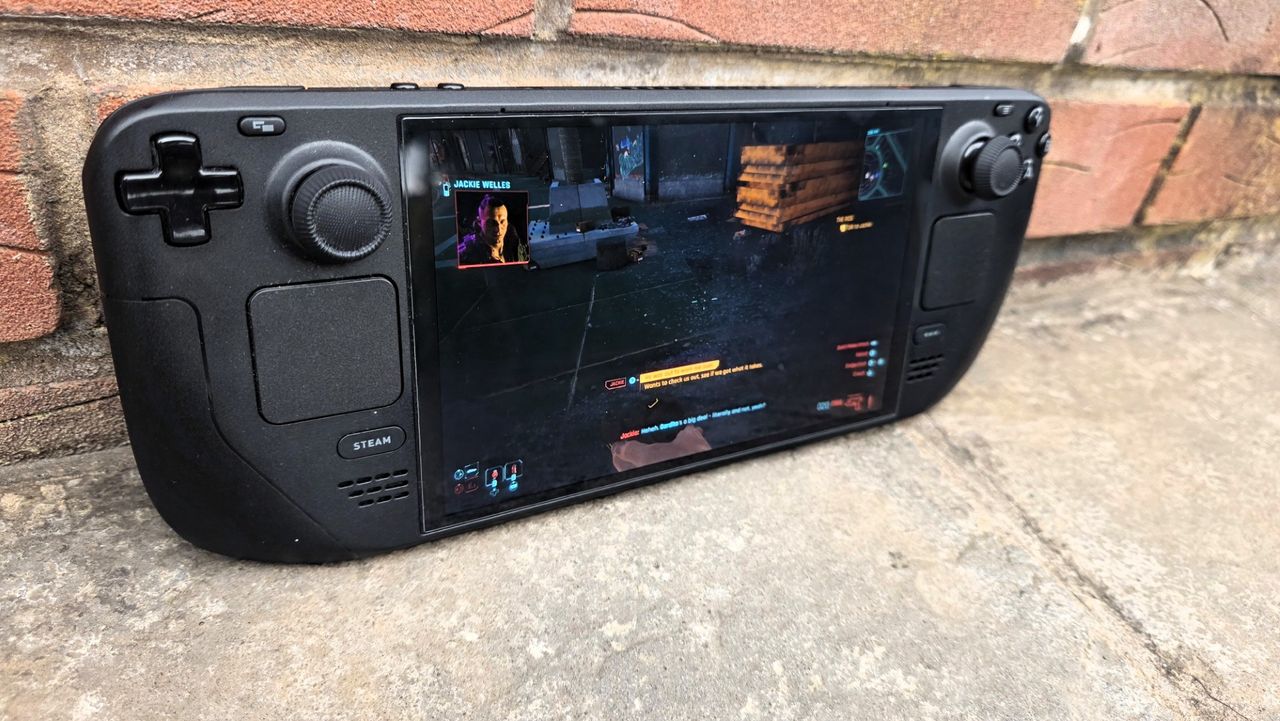
Steam Deck OLED playing Cyberpunk 2077.

The PC gaming world has been focused lately on the Steam Controller's launch this week, but it's another piece of Valve hardware that's lately stealing some of the spotlight.

According to Valve programmer Pierre-Loup Griffais, speaking with IGN, the company behind Steam is "hard at work" on the Steam Deck 2.

We're hard at work on it. And obviously, every step of the way, if you look at our hardware projects over the years, you can draw a straight line from the original Steam Controller and Steam Machine to Steam Deck, to everything that we're announcing and shipping this year. And we expect Steam Deck 2 will be a lot of the same, where a lot of what we're doing here will be learnings that build up to it.

Pierre-Loup Griffais, Valve programmer (speaking to IGN)

The first Steam Deck is what really kicked the PC gaming handheld craze off when it launched in 2022, with major brands like Lenovo, ASUS, MSI, and even Xbox getting in on the action in the following years.

So, with a Valve employee stating that the Steam Deck 2 is under development, that must mean it's coming sometime soon? Not likely.

Valve's Steam Deck 2 is in development, but don't expect it anytime soon

A look at Steam Deck prototypes created by Valve. (Image credit: Valve)

Valve is currently having a hard time getting its previously announced hardware, including the Steam Machine and Steam Frame, to market, never mind anything it has yet to officially unveil.

Announced alongside the new Steam Controller that launched on May 4, the console-like Steam Machine gaming PC and the new ARM-based Steam Frame VR headset have been delayed beyond their original "early 2026" launch target due to an ongoing memory crisis.

Valve is still hoping to get its new platforms out sometime in 2026, though I'm sure only a select few know if that goal remains a reality.

The RAM crisis could extend as far as 2030

The Steam Machine has suffered delays due to the ongoing memory and storage crisis. (Image credit: Windows Central | Valve | Crucial)

With AI datacenters gobbling up the world's supply of DRAM and NAND, memory and storage are a hot commodity. The blooming effects of these supply chain issues are being felt elsewhere, and the cost of almost everything with a processor continues to rise.

What's worse is that there's no real end in sight for the RAM crisis. Some experts believe that high prices could last until 2030, while others take a more optimistic outlook with a potential 2027 or 2028 solution.

With this timeline in mind, it's easy to assume that the Steam Deck 2 could be two or three years away from an official reveal, never mind a physical launch.

TL;DR: Valve claims it's working on the Steam Deck 2 as its Steam Machine and Steam Frame are delayed due to hardware shortages.

Valve is more worried about handheld gaming power than hardware prices

Valve wants the Steam Deck 2 to be considerably more powerful and efficient than the original Steam Deck (pictured here). (Image credit: Jennifer Young - WIndows Central)

Let's assume for a moment that there is no RAM crisis. The Steam Machine and Steam Frame launched alongside the Steam Controller, and everyone is having a grand time gaming on the hardware.

In this scenario, I still don't think the Steam Deck 2 would be arriving anytime soon. Valve has publicly stated that its goal for the Steam Deck's successor isn't just to boost performance while delivering similar battery life to the first-gen handheld.

We're not interested in getting to a point where it's 20 or 30 or even 50% more performance at the same battery life. We want something a little bit more demarcated than that. So we've been working back from silicon advancements and architectural improvements, and I think we have a pretty good idea of what the next version of Steam Deck is going to be, but right now there's no offerings in that landscape, in the SoC [System on a Chip] landscape, that we think would truly be a next-gen performance Steam Deck.

Pierre-Loup Griffais, Valve programmer (speaking to IGN)

This comment from Griffais was made in 2025. Since then, there have, of course, been advancements in chip technology. Intel launched its impressive Panther Lake mobile generation, Qualcomm revealed Snapdragon X2 SoCs, and AMD continues to forge ahead with Ryzen AI Max APUs.

Are they what Valve has been waiting for? Probably not. But they could be an early step on the way to Steam Deck 2's full development.

TL;DR: As of 2025, Valve has stated it's waiting for significant SoC performance and efficiency advancements before launching the Steam Deck 2.

Could the Steam Deck 2 be the first ARM-based PC gaming handheld?

Qualcomm's Snapdragon X2 Elite won't be used in the Steam Deck 2, but a successor SoC could do the trick. (Image credit: Windows Central)

Considering it's said that Valve made a ton of different prototypes for the original Steam Deck, I don't doubt that the company is exploring all options when it comes to the Steam Deck 2's SoC.

That could include ARM-based chips like Qualcomm's Snapdragon or the rumored NVIDIA N1X, especially if a performance-to-battery ratio is as important as Valve makes it seem.

👉 I tested 5 PC games on the ASUS Zenbook A16 with Qualcomm's Snapdragon X2 Elite Extreme: Is Windows on ARM improving?

Although Nintendo has had massive success using an ARM-based NVIDIA Tegra SoC in its Switch devices, there has yet to be a mainstream PC gaming handheld using ARM. That's a shame considering how efficient we've found Snapdragon X and X2 chips to be in laptops, but I get it — until recently, PC gaming on ARM hasn't been a great experience.

That's changing quicker than I think most people realize, and even something like the Surface Pro 11 with a Snapdragon X Plus chip, a PC that's by no means a gaming system, has proven to be a reliable device for having fun.

Valve is getting cozy with ARM in its Steam Frame VR headset

It's not like Valve would be breaking new ground by considering ARM for its Steam Deck 2.

The upcoming Steam Frame VR headset is known to be using an ARM-based Snapdragon 8 Gen 3 SoC, running SteamOS and games locally on the device (it also works connected to a PC).

Doesn't this seem like the perfect test bed for an ARM-based PC gaming handheld? If it works better than expected, great. If not, it's back to the drawing board.

Valve Steam Frame VR headset runs on an ARM-based Snapdragon SoC. (Image credit: Valve)

We've yet to see what NVIDIA's N1X SoC can actually do, but we have seen the rather significant generational upgrade to performance and efficiency that Qualcomm has pulled off with Snapdragon X2.

Assuming these improvements continue in future generations, the Steam Deck 2's arrival a few years in the future could line up perfectly with an ARM-based Snapdragon SoC with capabilities far beyond the current state.

TL;DR: Valve could be using its ARM-based Steam Frame VR headset as a test bed for a potential ARM-based gaming handheld.

The AMD-based Steam Deck 2 counter argument to an ARM device

A Steam Deck 2 running on an efficient and powerful ARM chip is an exciting thought, but it's certainly not a guarantee.

The original Steam Deck runs on a custom AMD Zen 2/RDNA 2 APU, and the upcoming Steam Machine is also leaning into an AMD Zen 4/RDNA 3 APU. Many believe the Steam Deck 2 will also stick with AMD, and for good reason.

Valve has put a ton of work into Mesa RADV drivers for AMD CPUs and the Linux platform (which SteamOS is based on), and it's not likely going to abandon that work anytime soon.

Will the Steam Deck 2 run on AMD hardware? It's unconfirmed, but there's plenty of evidence suggesting it will. (Image credit: AMD)

Of course, the Mesa3D Turnip driver used by Qualcomm Adreno GPUs has also been receiving its fair share of love from Valve, especially thanks to the Steam Frame, though some believe that has more to do with bringing PC games to your phone than an ARM-based gaming handheld.

In the same vein, Valve has been quietly funding FEX — an open-source translation layer for bringing x86 Windows games to ARM-based Linux — for about a decade.

TL;DR: Valve has put a lot of work into optimizing AMD drivers for the Linux platform, which many view as a primary reason why the Steam Deck 2 will use AMD hardware.

The state of the Steam Deck 2 is anyone's guess until Valve makes it official

The original Steam Deck (pictured here) changed handheld PC gaming forever. What will the Steam Deck 2 look like? (Image credit: Future)

I'm basing my predictions on what Valve reps have publicly stated as well as the current tech landscape, but it's ultimately only a select few at Valve who actually know what the Steam Deck 2 could look like.

What I want to know is whether or not you think the scenarios I've laid out here make any sense. Could Valve make the Steam Deck 2 ARM-based if future Qualcomm or NVIDIA chips prove to be a huge step forward?

Or will Valve stick with a future AMD chip, if only to take advantage of all the work it's put into the development of drivers for Linux? Let me know what you think in the comments section below!

Join us on Reddit at r/WindowsCentral to share your insights and discuss our latest news, reviews, and more.

Sign up to read this article
Read news from 100's of titles, curated specifically for you.
Already a member? Sign in here
Related Stories
Top stories on inkl right now
One subscription that gives you access to news from hundreds of sites
Already a member? Sign in here
Our Picks
Fourteen days free
Download the app
One app. One membership.
100+ trusted global sources.