Get all your news in one place.
100’s of premium titles.
One app.
Start reading
Euronews
Euronews
Sarvinoz Raxmonkulova

Uzbekistan targets 12 million tourists in 2026 as AI reshapes hospitality

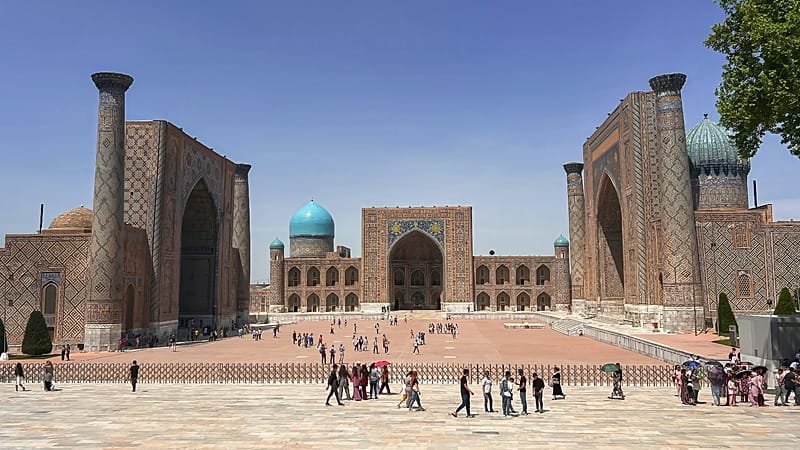
Artificial intelligence (AI) is increasingly becoming part of the operational infrastructure within Uzbekistan’s tourism sector, as the country prepares to receive 12 million visitors in 2026, according to the target set by the Tourism Committee.

Preliminary data from the National Statistics Committee indicate that Uzbekistan received 11.7 million foreign tourists during 2025. This growth in arrivals has been accompanied by a measurable expansion in accommodation capacity.

Uzbekistan currently counts around 7,000 accommodation facilities, including more than 1,200 hotels, according to sector representatives. As supply increases, operators are turning to AI-based systems to manage occupancy, pricing and cost control.

Rather than functioning as a marketing add-on, AI tools are being deployed in revenue management, risk monitoring and customer analytics.

Monitoring occupancy and reducing revenue leakage

Davron Tukhtaev, owner of the “Light” hotel chain which operates hostels, mini-hotels and apartments in Tashkent, Samarkand and Bukhara, began his business in 2018 with a single hostel. His properties now use AI-enabled systems to track guest flows and operational activity.

Davron Tukhtaev, owner of the “Light” hotel chain operating hostels (Davron Tukhtaev, owner of the “Light” hotel chain operating hostels)

“We have started implementing artificial intelligence systems in our facilities,” Tukhtaev says. “They allow us to track the number of guests, reduce risks and improve control of sales and operations.”

The systems compare physical occupancy with booking records, helping identify discrepancies and limit revenue leakage. For small and mid-sized operators, this replaces manual supervision with data verification.

Hotels are also increasingly using algorithm-based pricing systems that adjust room rates according to demand patterns, seasonality and historical booking data. Multi-channel distribution across online platforms requires real-time data synchronisation, an area where automation reduces error margins and administrative workload.

Data-driven guest profiling and operational efficiency

Industry specialists say AI adoption is shifting from experimentation to standard practice.

“I think artificial intelligence is part of our everyday reality, and it is important to implement it in hotel operations,” says Irina Dovzhenka, partner head of Nordic Star legal company. “Hotel brands are developing AI-based products that improve guest experience and operational efficiency.”

Irina Dovzhenka, partner head of Nordic Star legal company (Irina Dovzhenka, partner head of Nordic Star legal company)

Applications include automated chat systems, customer profiling tools that analyse booking behaviour and spending patterns, and predictive maintenance systems that monitor equipment performance.

The objective is cost control and service consistency rather than technological branding.

Small restaurants adopt analytics tools

AI integration is also visible in smaller HoReCa businesses.

Svetlana Khaninnaeva, chef and managing partner of the 16-seat restaurant Kazmyasa, says her team uses AI-supported software to analyse customer data.

“We analyse our guest database to understand what guests prefer, why they return and why they don’t,” she says. “That helps us improve service.”

Svetlana Khaninnaeva, chef and managing partner of restaurant Kazmyasa (Svetlana Khaninnaeva, chef and managing partner of restaurant Kazmyasa)

In kitchen operations, digital systems are used to manage documentation flow, supplier tracking and inventory forecasting. Stock levels are adjusted based on historical sales patterns, helping reduce waste and stabilise quality control processes.

“Kitchens are traditionally manual environments,” Khaninnaeva says. “Digital systems help us organise internal processes more efficiently.”

Capacity expansion requires efficiency tools

According to the Association of Ateliers in Uzbekistan, the accommodation segment has expanded significantly over the past five to six years. The sector now faces the challenge of aligning capacity growth with operational efficiency and service standards.

Farangiz Abdullaeva, head of the Association, says the next stage of development depends on professional management and digitalisation rather than physical expansion alone.

Farangiz Abdullaeva, head of the Association of Ateliers in Uzbekistan (Farangiz Abdullaeva, head of the Association of Ateliers in Uzbekistan)

Industry debate at Hotel Business Forum 2026

These developments were discussed at the Hotel Business Forum 2026 in Tashkent, where investors, hotel operators and technology providers examined the role of automation, smart hotel systems and AI-based management tools in the country’s tourism strategy.

Hotel Business Forum 2026 (Hotel Business Forum 2026)

Speakers at the forum focused on four main operational areas: occupancy monitoring, dynamic pricing, customer analytics and back-office automation. Participants agreed that future competitiveness will depend on how effectively businesses use data to manage demand, control costs and standardise service delivery.

All data and business cases presented during the discussions reflected ongoing implementation rather than theoretical planning, indicating that AI is already embedded in multiple segments of Uzbekistan’s hospitality market.

Sign up to read this article
Read news from 100’s of titles, curated specifically for you.
Already a member? Sign in here
Related Stories
Top stories on inkl right now
One subscription that gives you access to news from hundreds of sites
Already a member? Sign in here
Our Picks
Fourteen days free
Download the app
One app. One membership.
100+ trusted global sources.