
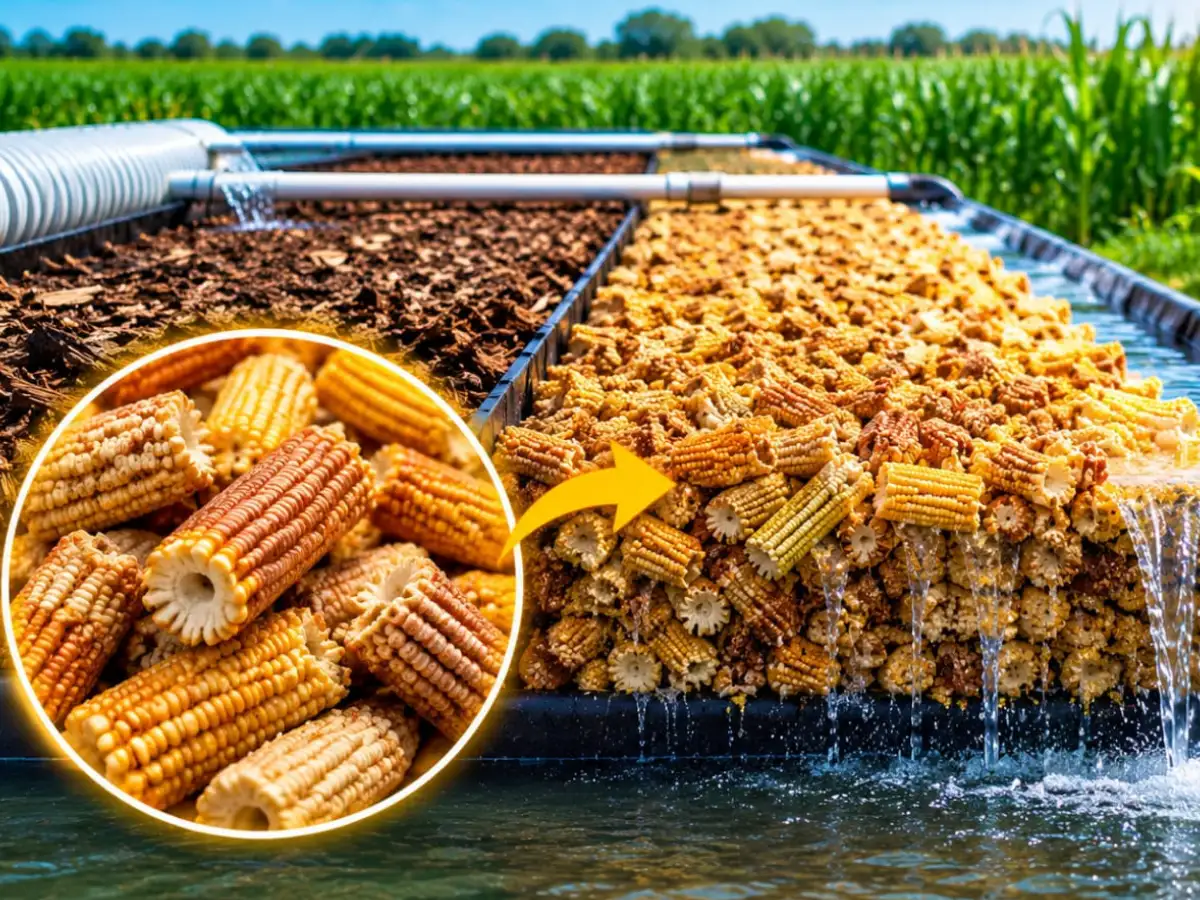
USDA field pilots have found that when most of the woodchips inside nitrate-removing bioreactors are replaced by corn cobs, farm drainage water is cleaned faster. In a study led by Iowa State University with USDA-ARS scientist Gary Feyereisen, published online in December 2022 in the Journal of Environmental Management, bioreactor beds built with 75 percent corn cobs removed nitrate at 1.6 to 10 times the rate of an all-woodchip bed. Woodchips have been the default material in these systems for over a decade, so a result like this points to a change in how farms across the Midwest could treat drainage water more effectively and, at a lower cost.
What is a nitrate bioreactor, and why should you care
A denitrifying bioreactor is a trench that is buried at the edge of a farm field. It is filled with material and connected to the underground pipes that drain extra water from cropland. As the drainage water moves through the trench, microbes eat the carbon in the buried material. These microbes change dissolved nitrate into nitrogen gas that rises into the air. The US Department of Agriculture has supported this method through its Natural Resources Conservation Service since 2015. This is because much nitrate from farmland is a big reason why waterways in the Corn Belt have pollution problems. It is also why the Gulf of Mexico has a dead zone every summer. Woodchips have been used to fill bioreactors since they began spreading across Iowa, Minnesota, and Illinois. The issue is that woodchips are becoming harder to get in large amounts. They are also more costly to move to fields.
Inside the USDA's corn cob field trial
Researchers did not simply guess that corn cobs might work better; they tested it directly in the field. A team from Iowa State University with USDA Agricultural Research Service scientist Gary Feyereisen built nine field-scale pilot bioreactors. They compared three different carbon mixes: woodchips, a blend of 25 percent corn cobs with 75 percent woodchips, and the opposite blend of 75 percent corn cobs with 25 percent woodchips. Each mix was tested at three water retention times, 2, 8, and 16 hours, the fixed lengths of time water stayed in the bed before draining out, so researchers could see how each material performed under different flow conditions. The findings were published in the peer-reviewed Journal of Environmental Management in December 2022, giving the results the scrutiny needed before any farmer changes farm infrastructure.


