
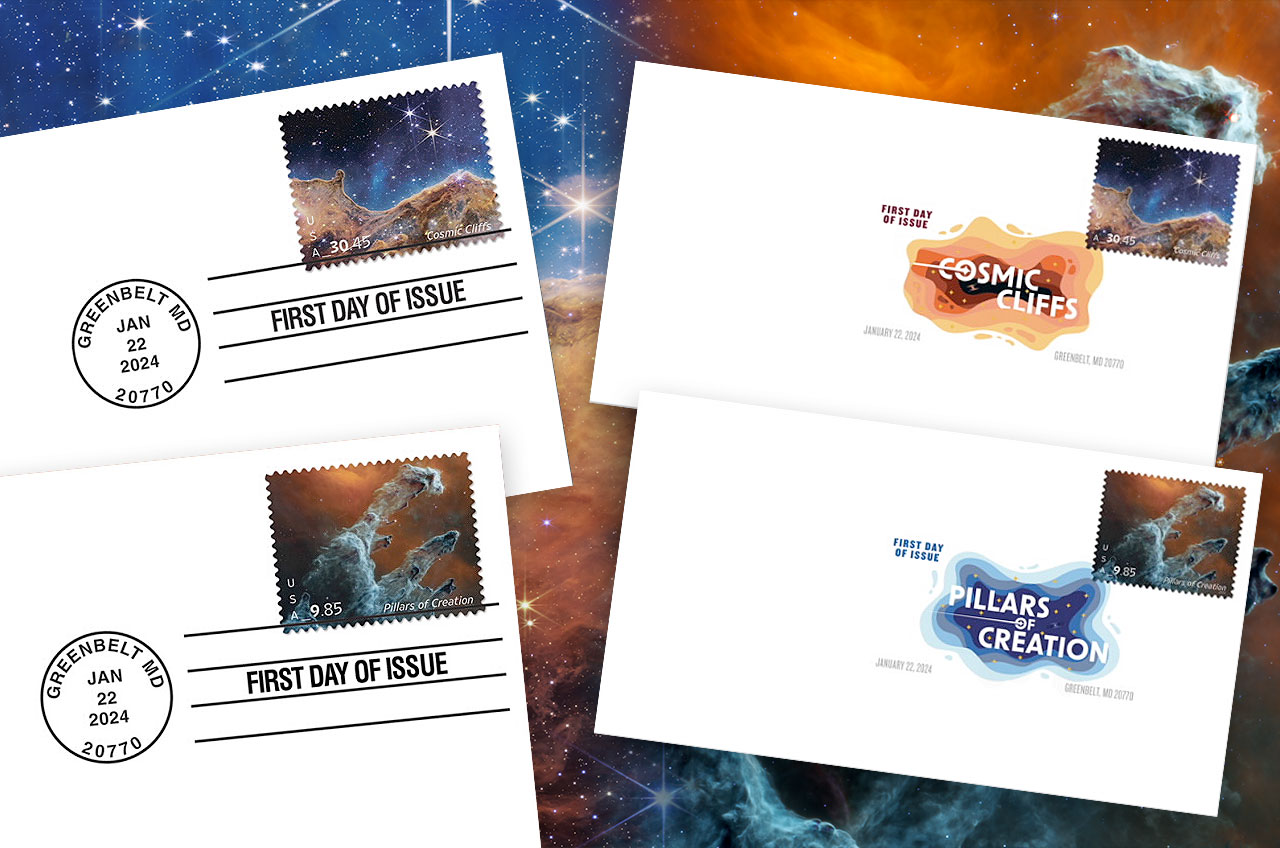
As light reaching the James Webb Space Telescope, it took between 6,500 and 7,600 years for the "Pillars of Creation" and "Cosmic Cliffs" to be received. As the images on two new U.S. Priority and Priority Express-rate postage stamps, they will almost assuredly get your mail to its destination much sooner.
The United States Postal Service (USPS) released both stamps on Monday (Jan. 22). Although their official "first day of issue" city is Greenbelt, Maryland — home to NASA's Goddard Space Flight Center, which managed the James Webb Space Telescope's development — a traditional first of day issue ceremony was not held.
"Celebrate NASA's James Webb Space Telescope and its continued exploration of deep space," reads the USPS website about the new $9.85 "Pillars of Creation" Priority Mail stamp and $30.45 "Cosmic Cliffs" Priority Mail Express stamp. These exquisite images were "made possible by Webb."
Related: James Webb Space Telescope (JWST) — A complete guide
The Priority Mail stamp displays Webb's infrared view of the Eagle Nebula, providing an alternate look at one of the Hubble Space Telescope's most iconic visages. The Webb's version of the "Pillars of Creation" reveals a landscape otherwise invisible to the human eye.
"Why does mid-infrared light set such a somber, chilling mood in Webb's Mid-Infrared Instrument (MIRI) image? Interstellar dust cloaks the scene," reads NASA's caption for this version of the "Pillars" captured in 2022. "And while mid-infrared light specializes in detailing where dust is, the stars aren't bright enough at these wavelengths to appear. Instead, these looming, leaden-hued pillars of gas and dust gleam at their edges, hinting at the activity within."
"How vast is this landscape? Trace the topmost pillar, landing on the bright red star jutting out of its lower edge like a broomstick. This star and its dusty shroud are larger than the size of our entire solar system," NASA's description reads.
"Cosmic Cliffs," one of the Webb's first targets, adorns the Priority Mail Express stamp.
"Called the 'Cosmic Cliffs,' Webb's seemingly three-dimensional picture looks like craggy mountains on a moonlit evening," reads NASA's website. "In reality, it is the edge of the giant, gaseous cavity within [the Carina Nebula], and the tallest 'peaks' in this image are about 7 light-years high. The cavernous area has been carved from the nebula by the intense ultraviolet radiation and stellar winds from extremely massive, hot, young stars located in the center of the bubble, above the area shown in this image."