-
Rubio, Motegi and Cho met in New York Monday for their third trilateral sit-down since July, with a draft Arctic cooperation memorandum establishing an "Arctic-Pacific Trilateral Partnership" among the expected deliverables.
- The meeting landed three days before Trump hosts Xi Jinping at the White House for their second summit of 2026, against a backdrop of Chinese rare-earth export curbs on Japan.
-
Alliance strains persist: President Lee Jae-myung is refusing combat troops for the Hormuz mission as his approval rating hits a record-low 37%, and Seoul's $350 billion U.S. investment pledge remains stuck over how nuclear-reactor profits would be split.
Marco Rubio, Toshimitsu Motegi and Cho Hyun sat down together in New York on Monday for their third trilateral meeting since July, timing the conversation to United Nations General Assembly week and using it to lock in the kind of steady, working-level contact that once would have counted as a diplomatic milestone on its own.
A Pattern, Not a One-Time Event
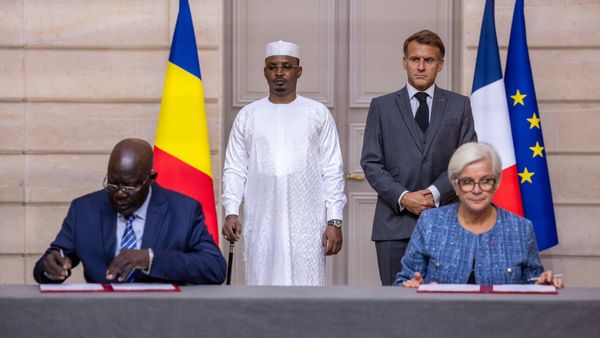
Rubio met his Japanese and South Korean counterparts for a photo opportunity at a Manhattan hotel Monday before the cameras left and the three turned to substance: economic security, North Korea policy and a slate of regional flashpoints, according to officials at Seoul's foreign ministry. Two earlier sit-downs came this summer — one during NATO's July 7 leaders' summit in Ankara, another at July's ASEAN Regional Forum in Manila — making Monday's session the third of its kind. The timing carried its own weight: the meeting landed three days before President Trump receives Chinese leader Xi Jinping at the White House on September 24 for their second face-to-face summit of the year, per Heritage Foundation previews of that visit, and wire coverage of Monday's session placed it squarely within that broader run-up, describing the allied huddle as a prelude to the bigger event with Beijing.
Hormuz, Iran and a Shared North Korea Line
On substance, Cho and Rubio discussed what part Seoul might play in keeping the Strait of Hormuz open to shipping, while all three ministers reaffirmed a long-standing goal: North Korea's complete denuclearization, according to dispatches from the meeting. Beyond the group session, Cho had additional stops planned in New York with nations connected to the US-Iran war, according to the same reporting.
Beijing's Mineral Leverage Sits Behind the Talks
Underneath the handshakes is a tougher industrial fight. Japan and China have been at odds since November, when Prime Minister Sanae Takaichi told parliament that a Chinese assault on Taiwan could threaten Japan's very survival — remarks Beijing treated as a provocation, CNN reported at the time. By January, Beijing's commerce regulators had rolled out licensing requirements covering rare-earth elements, gallium, germanium, graphite and specialty magnets headed to Japanese buyers — restrictions officials tied directly to Tokyo's position on the island, per trade-flow analysis from Asia Times published this month. Washington built its own response around Pax Silica, a US-led coalition for securing tech and mineral supply chains that launched in December 2025. The founding lineup included Japan, Israel, Australia, Singapore, South Korea and the United Kingdom; membership has since grown to roughly 25 signatory nations, according to a timeline kept by the Information Technology and Innovation Foundation.
An Arctic Pact Close to the Finish Line
New York was also expected to produce something on paper. Multiple diplomatic sources told Japan's Yomiuri Shimbun that a draft memorandum has the three governments agreeing Arctic access is essential to their economic security, with plans to stand up a working-level body provisionally called the Arctic-Pacific Trilateral Partnership. The maritime side would draw on decades of Japanese icebreaker experience built around the Antarctic research vessel Shirase, while the energy side would target expanded Arctic oil and gas output and tighter coordination with the Arctic Council. Beijing objected almost immediately: a Liaoning University researcher told the Global Times the plan risks turning the Arctic into fresh ground for geopolitical rivalry.
Pyongyang's Reply, Twice Over
North Korea greeted the run-up to Monday's meeting with a show of force. South Korea's Joint Chiefs of Staff confirmed the North fired two short-range ballistic missiles toward the East Sea from the Wonsan area on Sunday, spaced roughly three hours apart — one shortly before 3 p.m. that covered about 450 kilometers, and a second around 5:50 p.m. that flew more than 600 kilometers, with both believed to belong to the Hwasong-11 family, according to Seoul Economic Daily's Korean-language reporting. It marked Pyongyang's first launch in eight days and its 14th ballistic-missile launch event of the year. Officials handling Korean Peninsula policy at all three foreign ministries got on the phone Monday to trade updates and weigh next steps, extending a coordination channel that also activated after this month's trilateral Freedom Edge drills, which Pyongyang had already denounced before the exercise even started, Stars and Stripes reported from the opening ceremony.
Seoul Won't Send Troops to the Gulf
The Middle East is where the alliance shows its most visible strain. President Lee Jae-myung has rejected sending South Korean combat troops or military hardware to the US-led effort around Hormuz, despite sustained public pressure from President Trump. "We should not buckle under pressure or coercion," Lee told reporters, in remarks carried by GV Wire from New York Times coverage. His alternative: widen the mission of the Cheonghae Unit, a South Korean navy anti-piracy detachment based off Somalia, so it can help guard Korean shipping without pulling the country into combat. The pressure on him is easy to explain in numbers — nearly seven in ten barrels of South Korea's imported crude pass through Hormuz, shut since militants struck a pipeline in the strait on September 10 — and his public support has dropped to a fresh low of 37 percent as the standoff drags on, the Eastern Herald reported.
A $350 Billion Bill Still Unpaid
Money is the other flashpoint. Seoul agreed to invest $350 billion in US industries as the price of a trade deal that dropped US tariffs on Korean goods to 15 percent, but the fine print remains unsettled. Opposition lawmaker Kim Sung-won, who heads the National Assembly's trade panel, called Monday for formal legislative review, warning that nuclear reactors designed in South Korea could be locked out of the American market even as Washington claims the larger share of project profits, according to a Reuters account carried by Yahoo News. "Things become more worrying the closer one looks," Kim wrote in a Facebook post.
The Bigger Picture
The throughline across the minerals fight, the Arctic MOU and the Freedom Edge drills is supply-chain independence — keeping the parts that go into phones, chips, batteries and weapons systems out of reach of Chinese pressure, while Washington's nuclear umbrella keeps doing the older job of stabilizing the Korean Peninsula. None of that works if the Taiwan Strait or the South China Sea gets contested enough to choke shipping, which is why both waterways stay near the top of every agenda, given how fast a blockage there would show up in global prices. What Monday's meeting couldn't paper over, though, is that the three allies still don't agree on everything: troop deployments, investment terms and how to answer North Korea remain open questions, and Washington's attention this week is about to swing toward a much bigger visitor arriving at the White House.