
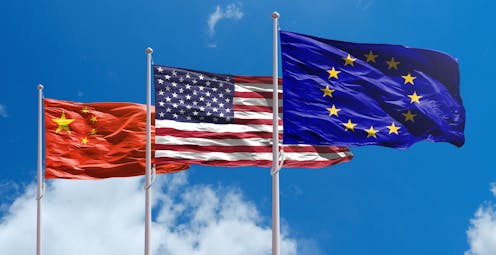
In the early 1990s, as the Cold War faded into memory, the Maastricht Treaty established the existence of the European Union (EU). Since its inception, the bloc has jostled for position in an international order increasingly structured around three poles: the United States, Asia and Europe.
Today, three decades after its founding, it is struggling to assert itself as a geopolitical actor on a global stage where strongman leadership and great powers – predominantly the United States (US), the People’s Republic of China (PRC) and, to a lesser extent, Russia – are enjoying renewed prominence.













