
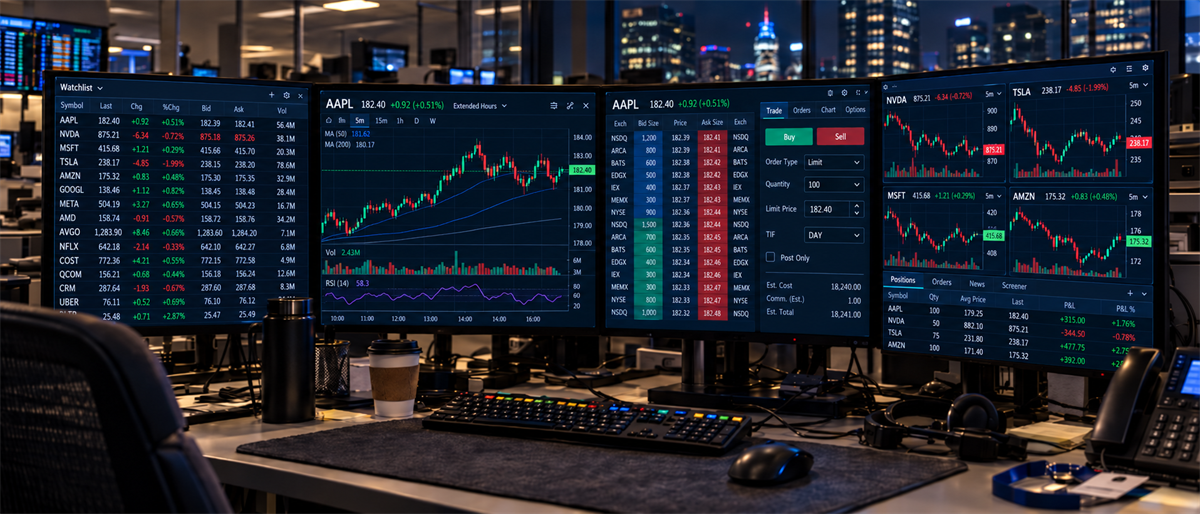
The traditional ring of the market closing bell is slowly losing its authority. On Sunday, Dec. 6, 2026, Nasdaq is scheduled to introduce a new 9 p.m.-to-4 a.m. ET night session, extending trading on the Nasdaq Stock Market to 23 hours a day, five days a week. Rather than replacing alternative trading systems (ATSs), the session adds a regulated, lit national securities exchange to an overnight market that ATSs already serve.
Bringing more overnight liquidity onto a lit order book can improve transparency and price discovery, while the National Securities Clearing Corporation's move to 24x5 clearing extends its central counterparty guarantee to eligible overnight trades across ATSs and exchanges. Together, those changes create a potential structural tailwind for operators and brokerages positioned to monetize cross-border order flow. The upcoming changes fundamentally alter the financial mechanics for the businesses facilitating these trades.

The Transition to a Regulated Night Shift
For the past few years, overnight trading has existed in a fragmented state. Off-exchange alternative trading systems handled the order flow, often leading to wide bid-ask spreads and limited depth. The December target date marks a transition away from these opaque networks toward a fully regulated, lit national securities exchange. The Securities and Exchange Commission approved the broad operational rule changes in April 2026, setting the stage for a continuous National Market System order book.
This shift heavily impacts exchange operators, particularly Nasdaq, Inc. (NASDAQ: NDAQ). The immediate assumption is that an exchange gains a new revenue stream directly from overnight transaction execution fees.
However, overnight trading remains highly concentrated in a relatively small number of securities and accounts for less than 1% of total trading in National Market System stocks. Because cash equity trading is a compressed-margin segment relative to software and data, the immediate revenue uplift from execution fees alone may remain modest.
Nasdaq's structural upside may lie in proprietary data distribution and connectivity fees. Bringing overnight trading onto an official exchange lets operators monetize real-time night-session tape data, direct proprietary feeds, and specialized clearing ports required for continuous access. This creates a high-margin recurring revenue stream that scales independently of thin overnight trading volumes. By acting as the central hub, Nasdaq, Inc. could transform a low-margin transaction execution business into a highly lucrative data and connectivity play.
Upgrading the Plumbing for After-Hours Capital
Moving order flow to a major exchange requires underlying plumbing upgrades. Previously, single-dealer trading systems suffered from single points of failure, which suppressed heavy institutional participation. Asset managers hesitate to execute block trades off-hours when liquidity is thin, and counterparty risk is elevated.
Recent infrastructure changes directly address these concerns. The Depository Trust & Clearing Corporation deployed continuous equity clearing processing in mid-2026 through its National Securities Clearing Corporation subsidiary. This upgrade removes the central post-trade bottleneck that previously limited exchange-level overnight execution.
Exchange matching also provides regulated price bands, such as 20% static limit collars, alongside standardized surveillance. Combined with central clearing, those protections could support tighter bid-ask spreads and encourage market makers to maintain inventory overnight.
When institutions face lower margin drag during off-hours execution, overall market participation could expand. This infrastructure shift provides the foundation large-scale asset managers need to deploy capital more comfortably during the twilight hours. By eliminating the systemic risks associated with fragmented alternative trading systems, the broader financial ecosystem gains a stronger foundation on which to scale operations.
Cashing in on Global Insomnia
While domestic investors view the evening session as an overnight market, international investors see it as regular daytime business hours. Asynchronous global time zones fuel organic volume growth for globally distributed brokerages. Institutional flow data indicates that investors in the Asia-Pacific and European regions drive a substantial portion of off-hours liquidity.
This global demand provides a fundamental tailwind for platforms equipped to handle multi-asset cross-border trading, such as Interactive Brokers Group, Inc. (NASDAQ: IBKR). Unlike domestic-centric firms, a global brokerage natively captures order flow from overseas institutions operating during their local market hours. Management commentary in recent earnings reports highlighted that overnight volumes grew nearly 300% year over year.
An official night session adds a lit exchange book that smart-routing technology can access alongside existing venues. This sharpens routing choice and could improve the trading experience for an established global client base. Expanding cleared customer daily average revenue trades during non-U.S. hours can support long-term commission revenue growth. Interactive Brokers Group, Inc. is positioned to capture a disproportionate share of this international volume, leveraging its global footprint to maximize the utility of a continuous U.S. equities market.
Operational Stability Beats Early Access
The retail brokerage landscape is also pivoting. Platforms that previously used 24-hour access as a marketing differentiator now face a shift. Robinhood Markets, Inc. (NASDAQ: HOOD) established its 24 Hour Market in May 2023, relying on external alternative trading systems to facilitate off-hours limit orders. When exchange-level execution goes live, competitive exclusivity disappears as rival retail brokerages can instantly route orders to a regulated exchange.
The loss of this early-mover moat is offset by a net bullish derisking event. Off-exchange overnight trading historically carried platform-level liability during extreme volatility. System outages at third-party liquidity providers, like the disruptions seen during the global market sell-off in August 2024, exposed consumer-facing brokerages to customer friction and execution halts.
Routing this order flow to a regulated exchange adds another layer of market transparency and execution resilience. NSCC’s 24x5 clearing, meanwhile, provides central counterparty protection for eligible overnight trades across both exchanges and alternative trading systems.
For Robinhood Markets, Inc., which recently achieved a 57% adjusted EBITDA margin in the second quarter of 2026, greater operational stability could support asset retention. Relinquishing exclusivity for structural reliability is a trade-off that could strengthen the underlying business model.
Dawn Patrol: Tracking the Transition to Continuous Liquidity
The transition to a 23-hour equities market institutionalizes liquidity. Moving from fragmented off-exchange networks to a lit, regulated order book fundamentally derisks the overnight session for both retail brokerages and institutional asset managers. Early-mover exclusivity fades, but the entire financial sector could gain operational stability, tighter spreads, and new avenues for high-margin data monetization.
The target launch date remains tethered to final industry-wide software validation and clearing margin stress tests. Investors might want to monitor upcoming trading volume disclosures and segment revenue reports to gauge how effectively exchanges and brokerages capture this continuous global demand. Watching how platforms adapt to standardized overnight limits will provide early indicators of long-term structural success.
The article "Up All Night: How Nasdaq’s 23-Hour Trading Could Wake Up Wall Street" first appeared on MarketBeat.