Bourbon is primarily produced in Kentucky, which accounts for roughly 95 percent of the world’s bourbon, according to the Kentucky Distillers’ Association and multiple industry reports. However, every barrel produced ends up generating a waste product that no one really knows how to deal with. This leftover liquid resulting from distillation is called stillage and with each barrel of bourbon produced, roughly six to ten barrels of this waste product result. Much of this stillage is currently sold to farmers as animal feed, but its weight makes it costly to dehydrate and difficult for local farms to absorb as distillery production has surged.
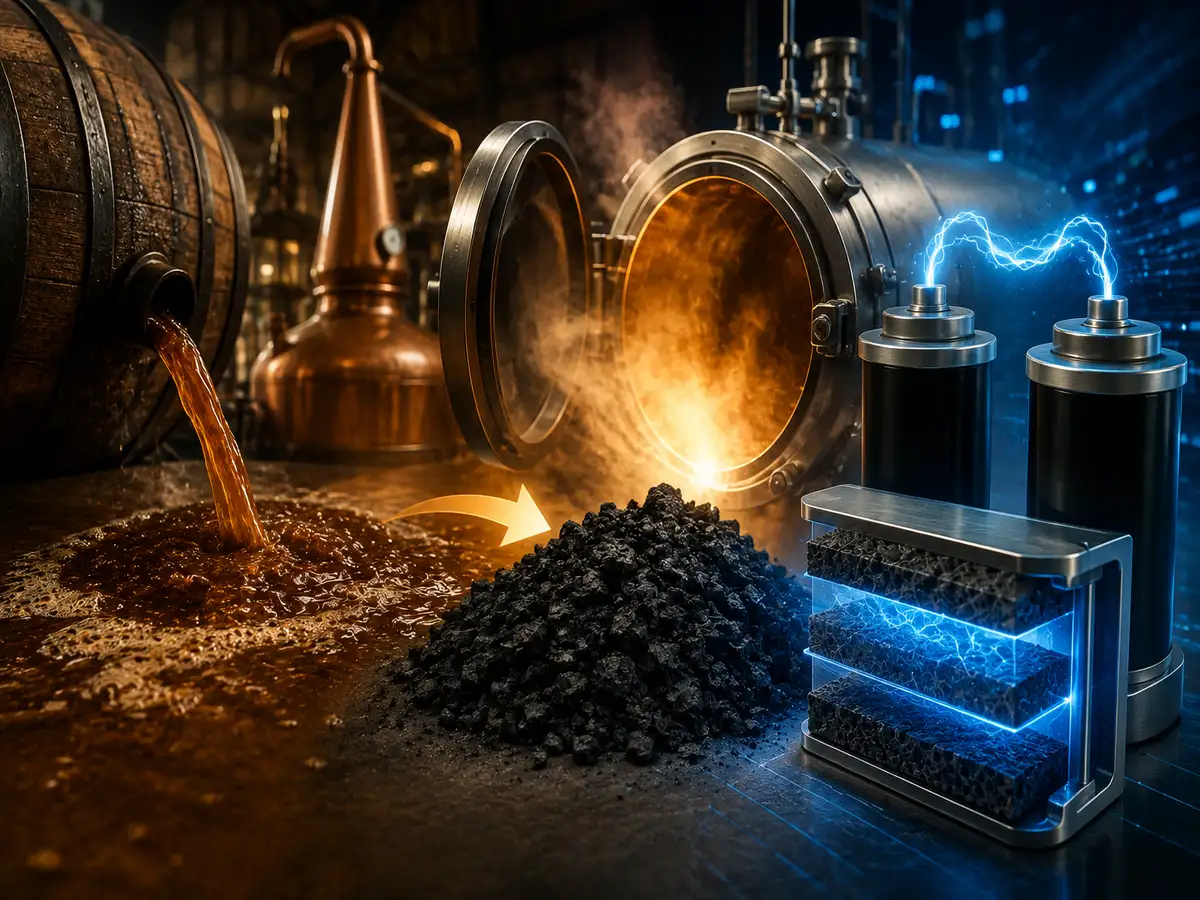
By pressure‑cooking the bourbon stillage, chemists made carbon‑rich hydrochar to create hybrid lithium‑ion supercapacitors that could store up to 25 times more energy per kilogram than conventional versions, while a second set of double‑layer devices retained almost 96 percent of their storage capacity after 10,000 charge‑discharge cycles, according to the University of Kentucky.
Stillage surplus as distillery growth outstrips local feed capacity
The project is driven by a simple supply‑and‑demand imbalance for stillage. Stillage, which can be used as animal feed or fertilizer, is received in liquid form and becomes difficult to ship because it is heavy and bulky. Drying it through evaporation or heating reduces its weight and volume, but the process can be costly and energy-intensive. Since there has been an increase in the number of distilleries in the region, the amount of stillage that is produced has surpassed the requirement of the farmers around those distilleries, thus causing the owners of such distilleries to look elsewhere to dump the material. Graduate student Josiel Barrios Cossio, working under chemistry professor Marcelo Guzman at the University of Kentucky, identified the problem during research on food, energy and water concerns in the state.
How pressure and heat turn wet stillage into hydrochar
This process is referred to as hydrothermal carbonization and Barrios Cossio explains it as working much like a pressure cooker. The stillage is introduced into a lab‑scale reactor without pre‑drying and then heated under pressure at temperatures between 180 and 250 °C, a typical operating range for hydrothermal carbonization of wet biomass. The water present in the reactor serves as a solvent and facilitates hydrolysis, dehydration, decarboxylation and aromatization of the stillage until what is left is black carbon called hydrochar.
This hydrochar served as the basis for the production of two types of carbon materials. When it was heated to about 1,000 °C in a furnace, a temperature commonly used to convert hydrochar into hard carbon, the material formed a hard‑carbon structure suitable for lithium‑ion storage. This type of carbon has loosely arranged carbon layers and can be easily used for the absorption of lithium ions. Another portion of the hydrochar was mixed with potassium hydroxide and heated to about 800°C to produce activated carbon, according to the study published in Materials Advances.
Building two different carbons from the same waste stream
The fact that they could produce two different carbons, which have different functions, enabled the group to develop two types of electronic devices. The first is an electric double-layer supercapacitor, which can be produced using a conventional method of putting together two activated carbon electrodes with the help of a liquid electrolyte in between them. The second device, which is more unique, combines one activated carbon electrode and another hard carbon electrode doped with lithium ions and hence can be considered a hybrid lithium-ion supercapacitor, having the advantages of both a battery and a capacitor. Barrios Cossio said that the hybrid device was actually quite a surprise, as devices of such type are not easy to manufacture.
This particular project had attracted experts from outside the group, as researchers from the Friedrich Schiller University Jena in Germany collaborated with the group. The research was presented at ACS Spring 2026 in Atlanta under the title “Bourbon Whiskey Waste-Derived Carbons for Electric Double Layer and Lithium-Ion Supercapacitors,” according to the American Chemical Society. There is also a peer-reviewed paper on the same topic in the journal Materials Advances: J. Barrios Cossio et al., 'Valorisation of bourbon distillery waste into single-source hybrid lithium-ion capacitors.'
What the supercapacitors actually achieved
The hybrid lithium-ion capacitors are the source of the headline 25× figure: the University of Kentucky reported that the devices stored up to 25 times more energy per kilogram than conventional supercapacitors. The symmetric double-layer capacitors made using the activated carbon electrodes achieved energy densities ranging from 1.9 to 23.8 Wh/kg, depending on the power density used during testing, while retaining 96 ± 2% of their initial capacitance after 10,000 charge-discharge cycles, according to the peer-reviewed Materials Advances paper.
The hybrid lithium-ion capacitors, evaluated separately, achieved energy densities ranging from 48 to 135 Wh/kg at power densities of 0.215 to 22 kW/kg, according to the paper. The hybrid design paired activated carbon with hard carbon to combine capacitor-type and battery-type energy-storage behavior. As the presentation makes clear, these figures represent proof‑of‑concept results rather than a commercial product. The next stage for the team would be conducting techno-economic and life-cycle analysis to test whether such a process can be scaled up beyond laboratory settings.
How this builds on Kentucky's earlier work with corn-based carbon
It was not the university’s first effort to convert agricultural feedstocks into supercapacitor materials. In 2018, University of Kentucky researchers Wenxin Cao and Fuqian Yang published ‘Supercapacitors from high fructose corn syrup‑derived activated carbons’ in Materials Today Energy. They showed that hydrothermal processing followed by physical activation could convert high-fructose corn syrup into spherical activated carbon particles with a surface area of 1,473 m²/g. Using a potassium hydroxide electrolyte, symmetrical supercapacitor cells made from the carbon achieved a specific capacitance of 168 F/g and an energy density of 4.2 Wh/kg.