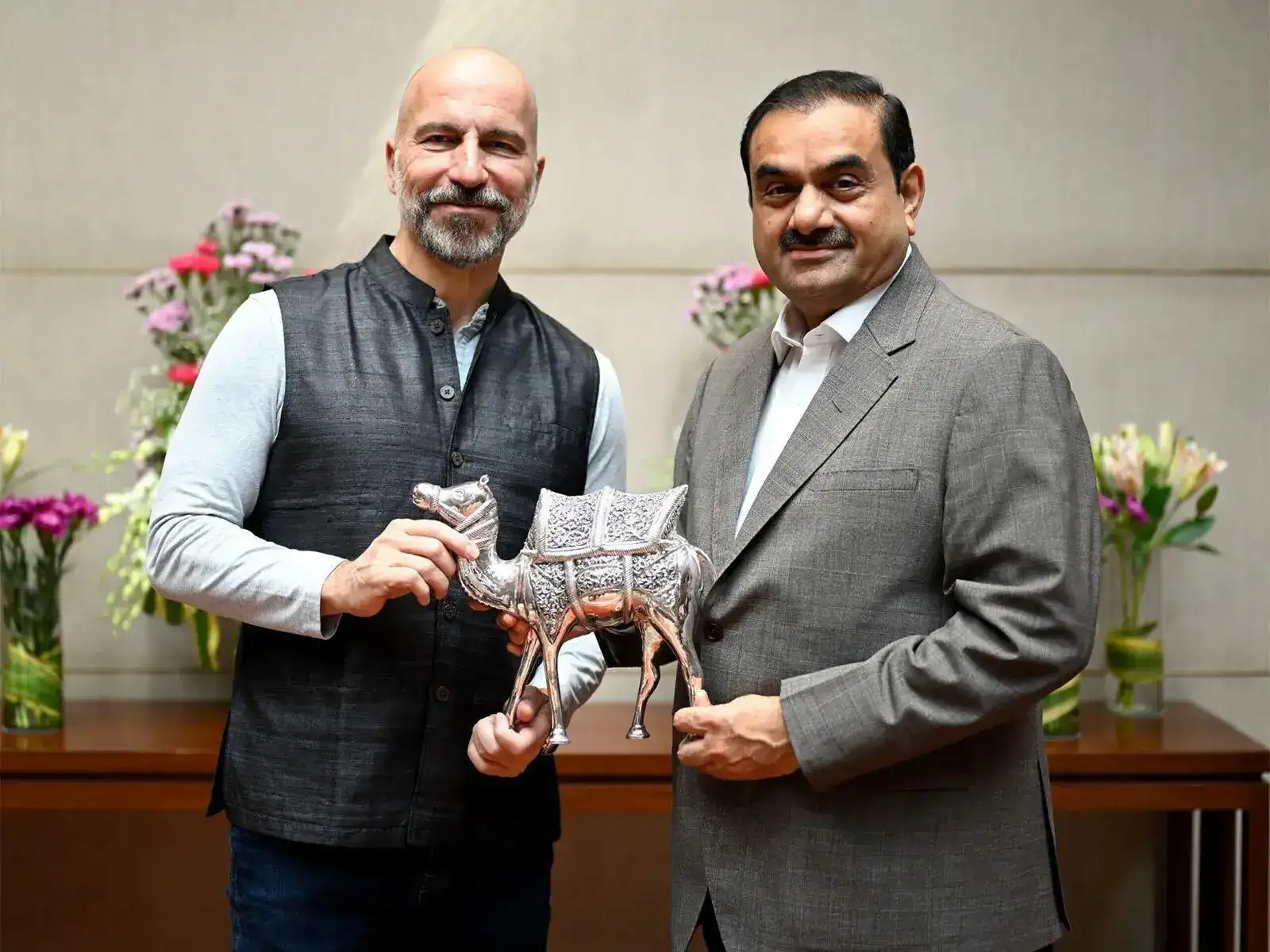
Uber will establish its first data centre in India with the Adani Group. This and more in today’s ETtech Top 5.
Also in the letter:

■ Dhan's move into insurance
■ Anthropic's $30 billion raise
■ Privacy law faces SC test
Uber to set up first India data centre with Adani Group
Uber CEO Dara Khosrowshahi has said the company will build its first data centre in India in partnership with the Adani Group. He announced the move on X after meeting founder and chairman Gautam Adani.
Deal details: The facility will be used to test and roll out Uber's technology, and is expected to go live later this year. It will anchor Uber’s plan to scale its global operations from India.
India visit: This announcement is the centrepiece of Khosrowshahi’s five-day India tour, during which he met several Union and state ministers. On Tuesday, he met with finance minister Nirmala Sitharaman to discuss Uber’s investment plans and India’s Viksit Bharat 2047 vision.
He also met aviation minister Ram Mohan Naidu. Later this week, Khosrowshahi will travel to Mumbai and to Uber’s tech centre in Bengaluru.
Zoom out: The deal builds on the Adani Group’s October 2025 partnership with Google and Airtel. Through its joint venture, AdaniConneX, the conglomerate is developing a large AI data centre and green energy project in Visakhapatnam, Andhra Pradesh.
Companies fish for cyber cover as AI liability risks surface
Top chief information security officers are increasingly looking at cyber insurance as a shield against emerging “AI liability”.
What's happening: Private-sector insurer HDFC ERGO told us it has seen a 25-30% increase in enquiries from companies buying cyber insurance for the first time.
- Premiums for high-risk sectors have risen 15-25% year-on-year globally, and up to 10% in India, according to Prudent Insurance Brokers.
- Cyber insurance remains a specialised product, but its relevance is rising as firms seek structured risk transfer for cyber- and AI-linked exposures.
What this means:
- Insurers have started explicitly assessing a company’s AI exposure, governance, and even its use of AI coding tools during underwriting.
- The scrutiny is especially tight for firms that have declared AI-related revenue.
- Deloitte expects the global AI insurance market to reach $4.8 billion in annual premiums by 2032, growing at roughly 80% annually.
90% of mature AI adopters cut BPO spends, says Z47-OpenAI report
A report by venture capital firm Z47, OpenAI, and Zinnov says Indian firms moving fastest on AI are already rethinking outsourced work.
More details:
- About 90% of advanced AI users are trimming some form of business process outsourcing (BPO) spend.
- More than one-third have reduced outsourcing by over 25%.
- The report also notes that most new AI spending is funded by reallocating existing outsourcing and software budgets rather than through fresh allocations.
Dhan parent enters insurance broking with GreenLife acquisition
Raise Financial, parent of online stock trading platform Dhan, has bought GreenLife Insurance, in its third acquisition this year. It marks Dhan's entry into insurance broking as wealthtech firms with deep pockets and growing profits look to build diversified financial services platforms.
Acquisition spree:
- Earlier this year, Raise Financial bought algorithmic trading platform Stratzy in a $5–6 million cash-and-stock deal.
- In January 2025, it bought media firm Filter Coffee.
-
In April, ET reported that it was in talks to acquire wealthtech startup Infinyte Club for around $10 million.
Deal details:
- The acquisition is a cash-and-stock transaction that paves the way for Raise Financial’s push into insurance distribution.
- The company plans to invest about $15 million to build a direct-to-consumer insurance business.
- GreenLife’s 25 employees will join Raise Financial and shift operations to Mumbai.
Chennai-based Zoho Corporation has invested Rs 70 crore in the government-supported Open Network for Digital Commerce (ONDC) to strengthen India’s sovereign technology stack.
Tell me more: The company wants to make technology more accessible and inclusive for businesses of all sizes.
“India's economy depends heavily on MSMEs, yet they face challenges on all fronts, from limited market access to structural constraints imposed by conventional digital platforms that rarely align with their unique needs,” said Sivaramakrishnan Iswaran, chief executive, Zoho Payment Technologies.
Also Read: Ixigo launches fully AI-native app and assistant, introduces agentic travel features
Anthropic in talks to raise $30 billion at $900 billion valuation: Report
Anthropic is in early talks to raise at least $30 billion in a round that could value the Claude-maker at over $900 billion— more than doubling its $380 billion valuation reported in February.
The round, still under negotiation with no signed term sheet, could close by month-end, according to a Bloomberg report on Wednesday.
Capital push:
- The raise tracks surging demand for Anthropic's AI tools as the company scales infrastructure ahead of a possible IPO as soon as October.
- Backers, including Google and Amazon, have already pledged billions, though their participation in the new round remains unclear.
Expansion plans:
- Anthropic is also in advanced talks to acquire AI tools startup Stainless for over $300 million, strengthening its developer ecosystem.
- If completed, the deal would give Anthropic control of a key tool developers use to access AI models from rivals like OpenAI and Google, tightening its grip on the AI ecosystem.
Also Read: DeepMind CEO Demis Hassabis’ Isomorphic Labs raises $2.1 billion led by Thrive Capital
SC likely to hear petitions challenging sections of India's first privacy law this month
India's Digital Personal Data Protection Act is headed for a crucial judicial test, with the Supreme Court set to hear multiple petitions challenging key provisions.
Driving the news: Petitioners, including the Editors Guild of India and several civil society groups, say the law erodes transparency by weakening the Right to Information Act.
Legal framework:
- At the core of the challenge is Section 44(3), which critics argue allows blanket denial of information requests involving personal data, scrapping the earlier “public interest” test.
- Petitioners also flag sweeping state exemptions, the risk of surveillance overreach, and the removal of civil remedies for data breaches.
Broader picture:
- The government insists the law balances privacy with transparency.
- But legal experts warn the court’s verdict could redraw the lines between citizen rights, press freedom and state power—shaping the architecture of India’s digital governance for years to come.
Also Read: IT companies fast aligning compliance architecture with DPDP enroute