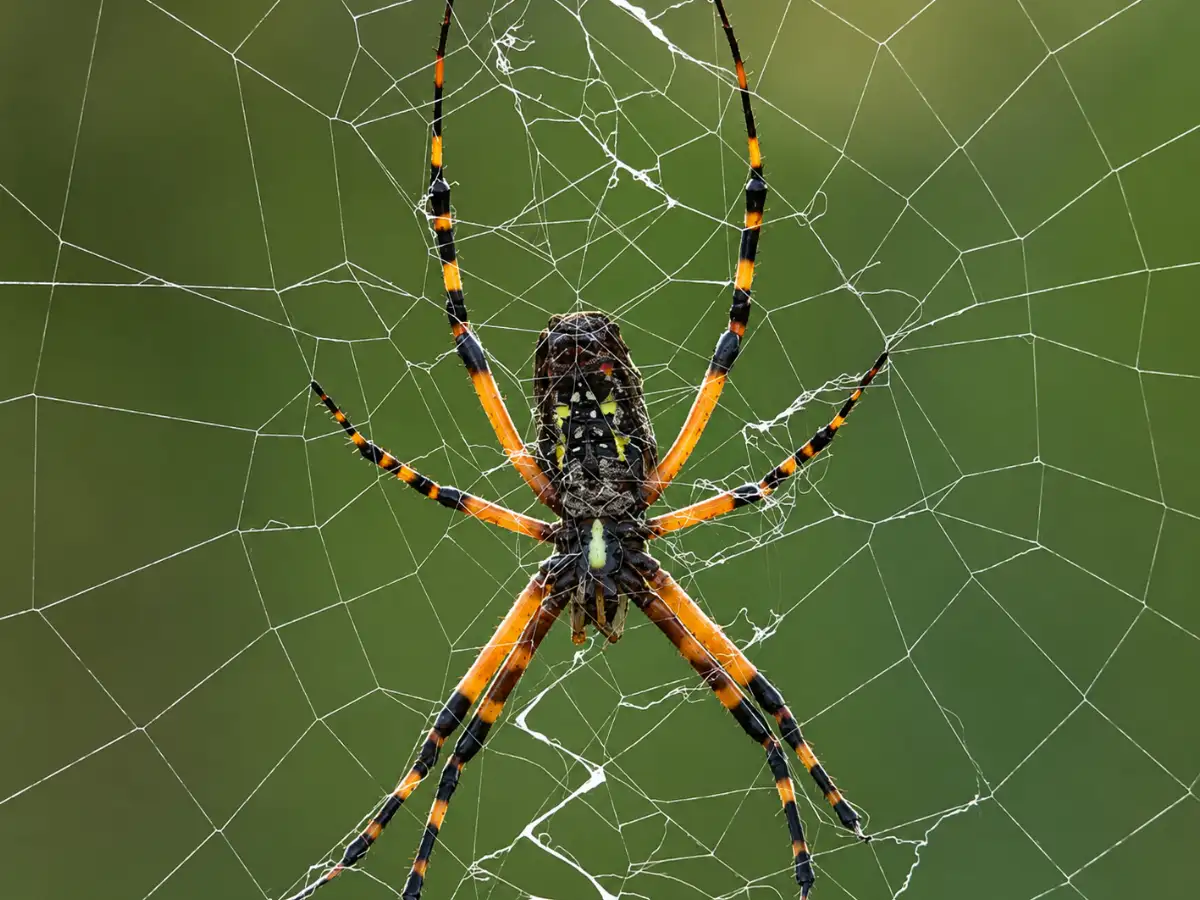
Every astronaut aboard the International Space Station had to get used to microgravity. Two spiders had to solve the same task, and the way they did it astonished the scientists watching. A study titled "Spiders in space-orb-web-related behavior in zero gravity," published in Science and indexed on PubMed, describes an experiment with two young adult golden silk orb weavers. The two arachnids were sent to the International Space Station, each in its own separate habitat, for two months in 2011, while two more of the same age and species stayed behind on Earth in identical, separate habitats as a comparison group. Scientists wanted to see how the absence of gravity would affect spiders' ability to make their signature webs and whether they could notice any differences between the two groups.
The species built for asymmetry

On Earth, golden silk orb weavers build impressively irregular webs. Their centers, or hubs, tend to be more towards the top edge, rather than the middle, taking advantage of gravity to help them pounce on any unwary insect that dares venture into their midst. Researchers believed their webs would be even less symmetrical in space, since the astronauts could not easily observe the spiders' movements. And since the spiders are usually positioned at the top of their web facing downward, they had to be placed near the top of the box. Researchers chose this species because previous studies showed that its webs are consistently asymmetrical on Earth. The scientists may have been especially careful because an earlier mission had failed. The first space-station spider experiment in 2008 used two different spider species; it wasn't canceled but was ultimately compromised when one spider escaped its enclosure and got into the other's habitat, and its web-building interfered with and partially destroyed the first spider's web. On top of that, the flies intended as their food proliferated, producing two webs that were difficult to interpret. The two spiders on board in 2011 were kept in separate enclosures to avoid such a problem.