
Get all your news in one place.
100's of premium titles.
One app.
Start reading
Guitar World
Guitar World
Entertainment
Jimmy Brown

Two essential G chord shapes: when to use each finger position and why

How to play the G chord on guitar.

One worthwhile thing every beginner guitarist should learn is that there are two different useful fingerings for an open G chord, as shown in FIGURE 1.

Either can be more advantageous, depending on what chord you play immediately before or after G. The guiding principle is to use the fingers that are closest to where they need to be for the next chord, or the previous one. In other words, it’s all about where you’re coming from and where you’re going.

For example, when switching from G to C, or from C to G, as shown in FIGURE 2, use your ring and middle fingers to fret the bottom two notes of each chord and have them do a small, tandem “bunny hop” to the next higher or lower string.

This “3-2-4” fingering for G, with the ring finger (3) on the low E string, the middle finger (2) on the A string and the pinkie (4) on the high E string, makes for a convenient, efficient transition from G to C and back, with minimal motion of the fingers and wrist. The key is to move economically from chord to chord.

(Image credit: Future)

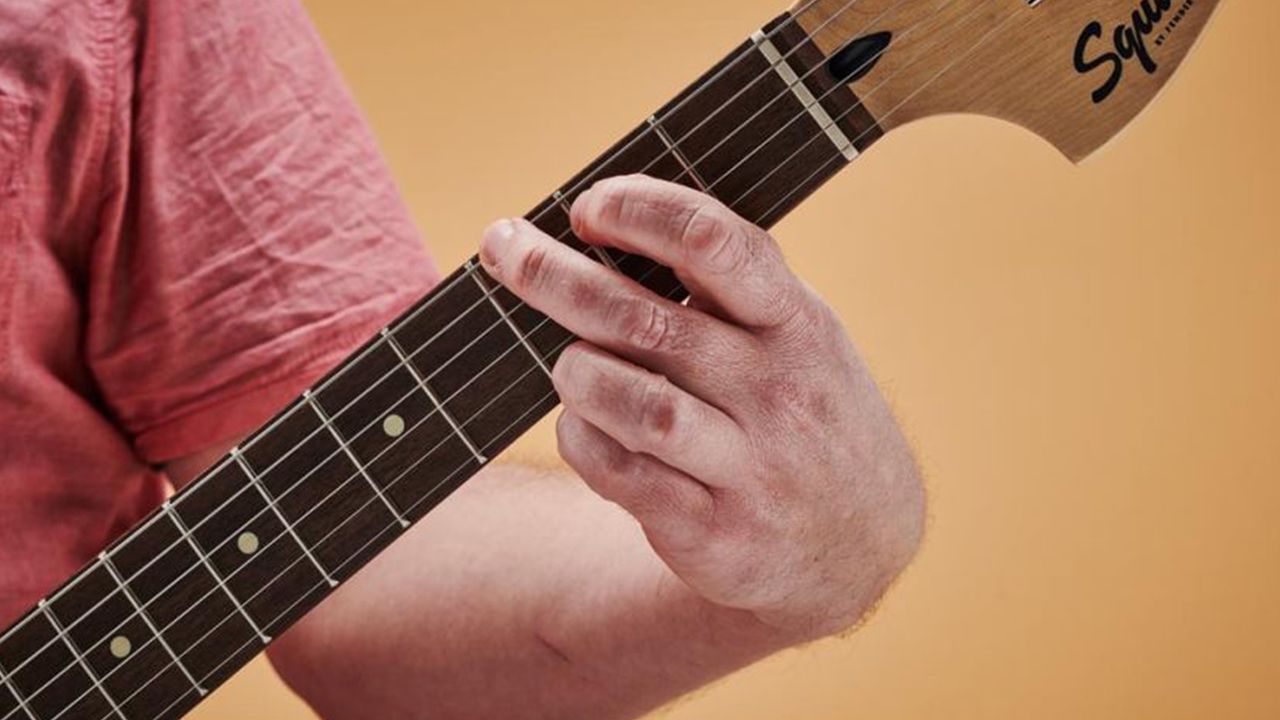
Now, if you’re switching from G to D, or from D to G, it makes more sense to use the “2-1-3” fingering for G, with the middle finger on the low E string, the index finger on the A string and the ring finger on the high E string (see FIGURE 3).

This fingering officially puts your hand in 2nd position and requires less movement when changing from G to D and back, as an open D chord, fretted with the first three fingers, is also in 2nd position.

(Image credit: Future)

Oftentimes, you’ll find yourself playing a progression that uses all three chords — G, C and D – in various orders, along with other chords. So, what do you do if you’re playing G - C - D - G? Or G - C - G - D - G? Use whichever G-chord fingering works best at any given moment. Sometimes you’ll end up using both fingerings within the same song, which is totally fine!

The 1st-position 3-2-4 fingering for G is the more commonly used one, as it works best when moving to and from other 1st-position chords, such as Am, Em, E or F.

(Image credit: Future)

There’s also this commonly used four-finger open G chord, which is considered a different voicing of G, with a D note on the B string’s 3rd fret instead of the open B note (see FIGURE 4).

This chord shape has been used to great effect in countless songs, such as Wish You Were Here by Pink Floyd, Poison’s Every Rose Has Its Thorn and Wonderwall by Oasis (with a capo at the 2nd fret).

Get to know all three open G chord fingerings well, so that you’ll have the technical facility to rock out on a variety of progressions and songs!

Sign up to read this article
Read news from 100's of titles, curated specifically for you.
Already a member? Sign in here
Related Stories
Top stories on inkl right now
One subscription that gives you access to news from hundreds of sites
Already a member? Sign in here
Our Picks
Fourteen days free
Download the app
One app. One membership.
100+ trusted global sources.