
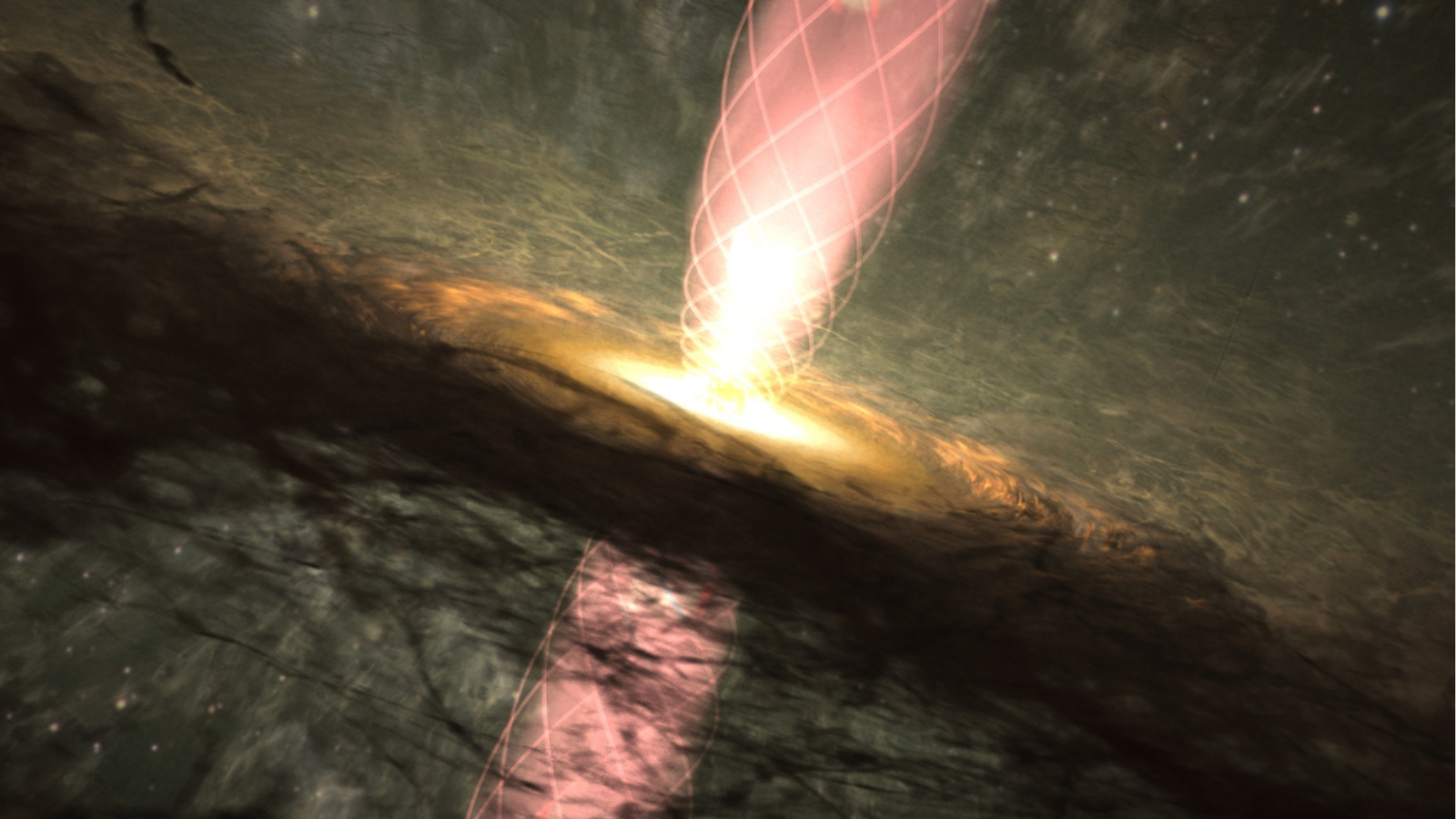
At first glimpse, it may seem like infant stars and supermassive black holes have very little in common.
Infant stars, or "protostars," haven't yet gathered enough mass to trigger the nuclear fusion of hydrogen to helium in their cores, the process which defines what a main sequence star is. Supermassive black holes, on the other hand, have masses equivalent to millions, or even billions, of suns crammed into a space no more than a few billion miles wide. For context, the solar system is estimated to be 18.6 trillion miles wide.
Yet, protostars and supermassive black holes do have at least one thing in common: They both launch high-speed astrophysical jets from their poles while gathering mass to increase in size. And new research suggests the mechanism creating these jets may be the same for these objects at opposite ends of the astrophysical spectrum.












