The White House unveiled a pact on the safe development of super intelligence, and the document misspelt the name of the country whose president signed it.
Beneath Donald Trump's signature on the White House Accord on Super Intelligence, the typed line reads 'President of the Unites States'.
Trump and six technology leaders signed the voluntary agreement at the White House on Tuesday 29 September 2026, and the official White House account posted it on X the following day.
The post had more than 20 million views by Thursday, and the typo quickly became the focus of replies and coverage.
One Letter, One Signature, Six Tech Chiefs
The error sits in the one place nobody could overlook. On the second page of the accord, as the White House's own post shows, Trump's signature is followed by his name, Donald J. Trump, and then by his title, with the final d of United replaced by an s.
The page carries no official letterhead, only the heading White House Accord on Super Intelligence.
White House Accord on Super Intelligence pic.twitter.com/NVNkHmLcbk
— The White House (@WhiteHouse) September 30, 2026
His co-signatories were spelt correctly. In a column beside Trump's name sit the signatures of Sundar Pichai of Google, Dario Amodei of Anthropic, Mark Zuckerberg of Meta, Greg Brockman of OpenAI, Elon Musk of xAI and Jensen Huang of Nvidia, each with their company printed beneath.
The typo was quickly confirmed as genuine once screenshots spread across Bluesky, Facebook and X, with fact-checks establishing that it appeared in the White House's own post rather than in a doctored copy. The White House did not immediately respond to a request for comment from USA Today.
'Par for the Course' in the Replies
The reply that captured the mood came from an account called Comedy of Things. 'Misspelling the name of your country on a document claiming super intelligence is par for the course for this inept band of clowns that works in that building,' it wrote beneath the White House post, a line that drew more than 21,000 likes and was viewed more than half a million times.
Misspelling the name of your country on a document claiming super intelligence is par for the course for this inept band of clowns that works in that building
— Comedy of Things (@ComedyOfThings) September 30, 2026
Politicians piled in. California Governor Gavin Newsom was among those who mocked the typo, as the signature block circulated far more widely than anything above it.
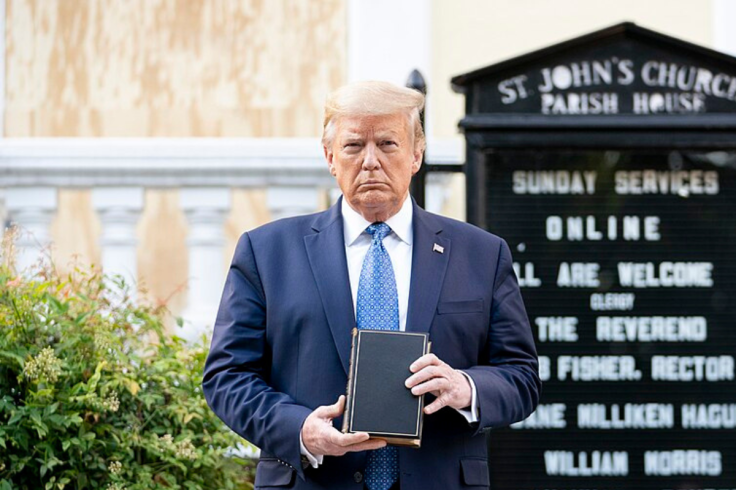
The timing sharpened the joke. On the day the accord was signed, Trump stood at the Andrew W. Mellon Auditorium launching America.gov, the government's new AI-powered website, and told his audience it was just a preview of what is possible with super intelligence, or SI, 'and that's the official name in the United States'.
The Golden Age of “Super Intelligence.” https://t.co/woOzB2yEg3 pic.twitter.com/IRMeTvNZNA
— Gavin Newsom (@GavinNewsom) September 30, 2026
He meant it literally. An executive order Trump signed that day, Inaugurating the Era of Super Intelligence, directs executive branch agencies to use Super Intelligence and SI in place of Artificial Intelligence and AI.
Trump had earlier polled his Truth Social followers on alternatives including Superior Intelligence, Extreme Intelligence and Supreme Intelligence.
The rebrand was meant to signal a new era. One of the first high-profile documents to carry the new name instead became a lesson in proofreading.
What the Pact Asks of Big Tech
Beneath the typo is a short, voluntary agreement. Its first page asks each company training and deploying frontier models to put robust internal controls in place to monitor their systems' capabilities and alignment in areas such as cybersecurity, biosecurity and chemical threats, and to ensure the models do not hack or access technical systems in unintended ways.
Three further commitments follow. Each company will empower an internal team to check that those controls work, bring in an independent external auditor or evaluator to assess them, and designate an independent board committee to oversee the results and ensure problems are fixed. The document says the participating companies will meet regularly to establish standards and best practices.
It stops well short of regulation. The text says it may make sense over time to codify the steps into laws and regulations, but the accord itself does not create a new legally enforceable regime, and Trump has described it as morally binding.
An accord meant to show the government could keep pace with the most advanced technology on earth will be remembered, for now, for one wrong letter in the country's name.