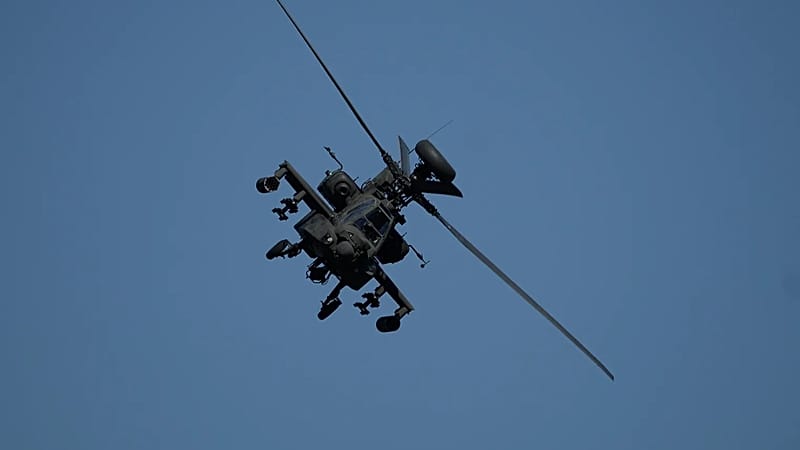
The US military announced on Tuesday night that it has begun strikes against Iran following the crash of a US Army Apache helicopter off the coast of Oman.
In a statement posted to social media, US Central Command (CENTCOM) said the strikes would be “a proportional response to unjustified Iranian aggression.”
The exact scope of the strike was unclear.
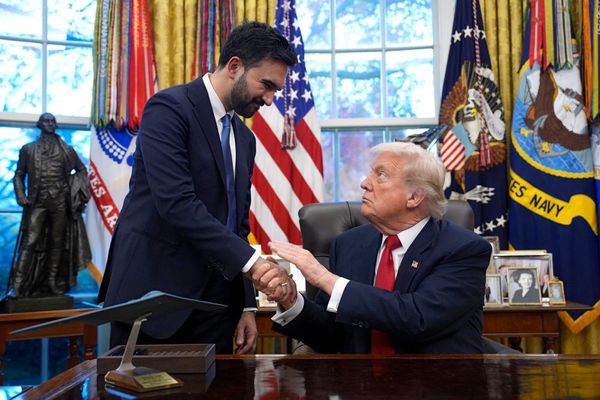
Earlier in the day, US President Donald Trump has vowed to retaliate after accusing Iran of bringing down the Apache near the Strait of Hormuz on Tuesday morning.
In a post on social media, Trump said military commanders had informed him that “the Iranians shot down one of our highly sophisticated Apache helicopters.”
He also said the helicopter's two crew members survived the incident without injury. Initial reports said that it was taken down by an Iranian drone.
"They are safe and uninjured," Trump wrote.
"Nevertheless, the United States must, of necessity, respond to this attack,” he added.
'Foreign forces at constant risk,' Iran's FM says
The incident marked the first publicly known use of a drone boat by the US military to recover personnel.
The unmanned vessel rescued two aviators after their Apache attack helicopter crashed close to the strategic waterway, largely shut to shipping by Tehran during the war, which began on 28 February after the US and Israel launched attacks on Iran.
The helicopter's loss added to tensions surrounding a two-month ceasefire that came under renewed strain after Iran and Israel exchanged fire on Monday for the first time since the truce was agreed.
“Foreign forces in proximity to our territory are at constant risk on account of their own human errors, plain accidents, or potentially being caught in crossfire," Iran's Foreign Minister Abbas Araghchi said in a post on social media.
"The Strait of Hormuz is not international waters but shared between Iran and Oman... Foreign forces in proximity to our territory are at constant risk on account of their own human errors, plain accidents, or potentially being caught in crossfire," he added.
The war has had far-reaching economic consequences, unsettling global markets, pushing energy prices upwards and contributing to rising costs for everyday goods.
Potential peace deal 'two or three days away'
Trump had spent Monday night in New York attending Game 3 of the NBA Finals, where he expressed renewed optimism about negotiations with Iran, saying there was a "good chance" of signing a deal in "two or three days".
Although he did not elaborate, Trump had said that if strikes resumed, it would cost lives and keep the Strait of Hormuz closed for months.
"If we go and bomb — which we could do very easily if we want, and we spend another two or three weeks bombing — they’ll have nothing left whatsoever," Trump said.
The downing of a US Army helicopter marks the second confirmed loss of a crewed aircraft to Iranian fire since the war began.
The Apache, a two-seat attack helicopter armed with a 30mm chain gun and capable of carrying Hellfire missiles, came down near one of the world's most important shipping routes.
CENTCOM said the aviators "were rescued by American forces after their helicopter went down near the coast of Oman.
"The soldiers were safely rescued within approximately two hours and are in stable condition."
A CENTCOM spokesperson said an unmanned naval surface drone assisted in the rescue operation, marking a rare use of the technology in a real-world recovery mission.
In April, a US F-15 fighter jet was shot down by what officials said was a shoulder-fired heat-seeking missile. The aircraft's two crew members ejected over Iranian territory and were later recovered during a rescue operation.
During that rescue mission, an A-10 ground attack aircraft was also damaged by Iranian fire. Its pilot was forced to eject after leaving Iranian airspace as the aircraft could no longer land safely.
In March, a US aerial refuelling aircraft crashed in western Iraq, killing all six crew members on board. US officials said the crash was not caused by hostile fire.
Earlier in the war, three US F-15E fighter aircraft were mistakenly shot down by Kuwaiti forces in a friendly-fire incident. All six crew members survived after ejecting.