Get all your news in one place.
100’s of premium titles.
One app.
Start reading
The Guardian - AU
The Guardian - AU
World
Guardian staff and agencies

Trump says he will impose new tariffs on South Korea as he criticises delays in trade deal

A dealer walks past near screens showing the Korea composite stock price index in Seoul, South Korea
Donald Trump has said he will raise US tariffs on South Korea. Photograph: Lee Jin-man/AP

Donald Trump has said he is raising tariffs on South Korean goods including automobiles, lumber and pharmaceuticals, accusing the country of not living up to a trade deal struck last year and briefly sending shares in Korean carmakers tumbling.

In a post on social media, the US president said the tariffs paid on South Korean exports into America would rise from 15% to 25% because the “Korean Legislature hasn’t enacted our Historic Trade Agreement, which is their prerogative”.
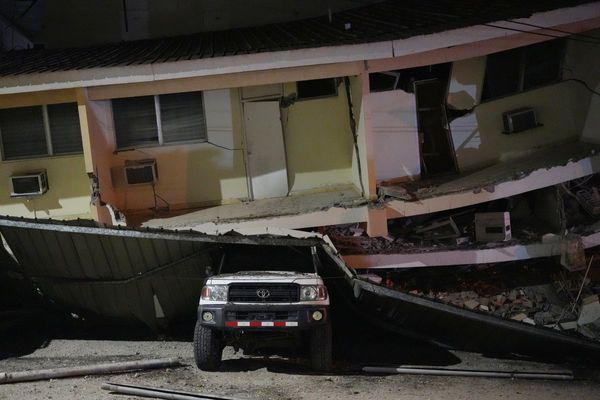
“South Korea’s Legislature is not living up to its Deal with the United States,” Trump said. The administration has yet to issue formal notices to enact the changes.

South Korea scrambled on Tuesday to assure the US it remained committed to implementing the trade deal, after Trump and President Lee Jae Myung agreed in principle last July for Seoul to make $350bn of investments in the US.

South Korea’s presidential Blue House said on Tuesday it had not been informed about the tariff hike plans in advance and that it would continue to take the required steps to finalise the deal.

It said Lee’s chief policy aide convened an emergency meeting with officials and that the trade minister, Kim Jung-kwan – currently in Canada – would head to Washington for talks on the issue with the US commerce secretary, Howard Lutnick.

South Korea’s trade envoy, Yeo Han-koo, said the government was still trying to figure out the background of Trump’s tariffs post and the measures Seoul could take. Yeo said he planned to visit the US soon and talk to his counterpart at the Office of the US Trade Representative in order to find a rational solution between the two governments.

Trump’s apparent about-face comes months after Washington and Seoul struck the trade and security deal last year, capping a period of tense negotiations. The agreement was finalised after Trump met Lee in October and included the investment promises by South Korea in return for tariff cuts by the US.

Since then, however, the deal has remained in something of a legal limbo in South Korea.

Seoul’s presidential office insisted in November the deal did not require parliamentary approval, arguing it represented a memorandum of understanding rather than a binding legal document.

But on Tuesday, the country’s ruling party said it would work with the opposition to speed up the passage of five pending bills that would allow the enactment of investment in the US.

Officials in the national assembly said the five bills would likely be incorporated into a single proposed law, which would need approval from the finance and judiciary committees before it could go to a floor vote.

Under the agreement, Washington would maintain tariffs of up to 15% on South Korean goods including vehicles, car parts and pharmaceuticals. Crucially, the deal’s terms brought US tariffs on South Korean cars down from a 25% level imposed by Trump earlier in 2025.

Trump’s latest threat, if enacted, would reverse that.

The auto industry accounts for 27% of South Korea’s exports to the US, which takes in nearly half of the country’s car exports. In the minutes after Trump’s announcement, shares in several South Korean carmakers fell as much as 5%, but clawed back their losses later in the day.

Trump has used the threat of tariffs throughout his second term as an instrument of foreign policy. Economists have raised concerns about the approach and the policy also faces a test in an ongoing case in front of the US supreme court. Tuesday’s threat targeting South Korea is his latest against key trading partners in recent days.

Over the weekend, Trump warned Canada that if it concluded a trade deal with China, he would impose a 100% tariff on all goods coming across the border. Earlier in January, Trump also threatened to slap tariffs on multiple European nations until his purchase of Greenland is achieved. He has since backed off the threat.

The chair of international economics at the Atlantic Council, Josh Lipsky, said Trump’s action on South Korea reflected impatience with the pace of Seoul’s enactment of the framework trade agreement.

“It’s just another reminder that the markets were wrong to believe we were going to get into tariff stability in 2026,” Lipsky said. “People say, ‘Oh, but he doesn’t follow through,’ and sometimes that’s true, but sometimes it isn’t. And the volatility alone – there is a price around that.”

With Reuters and Agence France-Presse

Sign up to read this article
Read news from 100’s of titles, curated specifically for you.
Already a member? Sign in here
Related Stories
Top stories on inkl right now
One subscription that gives you access to news from hundreds of sites
Already a member? Sign in here
Our Picks
Fourteen days free
Download the app
One app. One membership.
100+ trusted global sources.