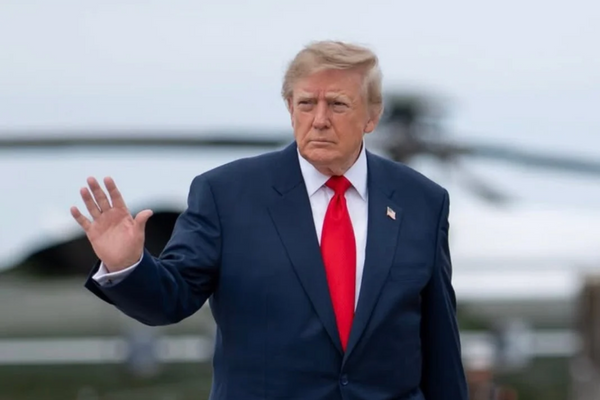
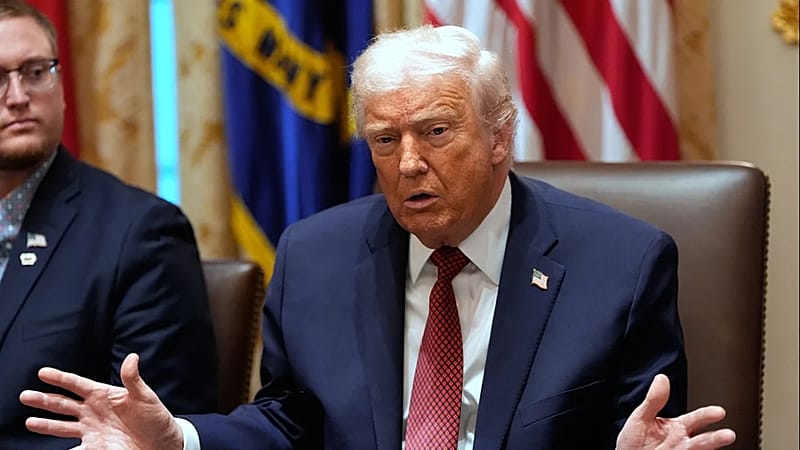
US President Donald Trump on Monday defended the military's decision to launch a second strike that killed two survivors of an initial attack on a suspected drug-smuggling boat in the Caribbean, claiming the men were trying to right the capsized vessel.
Trump's comments came as his administration faces mounting pressure from lawmakers to release footage of the 2 September operation, which killed nine people in the first strike before a follow-up attack some 40 minutes later killed the two survivors. Two additional strikes were then carried out to sink the vessel.

"They were trying to return the boat back to where it could float, and we didn't want to see that because that boat was loaded up with drugs," Trump told reporters on Monday at the White House.
When asked about his comments last week suggesting he was open to releasing the footage, Trump denied that was his position and said the reporter was "obnoxious" and "terrible".
The US president also backed Defence Secretary Pete Hegseth, who declined to commit to making the footage public.
"Whatever Pete Hegseth wants to do is okay with me," Trump said.
Last Wednesday Trump told reporters about the strike footage: "Whatever they have, we'd certainly release, no problem."
Campaign of deadly strikes
The 2 September operation was the first in what has become a months-long series of US strikes on vessels in the Caribbean and eastern Pacific Ocean that the Trump administration says are targeting drug smugglers working for cartels, including some it claims are controlled by Venezuelan President Nicolás Maduro.
At least 86 people have been killed in at least 22 strikes since early September, according to the administration. Despite bipartisan congressional opposition, Trump has broadly justified the campaign as necessary to stem the flow of fentanyl and other illegal drugs into the United States.
The administration claims the US is in a "non-international armed conflict" with roughly two dozen drug cartels it has designated as terrorist organisations, and that the strikes comply with the laws of armed conflict.
However, legal experts and some lawmakers have questioned whether the killings constitute war crimes, particularly the strike on survivors who posed no imminent threat.
Controversy over second strike
The 2 September attack has drawn particular scrutiny since the Washington Post reported last week that survivors were visible in the water when the second strike was ordered.
Admiral Frank Bradley, commander of US Special Operations Command who oversaw the operation, told lawmakers in closed-door briefings last week that all 11 people on the boat were on an internal US military target list of individuals authorised to be killed.
Bradley said Hegseth had ordered him to kill everyone on the boat, destroy the drugs and sink the vessel, according to sources familiar with the congressional briefings.
The second strike killed the two survivors but failed to sink the boat, prompting a third and fourth strike to complete the mission, Bradley told lawmakers.
Representative Adam Smith, the top Democrat on the House Armed Services Committee, said video of the attack showed the survivors were "basically two shirtless people clinging to the bow of a capsized and inoperable boat, drifting in the water — until the missiles come and kill them."
On Saturday, Hegseth said at the Ronald Reagan Presidential Library in California that officials were reviewing the video but did not commit to releasing it.
"Whatever we were to decide to release, we'd have to be very responsible about it," he said, citing concerns about exposing sources and methods tied to ongoing operations.
The Pentagon on Monday did not immediately respond to requests for comment on the status of Hegseth's review or confirm Trump's assertion that the survivors appeared to be trying to right the vessel before the second strike.
Questions over legal justification
Before the Trump administration began striking boats in September, counter-narcotics operations were handled by law enforcement and the US Coast Guard, with suspected traffickers treated as criminals entitled to due process.
The Justice Department produced a classified legal opinion over the summer arguing the president is legally authorised to conduct lethal strikes against the cartels in self-defence because they pose an imminent threat to Americans.
However, that justification has been questioned after reports that in at least one instance, a targeted boat had turned around and was moving away from the US before being struck.
Trump claimed on Monday that "every boat we knock out of the water, we save 25,000 American lives," though he provided no evidence for that figure.
Drug overdose deaths in the US totalled approximately 80,000 in 2024, a 25% decline from 2023, according to the Centers for Disease Control and Prevention.