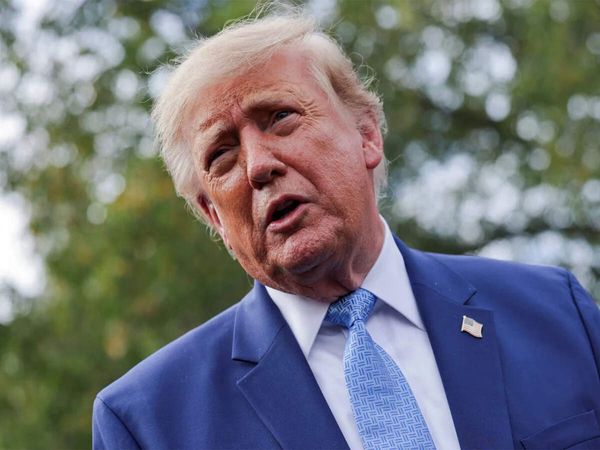
Donald Trump has claimed there have been talks between the US and Iran over the past day in which the two sides had “major points of agreement”, appearing to avert a potentially severe escalation of the conflict.
Tehran has denied the claim, in which Trump also speculated that a deal could soon be done to end the war. Iran’s foreign ministry spokesperson said no talks had been held with the US since the bombing campaign began 24 days ago.
Trump’s threat at the weekend to “hit and obliterate” Iran’s power stations and energy infrastructure if Tehran did not allow shipping to move freely through the strait of Hormuz, and Iran’s threat to destroy infrastructure across the Middle East in retaliation, had raised fears of a deepening conflict and global economic crisis.
In a flurry of presidential announcements on Monday, Trump first posted on social media that he had extended his deadline by five days, saying the US and Iran had held “very good and productive conversations” in recent days, then told reporters in Palm Beach, Florida, that his Middle East envoy, Steve Witkoff, and close aide and son-in-law Jared Kushner had held “very, very strong talks” with the Iranians a day earlier.
Later on Monday, Trump played up the chances of a deal, saying: “We’re giving it five days and then we’re going to see where that takes us. And I would say at the end of this period, I think it could very well end up being a very good deal for everybody.”
A European official said that while there had been no direct negotiations between the two nations, Egypt, Pakistan and Gulf states were relaying messages. A Pakistani official and a second source told Reuters that direct talks on ending the war could be held in Islamabad this week.
The Pakistani official said the US president, JD Vance, as well as Witkoff and Kushner, were expected to meet Iranian officials in Islamabad this week, after a call between Trump and Pakistan’s army chief, Asim Munir.
The White House confirmed Trump’s call with Munir. When asked about a possible visit by Witkoff and Kushner to Islamabad, White House spokesperson Karoline Leavitt said: “These are sensitive diplomatic discussions and the US will not negotiate through the press. This is a fluid situation, and speculation about meetings should not be deemed as final until they are formally announced by the White House.”
Oman, Turkey, Egypt and Pakistan have all been reported to have been involved in efforts to broker an end to hostilities in recent days, but it is unclear how substantial or productive such contacts have been. Oman’s foreign minister, Badr bin Hamad Al Busaidi, said on Monday that Oman was working hard to secure safe passage through the strait of Hormuz.
Keir Starmer told a parliamentary committee on Monday that the UK was aware discussions were happening. Starmer and Trump talked late on Sunday by telephone, according to Downing Street.
The EU chief, Ursula von der Leyen, called for an immediate end to hostilities, describing a “critical” situation for energy supply chains globally.
“We all feel the knock-on effects on gas and oil prices on our businesses and our societies,” von der Leyen said on Tuesday, on a visit to Australia. “It is of utmost importance that we come to a solution that is negotiated, and this puts an end to the hostilities that we see in the Middle East,” she added.
In reaction to the intensifying energy crisis, Japan said it will release another part of its strategic oil reserves from Thursday, and will tap into joint stockpiles held by producing nations in the country by the end of the month.
Early on Tuesday, state-run Iranian media reported another round of missiles fired at Israel, and rescue services in Israel showed images of a damaged building in the north but reported no casualties.
Lebanese state media said Israel carried out seven air raids on south Beirut overnight.
In all his comments, Trump declined to say with whom the US was speaking in Iran. “We’re dealing with the man who, I believe, is the most respected and the ‘leader’. It’s a little tough – we’ve wiped out everybody,” Trump said, stating only that the US had not talked to current supreme leader, Ayatollah Mojtaba Khamenei.
A senior Iranian official told Reuters the US had requested a meeting with Iran’s parliament speaker, Mohammad Baqer Qalibaf, but that the supreme national security council had yet to decide on any proposed talks and Iran had yet to respond. Qalibaf himself described “fake news … used to manipulate the financial and oil markets”.
The Fars news agency, which is linked to the Islamic Revolutionary Guards Corps (IRGC), had earlier also denied any talks, saying there were neither direct nor indirect communications with the US. Iran’s IRGC said they were launching fresh attacks on US targets, and described Trump’s words as “psychological operations” that were “worn out” and having no impact on Tehran’s fight.
The Iranian state news agency Irna quoted a foreign ministry spokesperson as saying “friendly countries” had sent messages indicating that the US wanted talks to end the war but none had taken place.
Iran has been defiant in the face of Trump’s threats and more than three weeks of the joint US-Israeli offensive. In response to Sunday’s ultimatum, Tehran threatened to target power plants supplying US bases across the Middle East, vital desalination facilities in Gulf countries, and to intensify strikes on Israel.
More than 2,000 people have been killed in the war that the US and Israel launched on 28 February, the majority of them in Iran. In Lebanon, authorities said 1,039 had been killed in Israel’s offensive against Hezbollah, with 2,876 others wounded.
Additional reporting by Saeed Shah in Islamabad