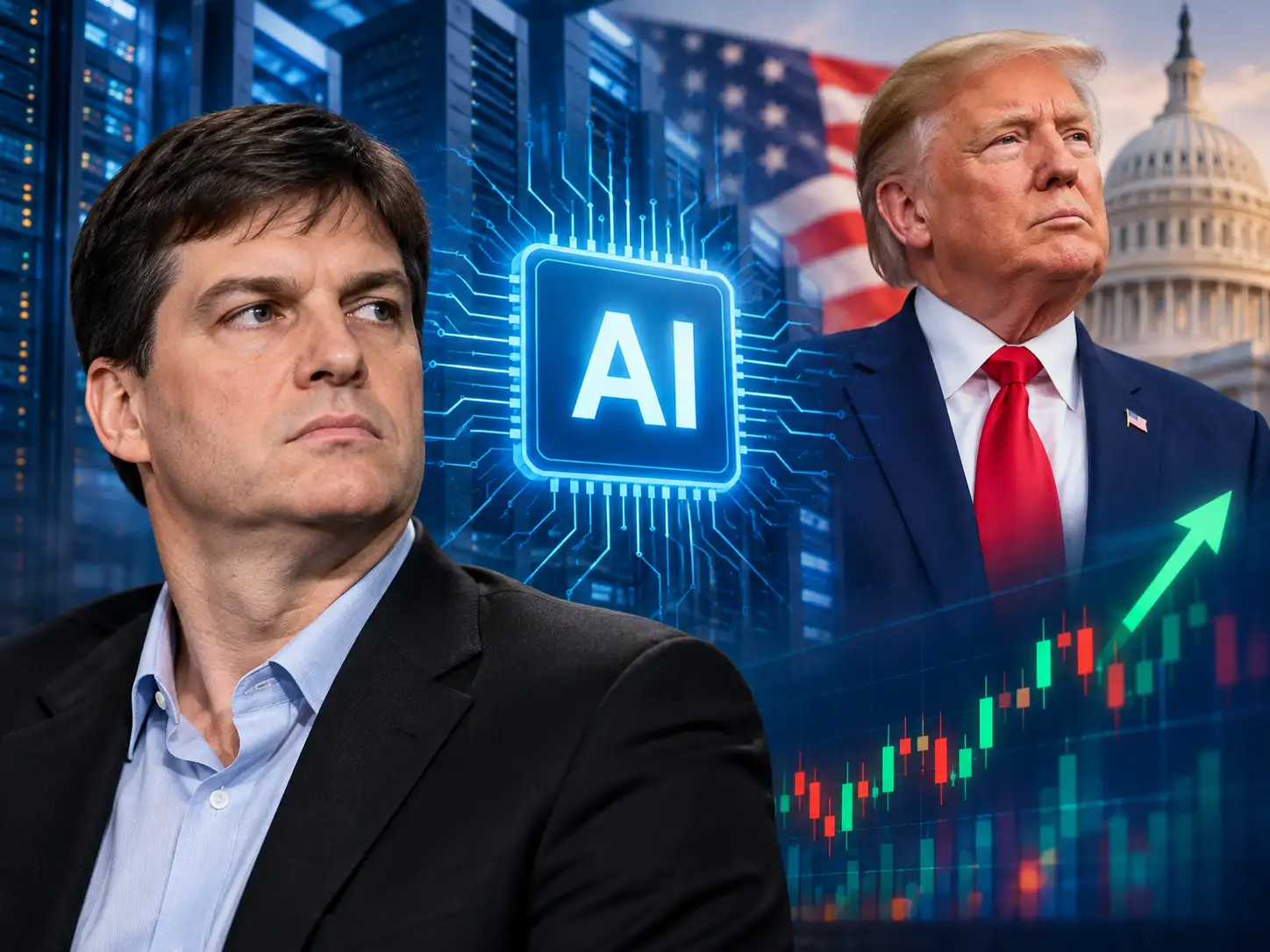
Popular American investor Michael Burry, famous for correctly predicting the 2008 housing bubble and now voicing concerns over the AI frenzy, said the President Donald Trump-led US administration cannot afford to let the AI boom fail.
The market veteran, popularly known as the ‘Big Short’ investor, explained that AI infrastructure buildout has become a critical support for the US economy, keeping very little room for the Trump administration to let the ongoing AI boom weaken, Stockwits reported. Notably, Burry has been shorting AI-linked stocks and warning investors of a sharp selloff ahead.

"Trump and his team know that the AI narrative and the buildout is the only thing keeping this economy going, and the most positive thing happening this year," Burry wrote in a recent Substack chat, as quoted by the report. "They cannot afford to let it fall," he added, while questioning what Washington could actually do to prevent a downturn.
AI slowdown fears
His latest comments come as investors increasingly fear a possible slowdown in the AI boom, after OpenAI, Anthropic and executives of other tech firms warned of the increasing risks to humanity following the rapid advancement of the nascent technology. Anthropic CEO Dario Amodei in a long X post earlier this month, called on AI companies to slow the rate at which they advance model capabilities amid mounting fears of misuse of artificial intelligence. The Anthropic CEO wrote that in nearly a year, AI agents "could be capable of taking over the entire internet, potentially causing hundreds of billions of dollars in damage."
World’s richest man Elon Musk, who runs xAI, as well as OpenAI CEO Sam Altman said that they agree with Amodei. “Dario is right…I have been sounding the alarm on AI for a long time,” Musk said in a streak of posts. OpenAI CEO Sam Altman in a series of posts noted that AI companies should pace the AI frontier, and that this has been the primary topic of discussions at the ChatGPT-maker in the recent weeks. “There are two ways AI progress could go very badly and that we must avoid. First, we could lose control of the future to AI…Second, we could end up in a world with too much concentration of power…Avoiding these two threats requires walking a narrow middle path; for example, one country could gain too much power. Another example is one lab ending up with too much power,” he wrote.
This led to a sharp selloff in global AI stocks. Trump meanwhile is aiming to make US leadership in artificial intelligence a national and economic priority. His government has been pushing for faster AI adoption across government and national security, more domestic computing infrastructure, and continued US leadership in AI over China.
Also read | Trump said he would dine with Anthropic CEO Dario Amodei amid mounting AI debate
Michael Burry’s AI warnings
Meanwhile, Burry has been sounding the alarm over excessive enthusiasm over AI. Recently, Burry said he continues to believe that the market is close to a major top, warning of a similar crash to that of 1987 when Dow Jones recorded a historic 23% plunge which led to the introduction of regulatory circuit breakers. However, the market investor noted that the S&P 500 making new highs likely will bring new money into the market.
Earlier this year, Burry wrote on a Substack post that he sees many indicators, both technical and fundamental, lining up for the same conclusion as the Dotcom crash. "1999 went where no market had gone before, and I would say so can this one...It is already there on a number of indicators," he said, arguing that massive venture capital flows, rising AI debt issuance, and extreme market optimism are creating conditions where valuations may detach from economic reality.
Burry’s popular bet against the housing market was depicted in the 2015 movie titled 'The Big Short', which starred Christian Bale, Ryan Gosling, Steve Carell and others.
Also read | Michael Burry revives AI warnings, Big Short investor says 'You could have heard it first'
Disclaimer: This article has been written by Debaroti Adhikary, who is not a SEBI-registered Research Analyst or an Investment Adviser. Debaroti Adhikary and his/her ‘relative(s)’ (as defined under Section 2(77) of the Companies Act, 2013) do not hold any financial interest in the companies mentioned in this article as of the date of publication. The views/recommendations mentioned in this article, wherever applicable, are those of the respective SEBI-registered Research Analyst/brokerage and have been reproduced/reported with due attribution. They should not be construed as the views or recommendations of The Economic Times Digital or the journalist. Readers are advised to consider the original research report and make their investment decisions based on their own assessment. Brokerage disclaimers here.