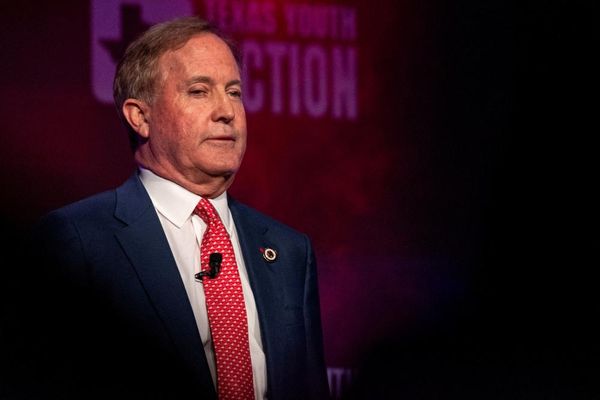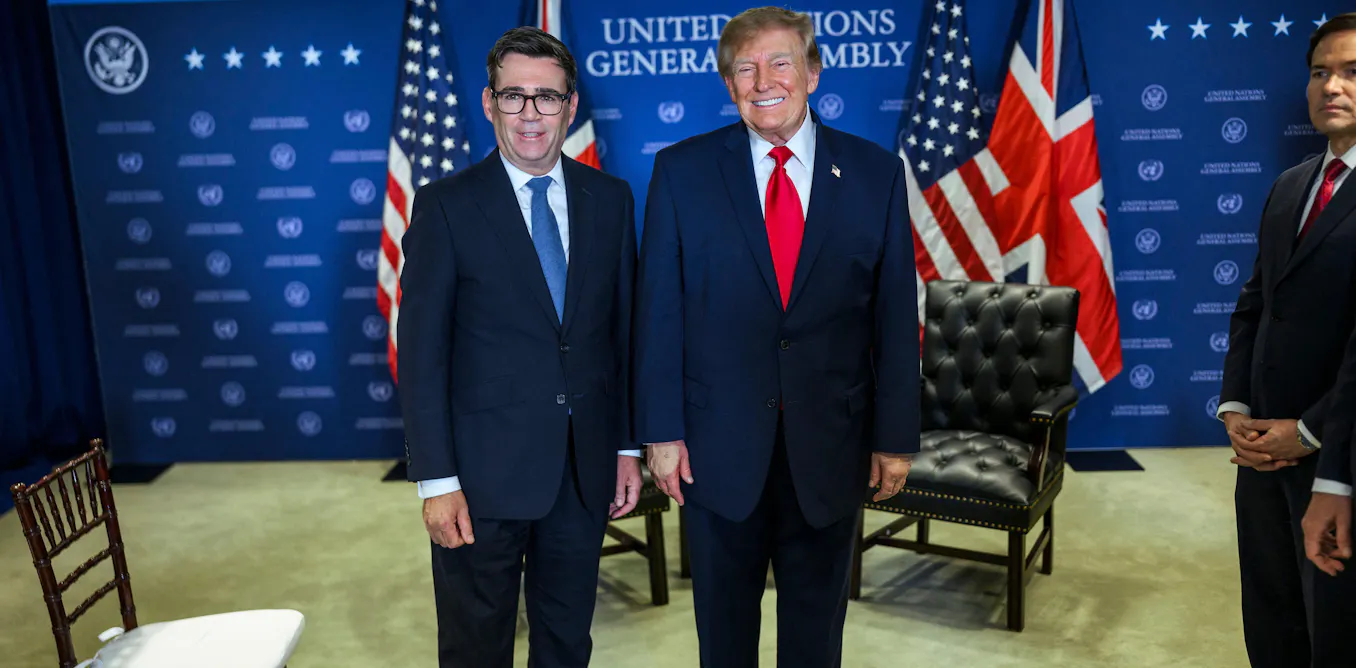
Tonally, it was perhaps not quite what the UK prime minister and his delegation had been hoping for. Moments before meeting Andy Burnham for the first time, Donald Trump told the world about “a British invasion fleet” arriving 250 years ago “to crush the cause of liberty”.
Immediately after Trump’s address to the UN General Assembly, the British and Americans met, and more cordially. “A really special country and we are with you all the way, Mr Prime Minister,” the US president declared.
A 45-minute meeting between Trump and Burnham, their foreign ministers, national security advisers, ambassadors and chiefs of staff concluded before the press was invited in for a 12-minute conference. Trump offered generalised (“I think he’s going to be good”), even flatulent (“a natural businessperson”) comments of approval. As, of course, he once did about Keir Starmer.
Perhaps nowhere more than in this incipient relationship might Burnham’s likeability – a quality not disputed by even his most hostile critics – be of material benefit: Burnham may disarm with charm. There was, Trump said, “good connection” between them. He congratulated Burnham – confusingly – on a “great election win”. (Had he heard of Makerfield?) “That was a big one.”
Conspicuous by their absence was mention of Burnham’s accent, Trump’s mother, the king – or indeed, the late queen.
It was while Burnham was airborne on his way to New York that the diplomatically significant RAF support for Saudi Arabia in its war against the Houthis in Yemen was announced. That move was conceived with an eye on the American response, and Burnham duly reminded Trump that “we accepted a call from Saudi Arabia”.
Seeking to de-escalate tensions with the White House, Burnham flagged his response as evidence that Britain will “play our part” in peace in the Middle East.
Avoiding awkwardness
It is never clear the extent to which Trump’s apparently casual remarks – recently over the sovereignty of the Falklands or the status of Northern Ireland – are also vindictive. (Were his comments about the Falklands because of Britain’s unhelpfulness over the Chagos Islands?) Maximalist demands often lead to compromise.
Some awkward issues were avoided publicly, such as the possibly provocative invitation from Canada’s finance minister for the UK to join the new EU-Canada alliance – or, indeed, the bromancing Evertonians Burnham and Canadian prime minister Mark Carney at the football recently.
Other awkward issues were publicly negotiated. It is perhaps auspicious that one policy predictably unpopular with this White House – sanctions against Israeli settlements – has been managed so deftly. Trump deflected the question when asked alongside Burnham.
It may help that where Starmer inherited an imperial Trump at his most powerful, Burnham finds a weaker president – and one who will probably be weaker still after November’s midterm elections.
Starmer inherited a war. His prime ministerial predecessors Herbert Asquith had gone to war in 1914 to defend Belgium against external aggression, Neville Chamberlain went to war in 1939 to do the same for Poland, and Boris Johnson in 2022 (effectively) did similar for Ukraine. Liz Truss, Rishi Sunak and Starmer also inherited Ukraine.
But Burnham has inherited Iran, which included as collateral damage Starmer’s carefully constructed relationship with Trump. Not acceding to US requests to use the airbases they already shared was Starmer’s most significant mis-step, notwithstanding the public and party praise he received for it.
Trump’s now normally extraordinary UN speech on September 22 was in part a post-hoc justification for his elective war on Iran. This has helped to define, through consequential economic pressures, the Burnham premiership.
The change of regime meant that Trump refrained from criticising the UK, though his slights at Starmer continued. To the suggestion that UK-US relations had been “up and down”, he replied to a British journalist: “They’re more up now than they were with your last prime minister.”
Chagos was “a terrible deal”, “ridiculous” – but, Trump said, significantly: “I think the prime minister’s going to be looking at it.” On Russia, the president said “the rhetoric from your last prime minister was too tough. He has to be a little bit careful.”
A warning to Burnham may have been implicit – “that dialogue is too nasty” – and praise was couched. “I will say he’s on your side,” Trump later said to Ukrainian President Zelensky of Burnham.
In his own address to the General Assembly later, Burnham pointedly ignored Trump’s warnings and spoke about Russia’s aggression in tones as hawkish and strident as anything Starmer ever said.
At the press conference, given the White House press corps boycott, questions from British journalists were prominent – and keen to elicit differences between the two leaders. A more than usually hesitant Burnham went through the prepared talking points, agreeing when invited to, manifestly out of his comfort zone.
At the weekend, Burnham will be in that happy place: his home crowd in his home town – the Labour Party conference in Liverpool. But, having satisfied the party membership and erstwhile Labour voters over Israel, he will find it much harder to do so over Trump.
The aim is clearly for a relationship that’s less craven – there was an “Andy” but no “Donald” – aware that his base is Labour’s grassroots, for whom no distance from Trump is too great.
By any measure, the meeting in New York was a success. Of the president’s fourth and likely final prime minister, we shall now see whether this particularly proficient people-pleaser can please this particular person.
This article was originally published on The Conversation. Read the original article.