- Stage 16: Évian-les-Bains - Thonon-les-Bains ITT
- Date: July 21, 2026
- Distance: 21.1km
- Start time: 13:00 CET
- Finish time: 17:50 CET
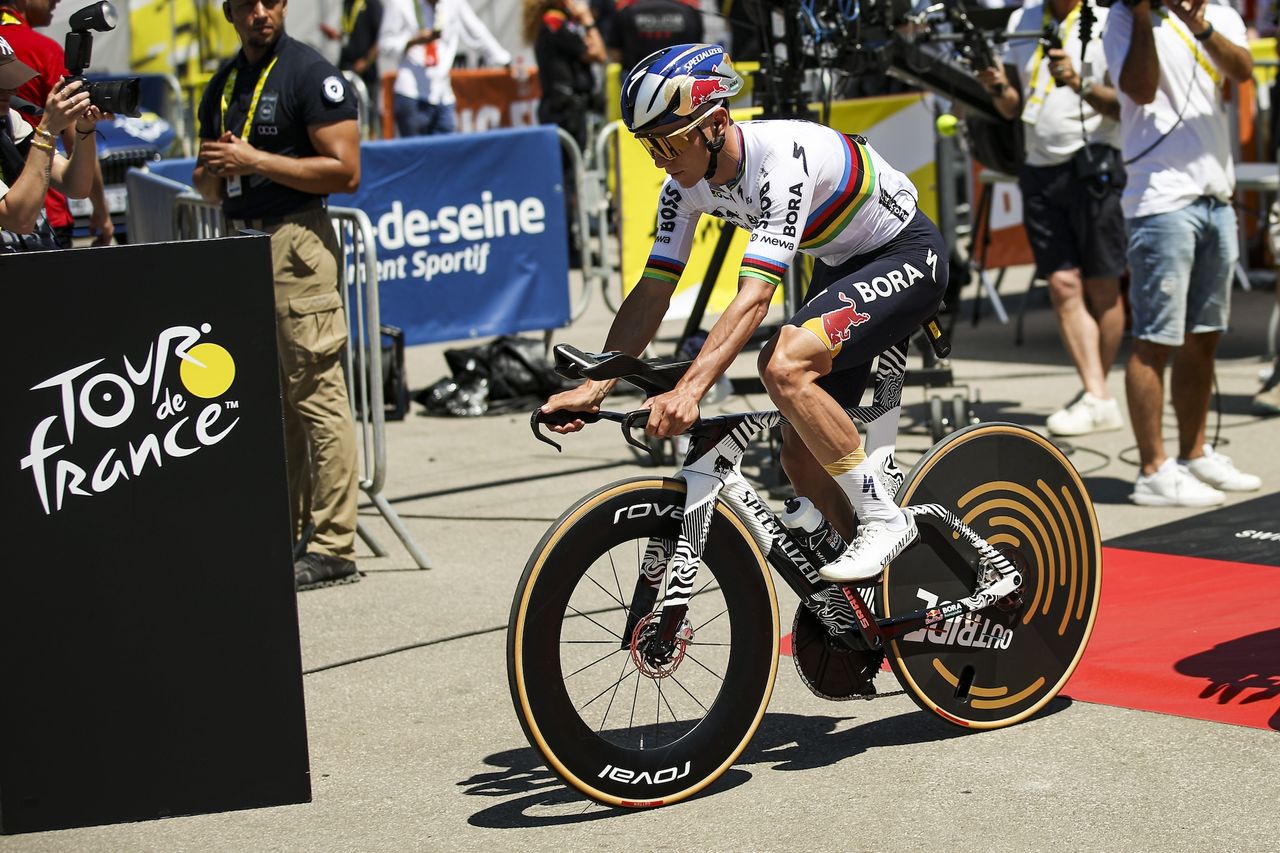
"First it's all out and then it's hope you can hold on," is how time trial expert Luke Plapp (Jayco-AlUla) sums up the Tour de France's only individual race against the clock this year, with its standout feature of a Cat. 2 ascent set to challenge the likes of yellow jersey Tadej Pogačar (UAE Team Emirates-XRG) and his closest runner-up, Remco Evenepoel (Red Bull-Bora-Hansgrohe).
Pogačar's advantage of 5 minutes over Evenepoel, who's widely rated as the best time triallist in the world, should give the Slovenian a more than sufficient margin to stay in yellow after completing the technical 26.5 kilometres from Évians-les-Bains to Thonon-les-Bains.
But even if Evenepoel cannot make more than sufficient inroads on the Slovenian on such a short, hilly course, starting on the shores of Lake Léman before heading inland then looping back to the coast at Thonon-les-Bains, the Belgian specialist can still use it to put space between himself and his rivals prior to the Alpine showdown next weekend.
There can be no doubt that Evenepoel is the favourite, then. But on a course as varied in its challenges - "it's a well-rounded time trial," is how Plapp, a three-time the National TT Champion, puts it. Nobody can be certain of what will happen.
On top of that, there's the risk of poor weather and summer thunderstorms suddenly acting as game changers, particularly on a long descent mid-way through the course.
"You have to for sure go down fast, but yeah, it's quite technical and tricky", Steve De Jongh, Lidl-Trek's head sports director, tells Cyclingnews. "We are hoping for no afternoon storms because that would be a disaster for the GC guys."
The route
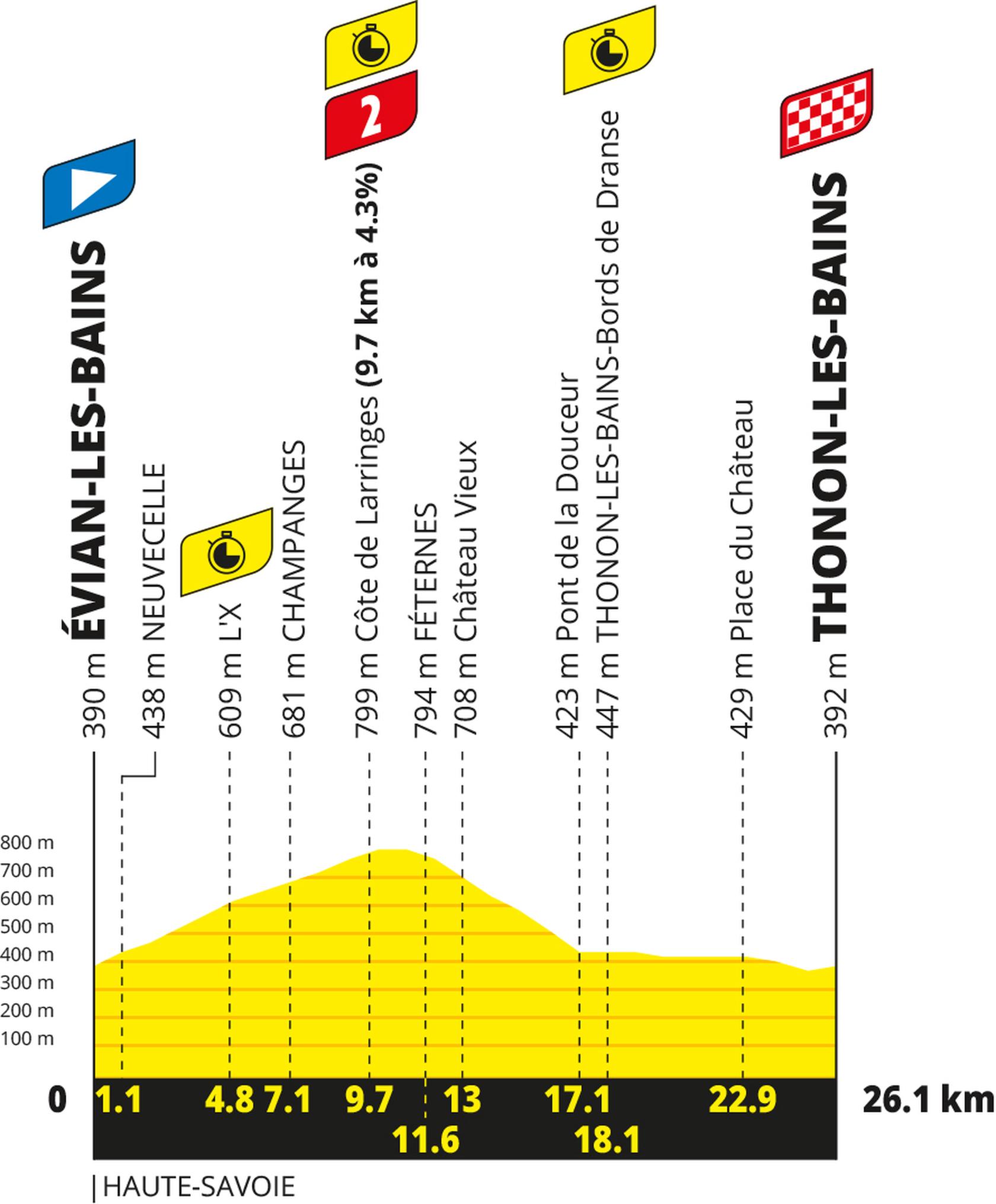
Just like the final time trial into Nice in the 2024 Tour, which began with an ascent of the Col de Turbie, this year's begins with the hardest challenge of the course, a 9.4-kilometre ascent of Côte de Larringes (9.7km at 4.3%).
But if there was a small section of flat for the riders to warm up before they hit the Turbie, here the riders are straight out of Évians-les-Bains onto the Larringes, and they won't stop climbing for a further 9.7 kilometres.
"It's more or less a 17-minute watts-per-kilo test, from the start to the top of the climb, yeah, to the top of the Cat.2, and then it's about how many risks are you willing to take and how quickly can you get down the downhill," Plapp says.
"The first part's actually beautiful, and it's just that bottom half that sort of gets a little technical and then it's more or less straightforward to the finish line.
"You've got six minutes there at the bottom of the descent, where it's just about putting the power down, and you've got a little section where it is technical, and then it's a pretty straight, fast power run home to the finish.
"So it's more or less gonna be 17 minutes full gas up the climb, then hold on for dear life on the downhill."
The strategy for such a long, grinding climb early on is simply one of making sure your engines are running at full strength from the moment you go down the start ramp - so the buildup is vital - then trying to hang on, Plapp says.
"I think it's a massive warm-up and then balls to the wall for 17 minutes, and hope that on that downhill, you can get enough recovery to sort of carry you through to the finish line as such," Plapp says.
"I don't think if you saved anything over the top, and tried to pace your effort, that you'd make up that much time. For sure, you would be a little bit quicker to the finish, but you'll probably gain more time there on the climb than you would if you were saving it for the final."
That strategy is nuanced, though, by whether the time trial is an individual stage target - as it is in Plapp's case and those of the specialists with nothing to lose long-term - or if you are a GC racer, trying to ensure you don't risk throwing away your options overall by riding too close to the edge.
"If you're a GC guy, you might be a little bit more conservative and make sure you do a very consistent and good ride to put yourself up there. But for the likes of myself and some other guys in that same boat, it's all out, and hope you can hold on, just back yourself that you can recover on the downhill and get to the finish."
- Points for stage : 20-17-15-13-11-10-9-8-7-6-5-4-3-2-1
The climb is certainly not harsh enough to warrant using a road bike on the ascent, as some steeper challenges would be.
"I think you'll see everyone on a normal 62 chain ring, and I dare say every single person will climb that climb in the TT extensions," Plapp says. "The calculation's well over 30 kph up the climb anyway - that's the speed we'll be doing to have a half-decent ride.
"So everyone will be on TT bikes, most likely in the extensions and with the big chain rings on, so I think it's gonna be still a very, very fast average speed for the day."
When you count in the weather factor and if the heavens do open, rather than just being a part to get through as fast as possible - itself no easy challenge - the downhill is potentially the key to the whole race.
"I think if it's dry, it won't be so bad. If it's wet, yeah, you'll really see some big differences emerge there. I think it's a brand new road as well, from what I could tell on the video, so it could be a little bit slippery, but fingers crossed it stays dry.
"The descent from a video in the car looks a lot smoother than it probably will feel at 80 kph on 25 mil wide tyres trying to navigate the sweeping corners, which will probably feel a bit scary.
"You're definitely gonna need to maximise every inch of road, though, to try and be as smooth as possible on that descent. But from what I've seen, it looks like a nice, well-balanced course."
The technical part of the course isn't just on the downhill off the Cat.2 Larringes, either, given there is quite a challenging run into the finish with a lot of roundabouts, changes of direction and so on. With riders' concentration beginning to waver by the end of their effort, the need to stay focused will be important - and difficult.
"There are quite a few left and rights and roundabouts, and I think also just picking the correct line, there could be quite a few options of whether you go left or right of the chicanes or the islands in the middle of the road. So I think you just gotta trust also the car and use them as your brains, and just do as they tell you to do," Plapps says.
"It definitely adds a different dynamic, it's not just switch off and get to the finish line, like there is a section there that you have to get right, or else you will lose a lot of time."
"But I think it's a pretty fair and good TT. There's actually still a fair bit of flat power required, I think it's about 10 minutes of actually pushing the pedals on the flat, as well as obviously the 17-minute climb."
Time checks
- L’X, km. 4.8
- Côte de Larringes, km. 9.7
- Thonon-les-Bains-Bord de Dranse, km. 18.1
Given the balanced nature of the course, if Evenepoel remains the top favourite, the question of who could give the Belgian a run for his money is more open. With the Cat.2 being more of a power ascent, Plapp believes the specialists like Ganna and Josh Tarling could well be in with a chance as well.
"I think the top 10 will be filled with probably a different mix of weights of riders," Plapp says, although he qualifies by adding that if they are on a good day, "Remco and Tadej could blow everybody out of the water. You never know."
As for his own chances, the three time National Time Trial Champion says, "I'd like to be in and around the top 10. If I can have a good climb, then I think that sets me up. So I'll know very, very early on, or halfway through the TT, how I'm gonna sit.
"I would dare say Remco will win, though. He'll probably push it a bit more on the downhill and through the technical parts than Tadej needs to, given his lead on the GC. He's got a few minutes up his sleeve play with too.
"But that fight for the podium will allow or get those contenders to push a bit more on the technical side of things, and Remco's obviously the best time-trialist in the world as well. So that will plays into it, too."
Mountains
-
Côte de Larringes (cat. 2, 9.7km at 4.3%), km. 9.7
- 5-3-2-1 pts for fastest four riders at check
Time limit
Est. Speed |
Est. Winner Time |
Limit % |
Max Time Cut |
|---|---|---|---|
48 km/h |
0:32:38 |
30% |
0:09:47 |
47 km/h |
0:33:19 |
30% |
0:10:00 |
46 km/h |
0:34:03 |
30% |
0:10:13 |
45 km/h |
0:34:48 |
30% |
0:10:26 |
44 km/h |
0:35:35 |
30% |
0:10:41 |