It's official, Total War: Warhammer 40k is real, and at some point in the next few years, we'll be dropping into the Imperium of Man to fight and conquer our way across the stars. It's been a long-time coming, frankly, as people have speculated about this combo of strategy titans for years at this point. With the success of Total War: Warhammer, it just makes sense.
While we don't have an exact release date yet, or know everything, we do have quite a bit of info to distill, including some stuff that is easy to speculate from the initial blog post and store page if you know the setting, as well as the recent developer roundtable. If you're interested in Total War: Warhammer 40k, you can wishlist it on Steam.

Does Total War: Warhammer 40k have a release date?

Currently, there isn't an official release date for Total War: Warhammer 40k, but Creative Assembly mention in the developer Q&A that we'll get more details in late 2026, meaning it's a fair assessment that the game isn't going to be released until 2027 at the earliest. We'll presumably find out a bit more about the release window when the developer roundtable drops on December 16. We do know that the game will release on PS5 and Xbox Series X/S consoles as well as PC—it'll be the first Total War ever to do so, in fact.
Total War: Warhammer 40k trailer
There is currently only one trailer for Total War: Warhammer 40k, which sets the scene with some cinematics, but also shows off some very early pre-alpha gameplay. Apparently content creators were already allowed to play some of the game earlier in the year, though they aren't yet allowed to talk about its features and the experience yet.
Who are the Total War: Warhammer 40k factions?

The same as with Total War: Warhammer, the 40k version will also have four factions on launch. Here are the official descriptions from the blog post:
- Space Marines: Genetically enhanced weapons of war, these warriors are few in number but each is the equal of a host of lesser troops. Clad in sacred power armour and wielding deadly weaponry, they are an uncompromising force that strikes with devastating and unyielding precision.
- Orks: Brutish hordes of destruction, they are unrelenting, countless and live for war. Storming the battlefield in endless mobs, they brandish unpredictable weapons and clanking war machines.
- Aeldari: An ancient and waning alien race, who once ruled the stars, but now find themselves scattered, battling against extinction. Swift and elusive, they strike with psychic precision and elegant weaponry, exploiting weakness before vanishing into shadow.
- Astra Militarum: The massed ranks of humanity’s largest fighting force are a bulwark of flesh and steel. Their legions of soldiers' march beneath the roar of battle-tanks and the thunder of artillery, grinding enemies into ruin with disciplined fury and sheer determination.
"What, no Chaos Space Marines?" I see you ask. Creative Assembly has confirmed that "Whilst they’re [Chaos] not in the game at launch, they’ll absolutely be part of our plans at some point, along with all the other iconic factions from the setting." You might remember, but Creative Assembly caused a bit of a controversy for itself back in the first Total War: Warhammer game, when it released Chaos as a pre-order DLC faction.
This annoyed a lot of people, since Chaos are so essential to the setting. It's possible that it is trying to avoid that happening again, but also take time to do the faction justice.
Speaking of DLC, unlike previous games, 40k won't sell its blood and gore option as a DLC (something that's also been unpopular in the past). It'll simply be included in the base game this time.
The recent developer roundtable also gave some insights into how factions will work, explaining that since the Space Marines are a small elite faction, they'll typically field smaller units than the Orks and Astra Militarum, who'll rely more on massed infantry.
The Aeldari also play "completely different from anything we've designed in the past," says Lead Designer, Simon Mann, with more of a focus on advanced technology and using the webway to avoid the biggest battles, which fits with their position as a dying race with few troops to throw into the fight.
Total War: Warhammer 40k story and setting explained

The setting for Total War: Warhammer 40k is, obviously, the grimdark future of the 41st millenium, where the Imperium of Man is beset on all sides by Xenos (alien) incursions, while the ruinous gods of the immaterium (Khorne, Nurgle, Tzeentch, and Slaanesh) corrupt all they can as they vie with each other for supremacy and to try to destroy the galaxy.
This game, specifically, is set during the Era Indomitus. After the Fall of Cadia and the destruction of its ancient pylons, the Eye of Terror (essentially a realspace gateway to hell which Cadia blocked) creates a galaxywide warp storm called the Cicatrix Maledictum, cutting off planets from each other and fracturing the Imperium.
Primaris Ultramarines (the blue Space Marines) and their Primarch, Roboute Guilliman, are awoken and begin the Indomitus Crusade to reclaim the stars for humanity, which is broadly what's happening in the trailer. It's a turbulent period which sees many different factions vying for power and control—perfect for Total War, really. The developer livestream confirmed that each campaign will take place in a "Crusade Theatre," essentially confirming that'll be a big focus of the campaign.
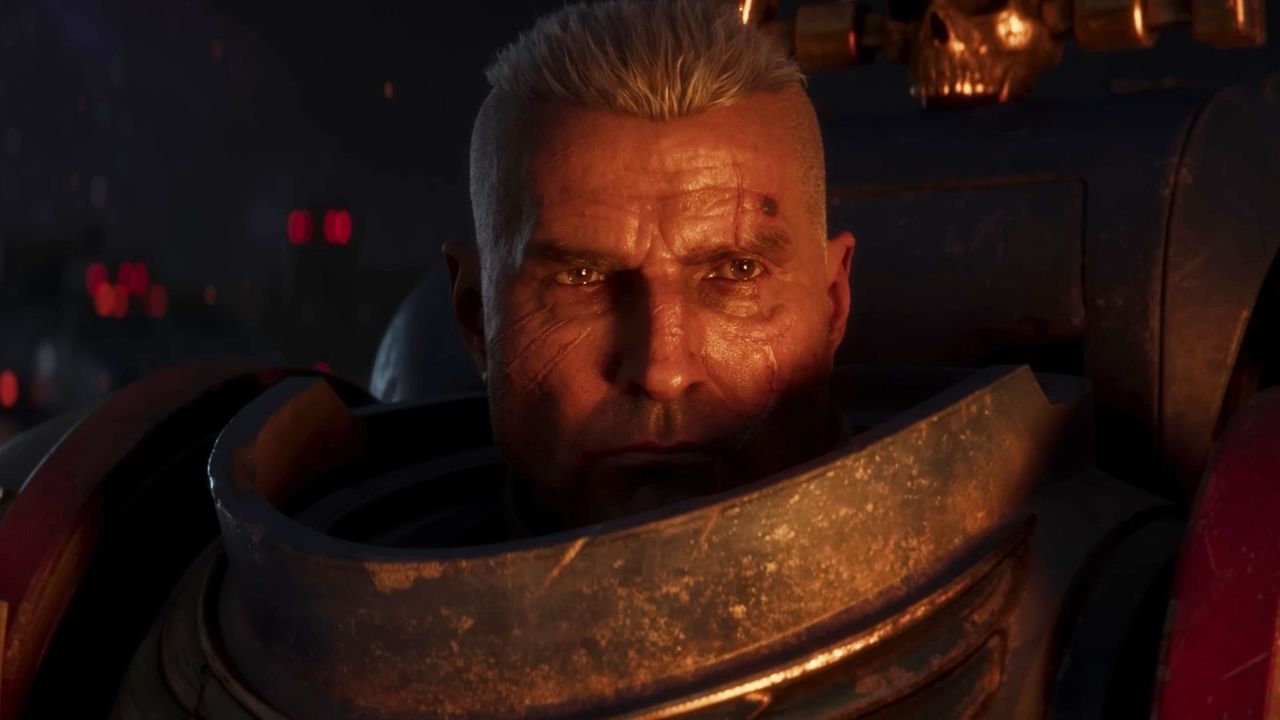
We also know that David Harbour, the Stranger Things actor, who announced the game at The Game Awards, is starring in it, too. While he might be voicing the game's tactical advisor (as all previous Total Wars have had one), I think it's likelier he's voicing some kind of new Space Marine commander, perhaps the white haired guy we see in the trailer.
Total War: Warhammer 40k gameplay features
The recent developer roundtable actually revealed a lot about how the game is going to work. Combining what they said with what we've seen of gameplay, there's quite a bit we can surmise:
- We're fighting in a "Crusade Theatre": Each campaign will take place in a "Crusade Theatre," where the Indomitus Crusade is being waged, meaning that we're not going to be fighting across the entire galaxy in one stint.
- Campaigns will have overarching progression: This part of the developer roundtable was a little vague, but the way Creative Director, Ian Roxburgh described it, made it sound as if each campaign will now feed onto a "higher layer that moves gradually across the whole sector, and then the whole galaxy." He doesn't go into specifics, but it sounds like campaigns will now influence events at a sector-wide level, and eventually a galactic level, adding an overarching progression to your campaigns, influencing the galaxy itself—pretty wild, honestly.
- There's both an army painter and unit customisation: While we knew about the army painting and visual customisation elements, the developer roundtable confirmed that there will be unit customisation, too, almost akin to wargear, allowing us to more mechanically tailor our troops towards our preferred playstyle.
- You can blow up planets: Exterminatus is confirmed to be in the game, permanently destroying planets, but they mentioned in the roundtable that it's a costly action, so isn't something you'll be able to do constantly.
- Some battles have objectives: This part of the developer roundtable made it almost sound a little like Dawn of War, as Battle Product Owner, Dave Petry, described how some battles will involve capturing orbital defense cannons, or how you might run into some Astra Militarum as the Space Marines who need saving. Beyond quest battles, Total War has never really had battle-based objectives, so this could be an interesting change.
- You can directly control some orbital bombardments: We saw the orbital laser in the trailer, but it's likely there will be a lot more army-based bombardment abilities similar to Total War: Warhammer, whether it's Basilisk artillery strikes for the Astra Militarum, or Thunderhawk strafing runs for the Space Marines. In the developer roundtable, Dave Petry described "dragging" an orbital lance across the battlefield, which makes it sound like you can directly control some bombardments versus just planting them down like in Total War: Warhammer.
- There are some big units: We'll apparently be able to "recruit from a deadly arsenal of faction-specific units, including powerful veterans," but that also includes "towering walkers and immense war machines." It seems like the scale of the battles is quite large, even by comparison with Total War: Warhammer, so we can likely expect some of 40k's biggest units, such as Imperial Knights, though perhaps not Titans.
- Battlefields are destructible: Based on the developer roundtable, it sounds like Total War: Warhammer 40k will have the most destructible battlefields of any game in the series, allowing you to tactically reshape the terrain through targeted destruction.
- There will be different planet types: The developer roundtable also showed off concept art for six different world types, including frontier, agri, mining, industrial, fortress, and hive, which is pretty exhaustive if we're assuming frontier includes death worlds.
- There are space anomalies: As Simon Mann says in the developer roundtable, "there are anomalies, there are things to do in the space between," during which a selection of concept art showed off some of these anomalies. One looked like an Ork asteroid fortress, one looked like a citadel of some kind, and another resembled a space hulk. These are presumably random campaign events we can encounter as we explore new systems.
- Fleet combat is not confirmed: While the developer roundtable did discuss fleets and their role on the battlefield, as you drop in troops or orbital bombardments, they didn't mention actual fleet-based warfare. I feel like they would have discussed this if it was a planned feature, so I speculate that, similar to naval combat in Total War: Warhammer, we might not get it as a feature on launch, or at all, though it's ultimately still too early to say.
Another key element is that it appears we won't be playing as the Ultramarines Primarch, Roboute Guilliman, when controlling the Space Marines. The Primarchs are essentially demi-gods, certainly stronger than most of Total War: Warhammer's legendary lords, so they are likely a bit OP for the game's purposes—though it looks like Dawn of War 4 will let us play as one.
Instead, the developer roundtable seems to confirm that we'll get our own Space Marine Force Commander who we can customise and make our own, both in terms of wargear and chapter.