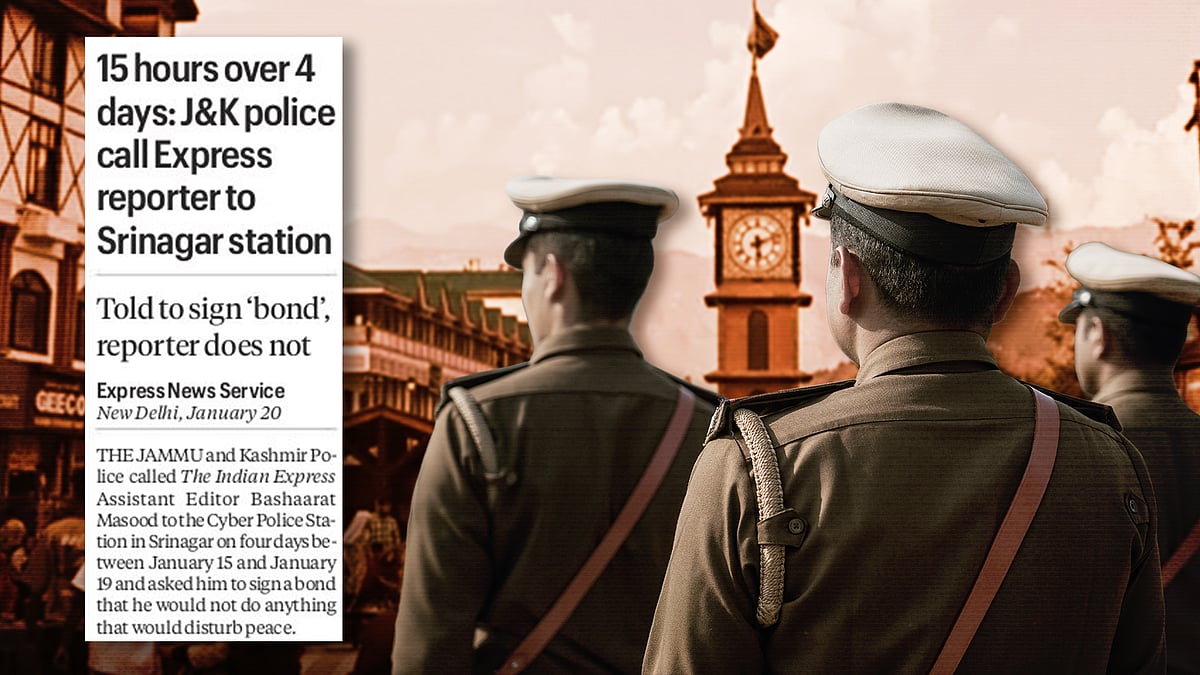
Days after journalists from national publications were summoned by the Jammu and Kashmir police, The Indian Express publicly backed its Srinagar-based reporter Bashaarat Masood, detailing the police action against him in a front-page report.

Headlined “15 hours over 4 days: J&K Police call Express reporter to Srinagar station”, with the strapline “Told to sign bond, reporter does not”, the report outlined how Masood was repeatedly called to the police station and asked to sign a bond stating he would not do anything to “disturb peace” in the union territory.
The paper’s decision to foreground the incident comes amid questions over the silence of national media organisations whose reporters have faced police summons in Kashmir.
I am glad the Indian Express has gone public on its support for their journalist in Kashmir. Major newspapers should do their part in countering government lawlessness, especially in places where impunity reigns. https://t.co/sKtimf6b0m
— Salman Soz (@SalmanSoz) January 21, 2026
"Masood, who has been reporting for The Indian Express from Srinagar for 20 years, did not sign the bond."
— Aakar Patel (@Aakar__Patel) January 21, 2026
zindabad pic.twitter.com/Fdag0KibfH
Masood, who has been part of the newspaper’s Srinagar bureau since 2006, had recently reported on a controversial police drive to collect information on mosques in the Valley. The police action against him was not linked to any formal FIR but carried out under Section 126 of the Bharatiya Nagarik Suraksha Sanhita. This section states if the magistrate is of the opinion there is sufficient ground for proceeding, he may, require such person to show cause why he should not be ordered to execute a bond or bail bond for keeping the peace.
In its report on Wednesday, The Indian Express said Masood told the magistrate he did not know the reason for which he was being asked to sign the bond, following which the police took Masood back to the station. The police “made him wait and did not specify… the reason for calling him to the station and making him sit there for hours.”
Chief editor Raj Kamal Jha was quoted as saying Masood’s work “over the last two decades speaks for itself”, adding that he had not signed the bond. “The Indian Express is committed to doing what is necessary to uphold and protect the rights and dignity of its journalists,” Jha said.
The development follows a statement by the Press Club of Kashmir on Tuesday, flagging what it described as the “intimidation” of journalists from national media organisations. The club said its members were “summoned or advised by the J&K Police to stop covering stories related to the profiling of specific religious institutions in the region”.
In a statement on Tuesday, the club said journalists were told this direction had come from higher authorities. “In one case, a prominent journalist from The Indian Express was compelled to submit an undertaking agreeing not to write such stories in the future, while others received similar instructions after being called to the police station.”
The statement came as J&K police started circulating a form titled “profiling of mosques” earlier this month, triggering alarm over surveillance in the region. The police exercise seeks details such as the physical structure of the mosque, cost of construction, source of funds, monthly expenditure and income. It also sought information about the people associated with the mosques, including their financial status, and bank, passport, ATM and credit card details. A similar form has also been shared with the people running madrasas.
While the Mirwaiz Umar Farooq-led Muttahida Majlis Ulama earlier termed it an “invasive data collection exercise”, National Conference leader and Parliament member Aga Ruhullah Mehdi said the “right-wing ideology which is running the system in this country” wants to control the pulpit.
Earlier this week, senior journalist Nirupama Subramanian posted on X about reporters being asked to sign bonds in Kashmir.
Reporters of Delhi national newspapers are being summoned by J&K police, harassed about routine “he said”, “she said” reports and asked to sign bonds they won’t do such reports again. First, the correspondent of one newspaper was summoned repeatedly over three days, and perhaps…
— Nirupama Subramanian (@tallstories) January 19, 2026
And those so-called newspapers and their chief editors have been silent about the harassment of their journalists for routine stories, essentially emboldening the unelected LG of J&K to do even more using the JKP. https://t.co/VIAo6BgHIw
— Sushant Singh (@SushantSin) January 19, 2026
Absolutely reprehensible. As it is, journalists in Kashmir work under constant threat - summoned and detained by police, their passports suspended or revoked. It is shameful if national newspapers remain silent and succumb to this kind of intimidation of their reporters. https://t.co/Iu5wL1fK1y
— geeta seshu (@geetaseshu) January 19, 2026
The summoning of journalists was subsequently criticised by several politicians.
CPM MLA Yousuf Tarigami posted, “Summoning reporters and asking them to sign bonds is a fresh attempt to browbeat them into submission. It reflects a wider pattern of intimidation of journalists aimed at silencing independent voices.”
People’s Conference chief Sajad Lone termed it a “new low”. “Why should the police intervene and summon journalists when they are doing a story based on facts.”
J&K PDP tweeted, “If reporters from national newspapers can be summoned, harassed, and pressured over routine reporting, it marks a serious erosion of press freedom. This intimidation must be unequivocally condemned. Kashmiri journalists have faced this for years. The silence on this only emboldens further crackdowns.”
Summoning reporters and asking them to sign bonds is a fresh attempt to browbeat them into submission. It reflects a wider pattern of intimidation of journalists aimed at silencing independent voices. https://t.co/swE3Orwy8W
— M Y Tarigami (@tarigami) January 19, 2026
This is reprehensible. Why should the police intervene and summon journalists when they are doing a story based on facts.
— Sajad Lone (@sajadlone) January 19, 2026
This is a new low. https://t.co/oCy88hcFFj
If reporters from national newspapers can be summoned, harassed, and pressured over routine reporting, it marks a serious erosion of press freedom. This intimidation must be unequivocally condemned. Kashmiri journalists have faced this for years. The silence on this only… https://t.co/A9ToY8nq7K
— J&K PDP (@jkpdp) January 19, 2026
Several journalists in Kashmir earlier told Newslaundry they receive background-verification calls from government offices many times a month, asking them to disclose PAN and Aadhaar numbers, bank account details, salary slips, property records, and even their marital status. Local officials, the story found, have been tasked with compiling personal and financial information of working journalists. This sort of intimidation, the statement noted, "weaken(s) independent journalism and undermine(s) the public's right to information”.
In November last year, the raid on Kashmir Times underscored a broader effort to extinguish independent voices. Since August 2019, dozens of journalists have left the profession, moved out of Kashmir, or withdrawn from reporting altogether.
At Newslaundry, we believe in holding power to account. Our journalism is truly in the public interest – funded by our subscribers, not by ad revenue from corporations and governments. You can help. Click here and join the tribe that pays to keep news free.
Newslaundry is a reader-supported, ad-free, independent news outlet based out of New Delhi. Support their journalism, here.