
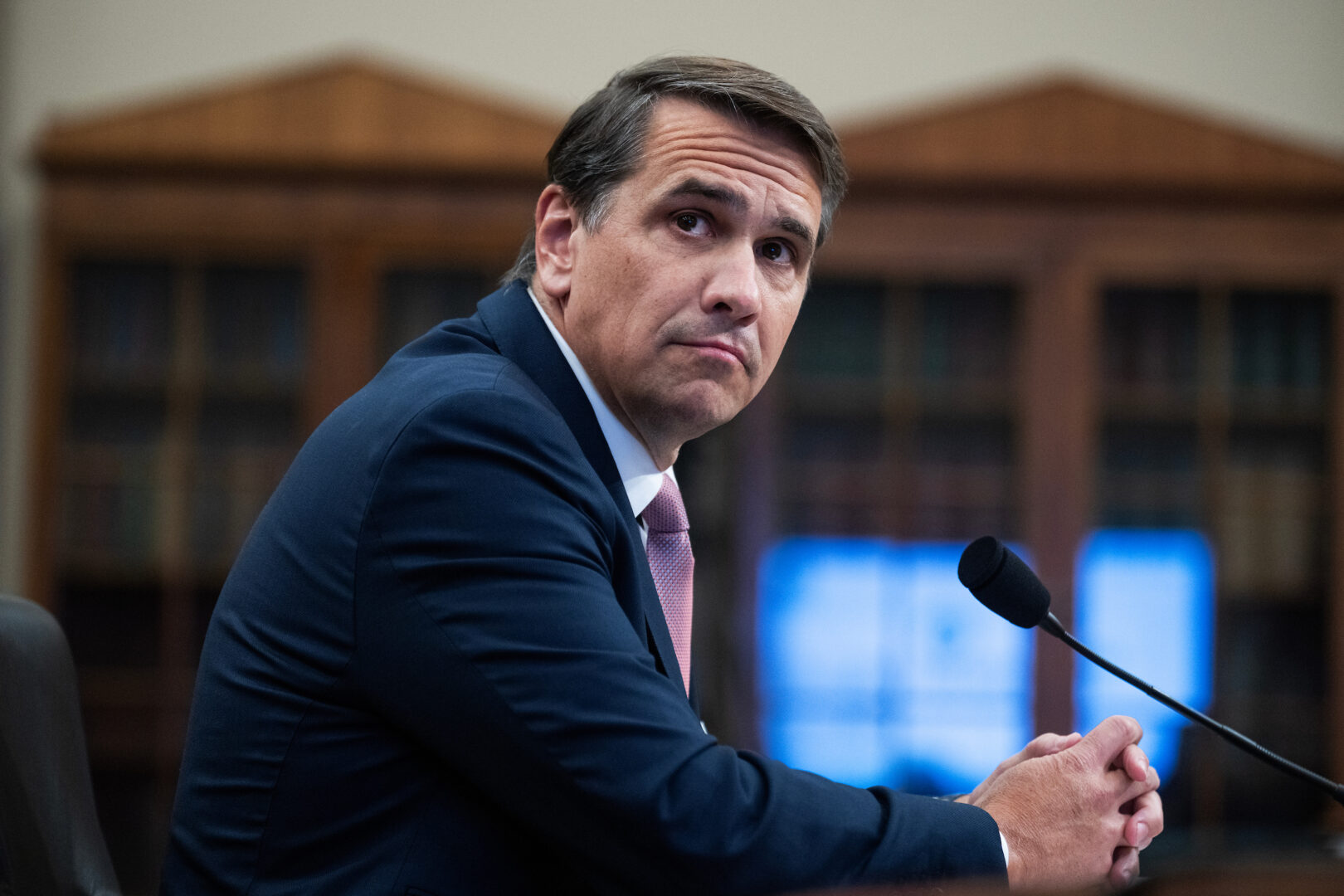
Todd Blanche faces his biggest public test Wednesday in his bid to serve as President Donald Trump’s fourth confirmed attorney general: a Senate Judiciary Committee with a pair of undecided Republicans.
The panel’s two-day hearing, which will feature Blanche on the first day and outside witnesses on the second, will likely air some of the most controversial efforts of the second Trump administration, ranging from the handling of the investigation into deceased sex offender Jeffrey Epstein to Trump’s nationwide immigration crackdown, criminal cases against the president’s critics and the $1.8 billion settlement fund that the Justice Department is still fighting for in court.

After the hearing Wednesday, the future of Blanche’s bid for attorney general rests in the hands of a pair of Republicans who do not face voters this fall: Sens. John Cornyn of Texas and Thom Tillis of North Carolina. The duo — Cornyn was defeated in his primary and Tillis is retiring after this term — have said they have not yet decided whether they will support Blanche’s nomination. Either could join Democrats to stall Blanche’s nomination.
In addition, the dais will be missing one of the president’s staunchest allies in Congress: the late Sen. Lindsey Graham, R-S.C. Graham, who died over the weekend after a sudden illness, previously served as the Judiciary Committee’s chairman and presided over the confirmation of Justice Amy Coney Barrett in 2020.
Unless Graham is replaced on the panel, the committee would have an 11-10 partisan split. A tie or negative vote in the committee does not doom the nomination, but would require a procedural maneuver on the Senate floor to discharge it.
Outsiders expect that controversies from Blanche’s tenure within the DOJ will likely dominate questioning — particularly his supervision of the release of department files on late sex offender Epstein. Blanche has served as acting attorney general since Trump ousted Attorney General Pam Bondi in April, and has served as the deputy attorney general since the Senate confirmed him last year. The deputy attorney general typically runs the day-to-day operations of the DOJ.
Jay Young, Common Cause’s senior policy director of civil rights and civil liberties, said his organization has focused on Blanche’s close ties to Trump as well as his role in some of the most controversial Trump policies.
Common Cause and other groups have put pressure on several members of the panel, notably Cornyn and Tillis. That includes efforts like online petitions and protests outside Tillis’ office, as “the math is the math.”
“We’re doing what we can in our power to remind Sen. Cornyn and Sen. Tillis what they had said in the past and let them know that by all objective standards their concerns were well justified,” Young said.
That also includes his involvement in the settlement of Trump’s $10 billion lawsuit against the IRS tied to the release of his tax returns during his first term. That settlement provided Trump and his family members immunity from tax audits as well as creation of a $1.8 billion fund for victims of “weaponization” of prior Democratic administrations.
Although Blanche later said that fund was “not moving forward,” the DOJ has continued to fight a court order blocking its implementation. Additionally, on Monday a federal judge in Florida ruled that Trump used her courtroom to “provide some legitimacy to an agreement to confer immunity to people and entities affiliated with the President and to earmark billions of dollars from American taxpayers to redress grievances not defined in the law.”
Possible swing votes
Cornyn, who lost his primary to a Trump-backed challenger, has told reporters that he would not decide on Blanche’s nomination until after the hearing.
Tillis, who announced his retirement last year and is similarly undecided, has said he intends to question Blanche about his support for defendants convicted of assaults on police officers during the attack on the Capitol on Jan. 6, 2021, as well as Blanche’s involvement in the $1.8 billion fund that could go to victims of “weaponization” of Democratic administrations.
Before the July 4 recess, Tillis told reporters that he had not seen “anything disqualifying” in his review of Blanche’s record. Later, Tillis told CNN that “if there’s even a whiff of a lack of independence, then that could influence my vote.”
Blanche has gotten the public backing of many Republicans and law enforcement organizations, including the national Fraternal Order of Police.
William Barr, Trump’s last confirmed attorney general of his first term, argued in favor of Blanche’s nomination in a Wall Street Journal op-ed last month. Barr said that Blanche is not a “toady” of the president and “no one has a better chance” of pushing back on Trump’s worst instincts.
At the same time, more than 1,000 former Justice Department employees signed on to a letter opposing Blanche’s elevation to the role. They accused Blanche of “corruption and abuses” that included weaponizing the department against the president’s political foes and undermining everyday criminal and civil justice work that keeps Americans safe in favor of political goals.
Democratic concerns
Democrats on the panel have roundly criticized Blanche’s nomination and submitted more than a dozen information requests about Trump administration steps ranging from the firing of DOJ antitrust official Gail Slater to terminating grant programs and Blanche’s involvement in the release of the Epstein files ahead of the hearing.
Judiciary Committee Democrat Sheldon Whitehouse of Rhode Island spotlighted those in a letter Monday, including the Epstein requests and the settlement fund.
“No new Attorney General should be confirmed until the Department has provided meaningful responses to all outstanding oversight requests, and commits to timely responses going forward,” Whitehouse wrote to the Justice Department.
Beyond the panel, at least one Republican has shown signs of concerns about Blanche’s role in one Trump administration effort in particular. Sen. Bill Cassidy, R-La., signed on to a brief with Judiciary Committee member Sen. Cory Booker, D-N.J., opposing the settlement fund in court and the pair sent a letter seeking information about a portion of the settlement providing Trump legal immunity from tax inquiries.
Carlos Uriarte, a former assistant attorney general for legislative affairs and now a partner at Morrison and Foerster, said the hearing will likely focus on the running of the DOJ.
“All nomination hearings are an opportunity to Congress both to vet the nominee and to demonstrate their ability to conduct oversight of the underlying institution and that is especially true when that leader is being elevated within the institution,” Uriarte said.
At the same time, the nature of a congressional hearing may end up letting Blanche off the hook. University of Michigan law professor and former federal prosecutor Barbara McQuade pointed out that senatorial confirmation hearings frequently do not support the kind of questioning that would really put Blanche on the spot.
“The senators are often not great at listening to answers and following up and asking a question,” McQuade said. “All they cared about was asking the question; they didn’t care about the answer.”