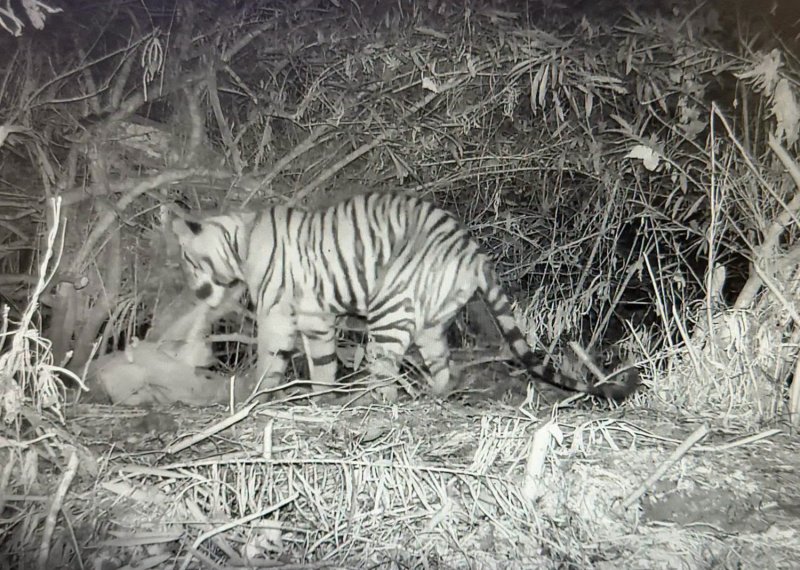
The tiger that killed a wildlife ranger in Huai Kha Khaeng Wildlife Sanctuary was not fully grown, still learning to hunt and failed to meet the definition of a "man-eater", the Department of National Parks, Wildlife and Plant Conservation (DNP) said on Thursday.
The clarification came a day after the tiger attacked and killed Sakarin Wichacharn, a 48-year-old ranger, in one of Thailand's most important wildlife sanctuaries.

Chayaporn Amratish, director of Protected Areas Regional Office 12 in Nakhon Sawan, said camera-trap records and the sanctuary's long-running tiger database had enabled officials to identify the animal responsible.
”The tiger was confirmed to be one of three male cubs born to a tigress known as "Apinya". The family occupies a natural range of about 40 square kilometres in the area,” Mrs Chayaporn said.
Attack likely a case of mistaken identity
Officials believe the attack was a tragic accident rather than predatory behaviour towards humans.
Based on behavioural analysis, the tiger is about 18 months old, an age at which young tigers begin venturing out on their own and learning hunting skills.
Mrs Chayaporn said the ranger was lying asleep on the ground when the attack occurred, which may have caused the inexperienced tiger to mistake him for natural prey.
Under normal circumstances, tigers that encounter humans standing, moving or making noise typically retreat.
She stressed that the animal's behaviour does not qualify it as a man-eater, as there is no evidence that it has repeatedly attacked people or deliberately targeted humans as its primary prey.
As well, the tiger's family has continued living within its usual territory and has not displayed unusual movements such as straying into nearby communities.
Sanctuary closed temporarily
The DNP has installed additional camera traps to closely monitor the young tiger's behaviour.
According to Mrs Chayaporn, if the animal is found to be hunting normally in the wild, officials will allow it to remain in its natural habitat while considering the use of tracking devices for long-term studies.
However, if it shows signs it may attack people again, authorities will move to capture it and undertake behavioural rehabilitation measures.
The department has also tightened safety measures for rangers. Staff have been instructed not to work alone, avoid close encounters with wildlife, improve living quarters, increase lighting in dark areas and sleep only in secure buildings.
Huai Kha Khaeng Wildlife Sanctuary has been temporarily closed to tourism and nature study activities until monitoring of the tiger and safety assessments are completed.
According to the DNP’s database, the sanctuary is home to about 100 adult tigers, along with roughly 30 younger tigers that have survived beyond their first year but still face significant risks during their development.
The department said the attack was highly unusual.
On Wednesday, DNP director-general Athapol Charoenshunsa described it as only the second known tiger attack on a human in the sanctuary system in the past 28 years.