Get all your news in one place.
100's of premium titles.
One app.
Start reading
The National (Scotland)
National
Laura Pollock

Three reasons Irish reunification could be nearer than we think

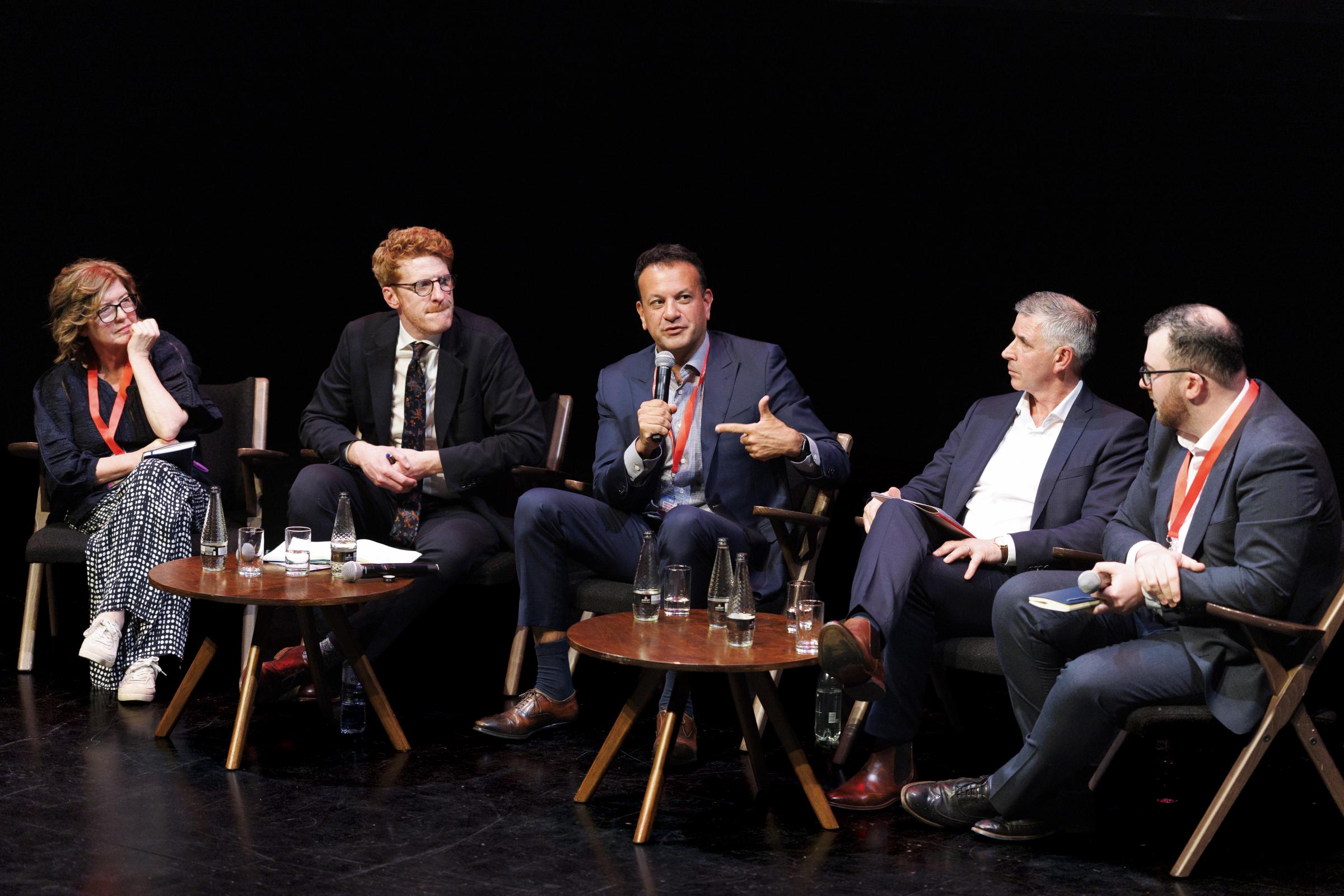
(left to right) Baroness Sue Gray, former senior civil servant, SDLP MLA and Leader of the Opposition Matthew O’Toole, former Taoiseach Leo Varadkar, former senator Ian Marshall and Conleth Burns of More in Common during a panel discussion titled (Image: Liam McBurney/PA Wire)

TODAY’S panel event organised by the Social Democratic and Labour Party exploring constitutional change, coinciding with the 10-year anniversary of Brexit, has given plenty food for thought for the people on the island of Ireland – and the wider Celtic Alliance.

Former taoiseach Leo Varadkar said Reform-led government in the UK that seeks to “double down on Brexit” could act as an “accelerator” towards Irish reunification.

Ireland’s current Minister for Justice Jim O’Callaghan suggested that a rise in English nationalism could influence the debate on Northern Ireland’s constitutional future and potentially bring forward the timing of any future referenda on unity.

And Baroness Sue Gray, who was formerly Keir Starmer’s chief of staff, has expressed fears for the future of Stormont.

All three made the comments at an event in Belfast focused on the future relationship between the island of Ireland and Britain and the prospect of Irish unification.

Let’s look at each argument one by one.

Leo Varadkar

(left to right) Leader of the Opposition Matthew O'Toole MLA, SDLP, and Leo Varadkar, Former Taoiseach, (Image: Liam McBurney/PA Wire)

Former Fine Gael leader Varadkar said the Brexit referendum had acted as an “accelerator for change” when it came to the debate on Northern Ireland’s future.

These were very similar comments made by Lynn Boylan, Sinn Fein Dublin MEP, at an event in Brussels this week. You can read about that here .

He said the election of a Reform UK government could have a similar effect, especially if the party pressed for a UK withdrawal from the European Convention on Human Rights (ECHR).

Such a move would pose profound questions for Northern Ireland, given much of the Good Friday peace agreement of 1998 is underpinned by the convention.

“I think there is a possibility that an accelerator could be a UK government led by Reform, led by Nigel Farage, that doubles down on Brexit, that takes this view that Brexit failed because it wasn’t done properly, and looks for a harder separation from the EU, and reopens these questions around ECHR, where the checks are done, and so on,” said Varadkar.

“That’s a possibility, and it’s a possibility that might be closer than we think.”

Varadkar said he considered a Reform-led government a “possibility” rather than a “probability”.

“I think, in the end, the UK won’t vote for Reform,” the former Irish premier said, as he suggested Andy Burnham may call, and win, a snap general election if elected Labour leader.

“I’m not predicting this, but I think we have to consider the possibility that a UK election, a UK Westminster election, which we were certain was going to be in 2029, now could happen in 2027 and there’s a possibility, although not a probability, that that could result in a Reform-led government or Reform/Conservative coalition, and we have to think about the consequences of that,” he said.

Varadkar’s successor as Fine Gael leader, Simon Harris, last week announced that his party would set out its vision for a united Ireland later this year.

“I was very happy about it, and I’m very glad to see that Fine Gael will be active in this space and part of this debate, so it was welcome,” Varadkar said.

Jim O’Callaghan

Irish Justice Minister Jim O’Callaghan TD during a panel discussion titled Political Change Across These Islands. The discussion was organised by the SDLP through CONNECT as part of The Future of These Islands: Preparing for Change event at the MAC Theatre in Belfast.Picture date: Thursday June 25, 2026. PA Photo. Photo credit should read: Liam McBurney/PA Wire
Irish Justice Minister Jim O’Callaghan TD (Image: Liam McBurney/PA Wire)

Fianna Fáil TD O’Callaghan said he was not concerned that Fine Gael had made that move on the issue of reunification.

“I think it’s healthy that political parties in the south are preparing and discussing this issue,” he said.

Under the terms of the Good Friday Agreement, a border poll on reunification should be called in Northern Ireland by the incumbent Northern Ireland Secretary when he/she believes there is evidence that public opinion in the region has shifted in favour of constitutional change. In that event, a simultaneous poll would also be held in the Republic of Ireland.

Successive UK governments have consistently declined to specify publicly what criteria will be applied when measuring public sentiment on the issue.

Outgoing prime minister Starmer previously insisted the question of calling a referendum is “not even on the horizon”.

O’Callaghan published his own paper in 2021 setting out his ideas on what a united Ireland could look like. Those included retaining a role for Stormont and the retention of the PSNI as a stand-alone police service for the region.

On Thursday, the justice minister said political events were likely to be inherently unpredictable in the coming 10 years.

Asked by reporters if he believed referenda could be held by the end of this decade, O’Callaghan said that could be the case if Reform UK came to power.

“There could be (a poll in the next four years) if Reform came to power, if they decided that they wanted to get out of the European Convention on Human Rights and if that required them to dispense with Northern Ireland, that could occur, but I can’t predict the future,” he said.

“I don’t know a date as to when there will be a border poll, but I think it is worthwhile having discussions like this as we have had today.”

O’Callaghan said there was an onus on future Irish governments to start planning for constitutional change.

He acknowledged that would create a “sensitive political issue” for the authorities in Dublin amid concerns about antagonising unionists in Northern Ireland.

The TD said he felt the way to address those sensitivities would be to initially frame the question in the context of the Republic of Ireland and its citizens, rather than broadening the debate to the whole island.

“I think a future Irish government is going to have to prepare for constitutional change,” he said.

“Obviously that decision and the process by which an Irish government prepares for it is a sensitive political issue in itself because we have to be conscious not represented in this room (the event venue in Belfast) is a significant population within Northern Ireland whose political representatives don’t want to engage with this issue.

“And how does an Irish government put in place a preparatory scheme which isn’t seen by unionism as being threatening or an attempt to steamroller them into something they don’t want to do, and that is a sensitive issue.”

On the potential of confining the planning to the Republic of Ireland in the first instance, O’Callaghan added: “That is a sensitive way for the Irish state to put out what it is we’re prepared to do to achieve Irish reunification, and I think that could be seen as something that isn’t threatening or insensitive to other people. There are people in this room who may be completely unsupportive of that and they may say, ‘well, why aren’t people in Northern Ireland having a say in the future of our island?’.

“But I think it’s a sensitive way of starting the discussion by an Irish government in the south.”

Sue Gray

Baroness Sue Gray, Former Senior Civil Servant, during a panel discussion titled Britain, Ireland and Global Relations (Image: Liam McBurney/PA Wire)

In her contribution, Gray made a case for greater collaboration between Whitehall and the devolved administrations in the UK.

“I think there is a feeling, and I felt this when I was in the Department of Finance, you know, my colleagues, they were my colleagues in the UK government, there were people that I would have sat down with before I’d come here, and I would go back and sit down with, and, you know, I wasn’t involved in discussions,” she said.

“I would get a phone call on the morning of a new policy with some funding.

“How that could have been so different if the devolved government had sat round that table and had contributed to that discussion, and I do think that is something that we need to do more of.”

The peer also expressed concern about how devolved government was currently functioning at Stormont.

“I do fear for Stormont, and I do think that people here deserve action and decisions, and that is a joint responsibility across many people,” she said.

Gray advocated introducing a “metro mayor” model across the devolved regions to give city authorities more powers to take decisions. In Northern Ireland, she suggested metro mayors for Belfast and Londonderry.

She also voiced support for Andy Burnham’s reported plan to move part of the Downing Street operation to Manchester if he becomes prime minister.

“I do think actually taking and just establishing an office outside Downing Street, outside London and the South East, sends a really powerful signal,” she said.

“It sends a very powerful signal to government departments who, you know, do think everything happens in Whitehall and London.”

Gray said she hoped Burnham was equipped to see off the challenge posed by Reform UK.

She told the event at the MAC in Belfast: “If Andy is the successor (to Sir Keir), I think that his experience, not just in actually, you know, working in Manchester, he’s also worked in Whitehall previously and held Secretary of State positions, so he can bring a lot of experience to the fore.”

Thanks for reading all, see you next week.

Sign up to read this article
Read news from 100's of titles, curated specifically for you.

Already a member? Sign in here
Related Stories
Top stories on inkl right now
One subscription that gives you access to news from hundreds of sites
Already a member? Sign in here
Our Picks
Fourteen days free
Download the app
One app. One membership.
100+ trusted global sources.