
Get all your news in one place.
100's of premium titles.
One app.
Start reading
Livingetc
Livingetc
Luke Arthur Wells

This Garden Designer's 'Creeping' Lawn Alternative Is Her Secret to Making Hard Landscaping Feel Softer and "Blurring Thresholds"

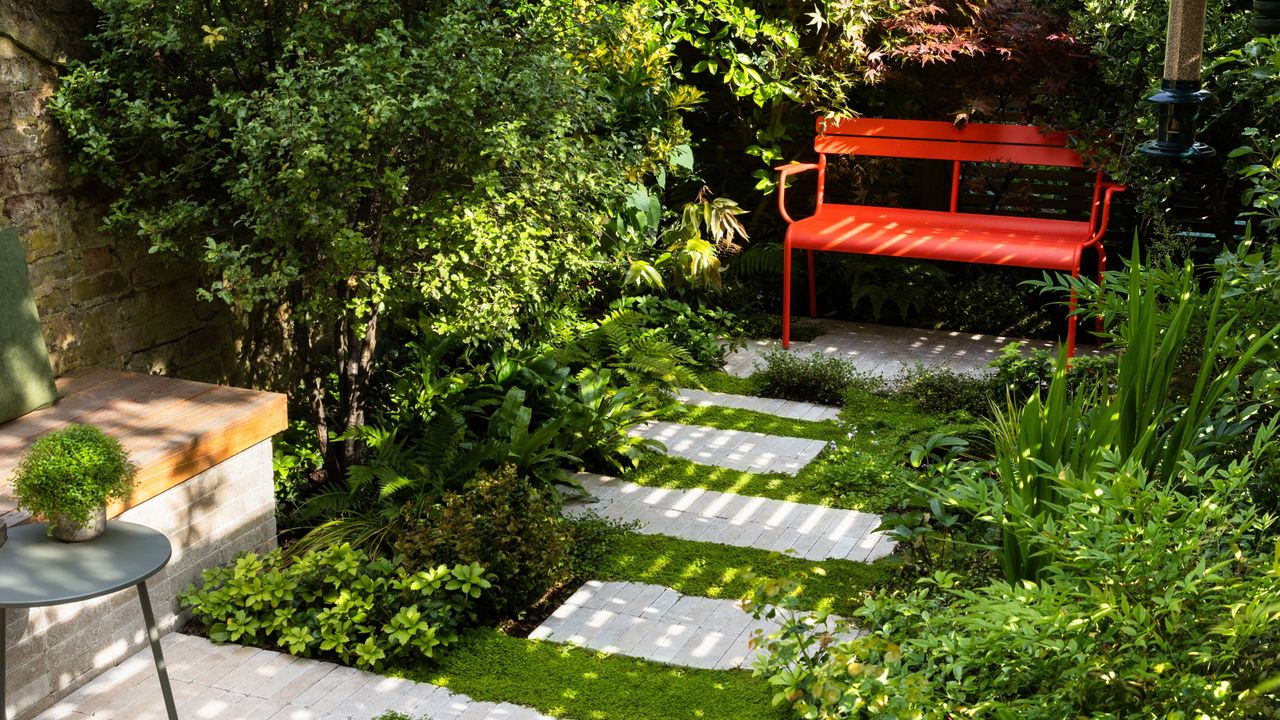
A garden patio with mind your business and ferns and a bright red garden bench.

When I'm asked what the small, creeping mat of plants I have filling the gaps in the hardscaping in my own courtyard garden is called, I'll always answer: Mind your own business.

But, that's not me gatekeeping — it's because Soleirolia soleirolii (found here at The Palm Centre) is otherwise known as Mind-Your-Own-Business, a creeping evergreen perennial with small leaves that's an aesthetically pleasing walkable groundcover that landscape designers love, but not just for its good looks.

Don't believe me? Just check out this garden by Gina Taylor of East London Garden Design. "In this shady garden with heavy clay soil where a lawn had completely failed, we introduced Soleirolia soleirolii to form a green carpet. Paired with natural stone sett pathways and planted in rills, it thrives in those conditions and stays vibrantly green year-round," the designer explains.

But, how is this plant best used in a garden design to play to its intriguing qualities? And, importantly, how easy is it to look after? Here, Gina gives us the lowdown on how to garden with this lawn alternative.

What's the Best Thing About Using Mind-Your-Own-Business in a Garden Design?

Mind-Your-Own-Business thrives in shady gardens, pictured here with ferns. (Image credit: Rachel Oates. Design: East London Garden Design)

"I love how Soleirolia doesn’t sit beside hard materials — it inhabits them. It threads itself into joints, spills over edges, and wraps around details, so the hardscape feels like it’s been there forever.

Design-wise, it achieves something quite subtle but powerful. It softens geometry without obscuring it. It highlights texture — you see the grain of the stone more, not less. And it creates that sense that the garden is gently reclaiming the built form.

As designers, we often talk about “blurring thresholds” — this plant does that effortlessly. It’s especially effective in fine gravel joints, between stepping stones, or at the base of walls, where it can creep and settle naturally."

How Did You Use It, and Complement It, in the Design of This Garden?

This creeping plant is ideal for softening the edges of a garden patio. (Image credit: Rachel Oates. Design: East London Garden Design)

"The key is that we didn’t treat it as a backdrop — we treated it as the base layer of the composition. The scheme is built in layers:

Ground layer — the Soleirolia creates a continuous, unified surface.

Mid layer — mixture of hardy evergreen ferns, Haconechloa Macra grasses, and shade-tolerant perennials (Pachysandra Terminalis, Tiarella ‘Spring Symphony) are spaced so they feel like they’re puncturing through that carpet.

Structural layer — shrubs and architectural plants give rhythm and height: tall evergreen Pittosporum Tenuifollium, Euonymus Fortuney and Leucothoe.

What makes it feel natural is the spacing and restraint. Instead of dense planting everywhere, we’ve allowed breathing room so each plant reads clearly against that fine-textured ground. That’s why it feels like everything is emerging from it — because, in a way, it is. The ground cover isn’t an afterthought; it’s the canvas. And in a small urban garden, that cohesion is everything. It allows the space to feel calm, immersive, and quietly luxurious, rather than busy. "

How Easy Is It to Care For?

It's a sort of low maintenance garden plant, but it can also spread quickly. (Image credit: Rachel Oates. Design: East London Garden Design)

"It’s one of those plants that feels effortless, but there is a balance to strike. On the one hand, it’s incredibly generous. It establishes quickly and forms a dense carpet, suppresses weeds and reduces the need for mulching. In the right conditions, it’s almost self-sustaining. But it will wander. Its stems root as they go, so it can spread beyond where you intended if left unchecked.

In practice, maintenance is about editing rather than tending. Light trimming or lifting where it encroaches, keeping edges clean around key plants, and ensuring moisture levels don’t fluctuate too wildly. I’d describe it as low-maintenance, but not no-maintenance— it rewards a light, regular hand."

I love Mind-Your-Own-Business as an example of more naturalistic garden design, and it works so well in urban gardens as a contrast to your hard landscaping.

For more inspiration for your garden this season, why not sign up to the Livingetc newsletter?

Sign up to read this article
Read news from 100's of titles, curated specifically for you.
Already a member? Sign in here
Related Stories
Top stories on inkl right now
One subscription that gives you access to news from hundreds of sites
Already a member? Sign in here
Our Picks
Fourteen days free
Download the app
One app. One membership.
100+ trusted global sources.