Get all your news in one place.
100’s of premium titles.
One app.
Start reading
Guitar World
Guitar World
Entertainment
Richard Barrett

“This can be the area that spawns the most intimidating names”: 5 altered chords you need to know – and how they get their names

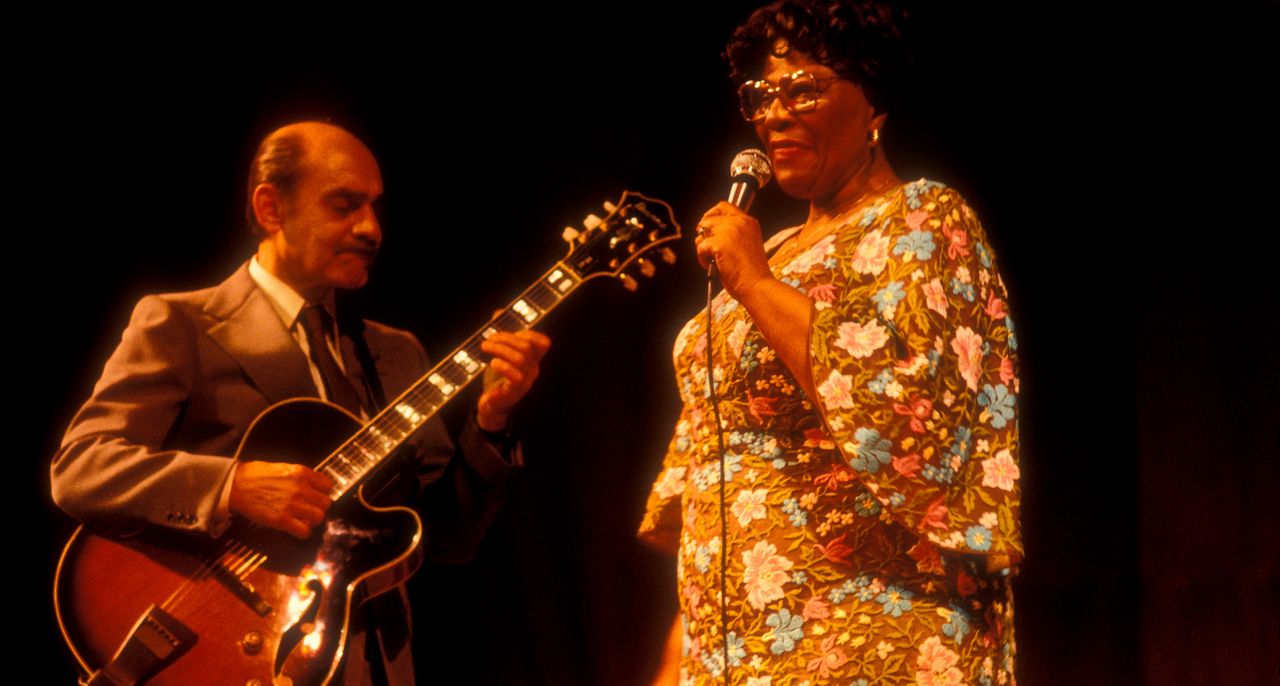
Joe Pass lays down some chords as he accompanies Ella Fitzgerald.

Recently, we’ve been exploring extended chords, and while we did touch on some altered chords, this is a fuller explanation with tips on how to avoid some common pitfalls with the naming conventions.

That being said, it’s important to remember that the names are only an attempt to describe/itemise the different sounds available to us. Altered chords aren’t necessarily extended, but this can be the area that spawns the most intimidating names, some of which we’ll attempt to demystify here.

Let’s start by defining exactly what ‘altered’ means in this context, which is: moving a note within a chord out of the ‘parent’ scale. For example, a C augmented (usually written as ‘aug’) triad contains C-E-G# (Root-3rd-#5).

The 5th has been raised (augmented) by a semitone, giving us a G#, which is not found in the C major scale – and is great for adding tension. It really is as simple as that, even though some of the names can seem a little daunting at first glance (see Example 5).

Example 1. Caug5

(Image credit: Future)

You’ll see the similarity to a regular C major chord, but that #5 (G#) on the third string takes it somewhere else – perhaps it can resolve to an F major, or maybe raise that G# another semitone to A at the 2nd fret, giving us C6? Altered chords are all about the context.

Example 2. C7(b5)

(Image credit: Future)

Having raised the 5th in Example 1, we’re lowering it in this C7(b5). It’s also a 7th chord, which adds a more jazzy feel. Take care to mute the fifth string and you can move this chord to any key. This would resolve well to C7 by raising that b5 on the second string a semitone.

Example 3. C7(b9)

(Image credit: Future)

The same overall principles apply when looking to alter extended chords. This C7(b9) is a classic jazz chord, with the b9 (Db) appearing at the 2nd fret of the second string. Raise it a semitone to the 3rd fret and you’ll find a D, giving us a nice resolution to a C9 chord.

Example 4. C9(#11)

(Image credit: Future)

If we build further on the ideas in Example 3, we might make this dramatic C9 (#11) chord. The #11 itself (F#) is found at the 2nd fret of the first string. They’re both F#/Gb, so why a #11 rather than a b5? Because we also have the 7th and the 9th here, making this an extended chord.

Example 5. C7(#5#9)

(Image credit: Future)

The classic Hendrix chord gets an extra note here, the #5 (G#) above the more often heard #9 (D). You can add this by simply flattening your fourth finger across the first and second strings. This sets up a nice resolve to F13, but why not experiment and see what else sounds good to you?

Sign up to read this article
Read news from 100’s of titles, curated specifically for you.
Already a member? Sign in here
Related Stories
Top stories on inkl right now
Our Picks
Fourteen days free
Download the app
One app. One membership.
100+ trusted global sources.