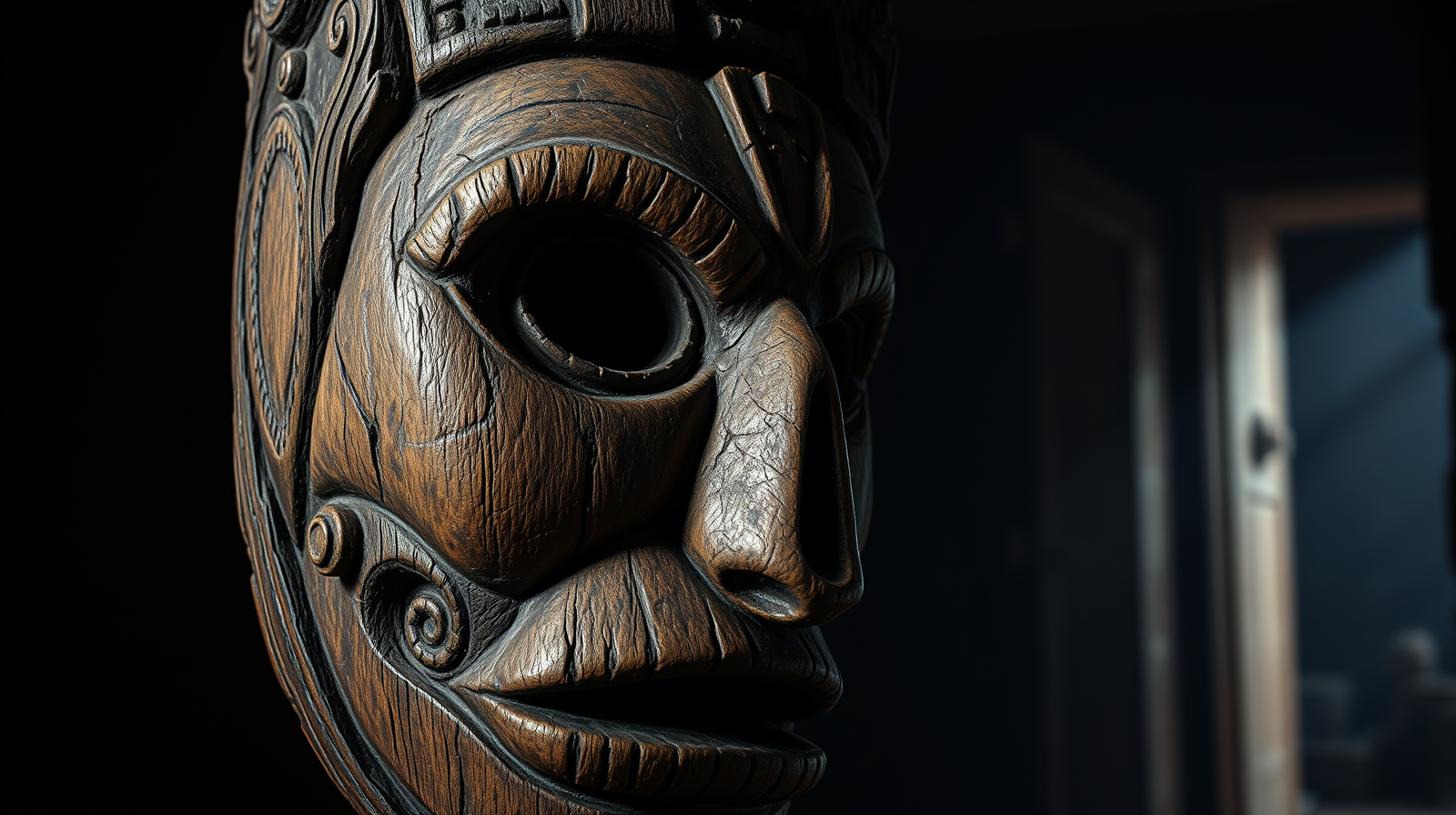
Carved from wood more than five centuries ago, a small skull faced mask held today at the Walters Art Museum in Baltimore once gave physical form to one of the most feared and revered deities in the entire Aztec pantheon, Mictlantecuhtli, lord of the underworld. Measuring just 6.75 by 5.5 inches, the mask depicts the god with sunken, black pupiled eyes and a triangular, bone like nose, giving it an unmistakably skeletal appearance. Mictlantecuhtli ruled over Mictlan, the underworld through which the Aztecs believed every soul had to travel, and this rare surviving mask offers a direct physical link to the rituals built around one of Aztec religion's most formidable gods.
Get breaking news anytime, anywhere. Download the TOI app now!

What the 500-year-old Aztec death mask reveals about Mictlantecuhtli
According to the Walters Art Museum's own catalog record of the object , which holds the mask in its permanent collection, close examination has revealed small reddish circles on its cheeks, most likely representing splotches of decay associated with the god, details that closely resemble similar markings shown on Mictlantecuhtli's face in the pictorial manuscript known as the Codex Borgia. The god's teeth were painted with vertical black lines, and both ears appear to have been pierced, consistent with depictions of Mictlantecuhtli wearing ear ornaments made from human bone. The mask itself dates to between roughly 1450 and 1521, placing its creation in the final decades before the Spanish conquest.
Why masks held such deep spiritual meaning in Mesoamerica
Throughout Mesoamerica, wearing or displaying a mask during religious ritual was understood as something considerably more significant than costume or decoration. According to a peer reviewed study published in the Cambridge Archaeological Journal , the production and use of masks across multiple scales and contexts represents a millennia long tradition in Mesoamerica, with researchers Guy David Hepp and colleagues arguing that masking artefacts recovered from well documented archaeological contexts index broader sociocultural changes in a given region over time, including the way religious and iconographic authority gradually became concentrated among ruling elites in the centuries before the Spanish arrived. Their research draws in part on earlier foundational scholarship, including art historian Cecelia Klein's 1986 study on the material effects of masks in Aztec Mexico, which argued that masking practices were directly tied to how imperial and religious power was expressed and reinforced.
Why this particular mask was likely never actually worn
Despite masks playing this genuinely central role in ritual, this particular object appears to have served a different purpose than the masks people physically wore during ceremonies. According to the Walters Art Museum, the mask has no holes for eyes, and this absence has led researchers to conclude it was probably affixed to a statue or wooden figure representing Mictlantecuhtli rather than worn directly on a human face, making it a rare surviving example of a specifically sculptural Aztec mask rather than a ceremonial one. Such objects have survived only very infrequently, adding further significance to this particular mask as a genuine piece of Aztec devotional material culture.
How scientists actually verify masks like this are authentic
Establishing that an object like this genuinely dates to the pre-conquest period rather than being a later imitation is itself a matter of careful scientific analysis rather than simple visual judgement. According to a study published in the journal Forensic Science International , researchers investigating the authenticity of a separate Aztec wooden mask held at the Museum of Ethnography in Budapest used a combination of non-destructive x-ray fluorescence, infrared spectroscopy, Raman spectroscopy and radiocarbon dating on both the wood and its adhesive materials, ultimately dating that object to between 1492 and 1653 and confirming it as a genuine piece of Aztec origin. This kind of multi method scientific testing, cross referencing wood species, pigment composition and radiocarbon dates, is the standard researchers rely on to separate authentic pre-conquest masks from later reproductions.
Why Mictlantecuhtli mattered so much in Aztec belief
Mictlantecuhtli was responsible for the souls of people who died what the Aztecs considered heroic deaths, in battle, sacrifice or childbirth, helping guide them through the nine levels of the underworld toward eventual eternal rest. He was typically depicted with his arms raised, ready to tear apart the dead as they entered his domain of Mictlan. According to the Walters Art Museum, death held a genuinely central place in Aztec religion, forming one of the twenty day signs of the Aztec calendar and reflecting its essential role in the natural cycle of the cosmos as the Aztecs understood it, a concept directly tied to regeneration and resurrection rather than simple ending.
Why death and rebirth were never truly separate ideas for the Aztecs
This mask, and the god it represents, sits within a broader Aztec cosmology in which death was never viewed simply as a conclusion. The Walters Art Museum notes that Mictlantecuhtli features in an Aztec creation account in which the god Ehecatl travels into Mictlan to retrieve the bones of long dead ancestors, bones that are eventually used to create a new race of humans, tying the lord of the underworld directly to renewal rather than only decay. More than five hundred years after it was carved, this small wooden mask remains one of the clearest surviving physical connections to that complex, deeply intertwined understanding of death and rebirth at the heart of Aztec religious life.