Get all your news in one place.
100’s of premium titles.
One app.
Start reading
The Guardian - US
The Guardian - US
World
Justo Robles in New York

‘They fought for American values’: Afghan immigrants and advocates push back against Trump crackdown

people holding a flag
An event promoting the Afghan Adjustment Act, on 20 October 2022 in Thornton, Colorado. Photograph: The Washington Post/Getty Images

Afghan immigrants and advocates across the United States are pushing back firmly against the Trump administration’s most recent crackdown on legal immigration, saying the American government is punishing hundreds of thousands of people for the alleged actions of one man.

Since the shooting of two national guard soldiers in Washington DC late last month, with the authorities charging an Afghan man as the suspect, the Trump administration has taken harsh action, especially against Afghans in the US, generating a mix of fear, outrage and defiance in the diaspora.
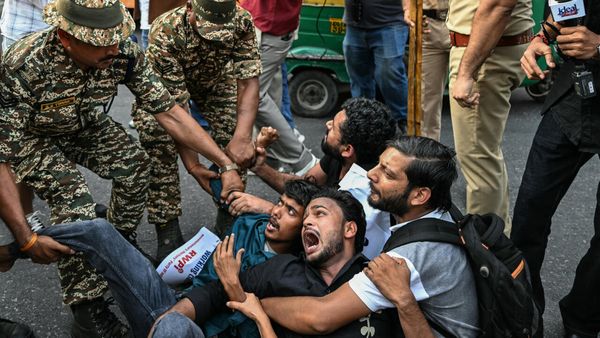
The government has completely frozen asylum decisions at US Citizenship and Immigration Services (USCIS), paused visa and immigration applications filed by Afghans and, more widely, halted all legal immigration cases for nationals of 19 countries listed on its travel ban, including citizenship ceremonies.

“The attacker hasn’t been put on trial, but the whole Afghan community has been labeled as guilty,” said Yahya Haqiqi, president of the Afghan Support Network in the US, an organization founded shortly after the fall of Kabul to Taliban control in 2021 that has helped thousands of Afghan refugees settle in Oregon.

“There are folks that came here because they fought for American values in Afghanistan, and because of the action of one individual, they and the whole community are being harmed. They are scared of their future, of not knowing what’s going to happen tomorrow.”

The administration also directed officials to re-investigate the cases of immigrants from those 19 countries who were granted legal status under the Biden administration, and reduced the validity period for work permits issued to several groups of immigrants, including asylum-seekers and refugees.

Trump administration officials have argued the changes are necessary after federal authorities identified the suspect in the shooting of the national guard soldiers, one of whom died, as Rahmanullah Lakanwal, a 29-year-old Afghan evacuee who entered the US in September 2021 and was granted asylum in April 2025.

The moves also come amid reports of stepped-up apprehensions by Immigration and Customs Enforcement (ICE) in some heavily Afghan communities.

Afghans who spoke with the Guardian said they condemn the killing of national guard soldier Sarah Beckstrom and that they hope guardsman Andrew Wolfe fully recovers after being critically wounded. But, they said, the policy changes introduced by the administration are unnecessarily creating uncertainty for thousands of families fighting to stay in the United States.

Shir Agha Safi said he worked as an intelligence officer alongside American forces fighting the Taliban in Afghanistan. He came to the US in 2022 as part of Operation Allies Welcome, the Biden administration effort to resettle tens of thousands of Afghan evacuees.

Safi said he applied for a green card in 2023 through the special immigrant visa (SIV) program, which offers permanent residency to Afghans who supported the American war effort, as translators or in other roles.

“I agree with the re-examination of green cards,” he said in a telephone interview with the Guardian last week – but not for the reasons the Trump administration is citing.

“The US government should recognize the faces of those who served the US mission in Afghanistan,” he said. Safi is now the executive director of Afghan Partners in Iowa, a non-profit in Des Moines, where around 500 Afghan families settled after the 2021 evacuations.

“Some are feeling a sense of betrayal in my community, of being marginalized, but I said that if they have not done anything wrong, they should not be afraid of the changes,” he said.

Some 80,000 Afghan immigrants were granted humanitarian parole to enter the United States under Operation Allies Welcome. As of 2022, nearly 200,000 Afghan immigrants had been welcomed into the United States, with California, Virginia, Texas and New York being the states with the highest concentrations of Afghans.

Haqiqi , in Oregon, said that Afghans in the Portland metro region “are scared of just living, they are scared of exposing themselves as Afghans, not just to immigration officials, but how people will react to them as part of their community”.

Meanwhile, Safi added that in Des Moines, Afghans have been detained by federal immigration officials following the announcement of the sweeping changes to US immigration policies. The government defended the reason behind the reshaping of the process of asylum, visas and green cards, citing concerns for the safety of the country.

“Military-age males were routinely flown into the United States before their identities and backgrounds were fully established, with the Biden administration asserting that thorough vetting would occur only after arrival,” said Tricia McLaughlin, assistant secretary for public affairs at the Department of Homeland Security.

“Under the Trump administration, we have instituted rigorous, multilayered screening: mandatory biometric enrollment, comprehensive social-media vetting, expanded recurrent background checks, and a requirement for annual in-person reporting. The safety of Americans must come first.”

In 2022, a report by the inspector general said that the National Counterterrorism Center had failed to use Department of Defense biometric data when vetting Afghan evacuees after the chaotic 2021 troop withdrawal.

In June, a federal report that reviewed the participation of the Federal Bureau of Investigation (FBI) in the evacuation of Afghans since 2021 said: “When potential threats to national security were identified related to certain evacuees, we found that the FBI proactively used its investigative authorities and continuous identity discovery tools to mitigate those potential threats.”

In the wake of the latest policy changes, Vermont’s governor, Phil Scott, a Republican, said: “The shooting in Washington DC is a painful reminder that people can become violent for inexplicable reasons, especially those involved in warfare. Although there’s no excuse for what happened, it’s also not fair to cast blame on an entire group of people who are doing the best they can to integrate into our communities and follow the American dream.”

In a recent memo, USCIS confirmed it had paused all pending immigration applications from 19 countries on the travel ban, including Afghanistan. This means that those people with pending applications for green cards and other benefits, like Safi, are in limbo indefinitely, with their cases unable to move forward for the foreseeable future.

Even before the new restrictions, only a small number of visas were issued to Afghans due to the inclusion of Afghanistan in the travel ban. The majority were special immigrant visas.

According to a federal report, from January to March of 2025, there were more than 10,000 Afghan applicants seeking approval of special immigrant visas. That process has been brought to a complete halt since the shooting in Washington.

Immigration lawyers and Afghan refugees are still scrambling to understand how the Trump administration’s new restrictions will be implemented and for how long. But what is clear is the far-reaching scope of the crackdown. The asylum pause, for example, could affect some 1.5 million applicants awaiting a decision on their cases.

One of them is Freshta, a 29-year-old Afghan immigrant who came to the US in 2022 on a visa for highly qualified students. She asked for her real name to be withheld, citing fears about being targeted and ultimately deported by federal immigration officials amid the recent crackdown.

Freshta said she applied for asylum with USCIS in the first months of 2023. But her case has been brought to a complete halt due to the pause in asylum decisions.

“I came here the legal way. I came here because everyone said there was freedom of speech and I could pursue my dreams as an Afghan woman,” Freshta said in an interview over tea on a recent afternoon in New York City.

“That doesn’t exist in Afghanistan. Everybody knows that women can’t go to school, can’t work, let alone have an opinion. See? I don’t wear scarves, I don’t follow the Taliban’s rule, so small things like these, if not kill me, would create a lot of challenges.”

Decisions on the granting of asylum are made by the Department of Homeland Security. The Guardian reached out to the agency asking whether asylum applicants should expect their applications to be terminated, but the question wasn’t addressed.

“I feel like I am getting close to who I was dreaming to be but it’s hard to be an immigrant now,” Freshta added. “If I speak the language, I pay taxes, I integrate into this society, what else can I do? I want a normal life, a normal human being with dignity.”

Sign up to read this article
Read news from 100’s of titles, curated specifically for you.
Already a member? Sign in here
Related Stories
Top stories on inkl right now
One subscription that gives you access to news from hundreds of sites
Already a member? Sign in here
Our Picks
Fourteen days free
Download the app
One app. One membership.
100+ trusted global sources.