
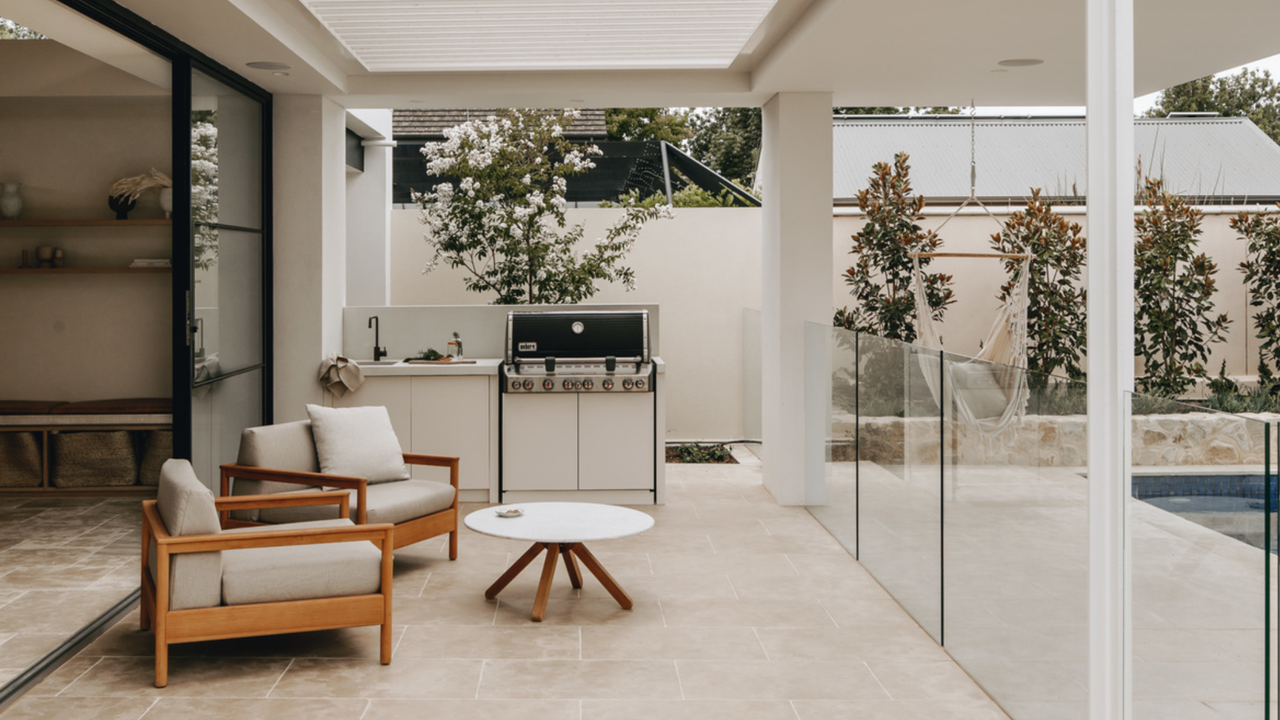
With the right layout, even the smallest of outdoor spaces can feel like your own private sanctuary. For city-dwellers, having any outside space at all can feel like the ultimate luxury, so it's understandable to want to make the most of it. And as we finally begin our long-awaited arrival into spring, there's no better time to get started than right now.
A small patio can often feel like a bit of a dead end, especially when so many popular garden ideas are catered to those with vast, sprawling outdoor spaces. It's easy to feel as though there's nothing much you can do, leaving you stuck with a sub-par patio. But with some special love and attention, and our experts' handy tricks, that doesn't have to be the case.

And, as it turns out, you don't need any major landscaping work for your tiny patio to feel larger; you just need the right layout, and our experts' three top tricks will help you achieve exactly that.
1. L-Shaped Patios

"One of the best layouts for a small garden is to build an L-shaped patio in a corner," suggests Loren Taylor, owner of Outdoor Fountain Pros.
L-shaped layouts are a go-to solution for spaces that are tight on space, including small kitchens. But this approach is just as well-suited to your outdoor areas as it is to your interior spaces.
Design your patio to extend along the length of two of your garden walls, leaving an empty space in the centre of your garden, for some evergreen plants and other greenery to grow.
As Loren explains, "The open space creates a sense of greater depth," making your garden feel larger as a result.
This illusion of more space comes from creating smart lines of sight through your garden, for example, Loren suggests, "A small narrow stepping-stone path can lead to plants at the back of the garden, focusing the viewer’s eye towards the front and creating the illusion of greater length." You want to create sight lines that extend your space, so winding paths leading to the furthest point in your garden are a great way to go.
2. Divide By Function

When you're working with limited space, it can be tempting to crowd as much as possible into each area. However, this can end up making your garden feeling more cramped and claustrophobic.
Instead, try separating your patio areas by function. Kat Aul Cervoni, founder of Staghorn NYC Landscape Design and The Cultivation by Kat, says, "If a backyard space allows, having two separate patio areas (one for outdoor dining and one for lounging) can be a fun way of creating multiple destinations even in a small backyard and can open up the opportunity for other shapes."
This could look like one small entertaining area, and another spot for gardening, or dining. If you have young children, this approach can help you in creating an area dedicated to play, without it taking over your entire garden.
"I delight in designing small spaces with as much functionality as possible, but there is a limit," warns Kat. This approach relies on a sense of restraint, so don't go overboard. Kat says, "Depending on the square footage the max number of key functions is two, e.g., dining and lounging."
3. Lead Upwards

As Loren mentioned, one of the key tools in making a compact patio seem larger is playing with sightlines. Knowing the direction your guests' gaze will fall, and working with that, can help create the illusion of more space — and when you're applying this philosophy to the outdoors, the sky is the limit, literally.
When designing your patio, unlike with small living rooms, you don't have the restriction of a low ceiling, so you have more freedom to enhance the sense of space by drawing the eye upwards.
This is exactly why landscape designer Caroline Ervin advocates the use of vertical elements in your patio design. She says, "Trellises, arbors and gates, structures like tuteurs with plants climbing upon, and even varied plant heights will soften and add verticality."
Bringing in these taller elements allows you to maintain as much surface area as possible, while still bringing more interest into your garden design — a vertical garden would be a great way to do this.
Your garden lighting can also help. Try illuminating any taller features, including trees, with outdoor uplighters. As Caroline explains, "This draws the eye up and outward at night, giving a sense that the space is larger than it may be."
Use these clever solar-powered lights to bring a soft illumination to your outdoor area, and when used beneath taller features, can help to make your small garden feel larger.
If you want to bring some luxury to your small patio, invest in one of Nordic Knots beautiful indoor-outdoor rugs. This checkerboard pattern is a particular favorite.
This lovely outdoor dining set is far smaller than the average, while still providing a decent amount of space for summertime dinners, making it a great addition to your patio setup.
Still on the hunt for design ideas for your small garden? Plenty of the hottest garden trends for 2026 are just as applicable to your tiny patio as they are a sprawling garden.
To stay on top of all the biggest trends and design tips, for your interiors and exterior spaces, make sure to subscribe to our newsletter.