
Get all your news in one place.
100's of premium titles.
One app.
Start reading
Capital & Main
Capital & Main
Ethan Bakuli

‘There’s Power in Numbers’

Erika LaFountain, left, works as an in-home caregiver for Ricky Johnson in Jackson, Michigan. Although Johnson, who has cerebral palsy and epilepsy, needs assistance with daily tasks like bathing, dressing and cooking, he feeds himself, plays video games on his PS5 and drives his electric wheelchair. Photo: Alejandro Ugalde Sandoval.

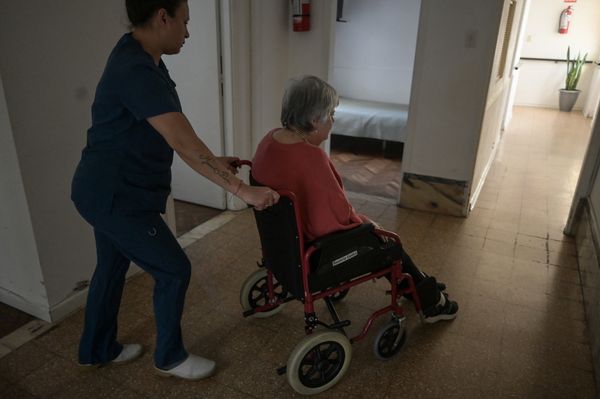
When Ravina Turner, 53, started working for Michigan’s Home Help Program around 2015, she was just grateful to get paid. For years, she’d missed work to care for her daughter, Davina, who has Crohn’s disease and colitis.

At first, the Home Help Program, run by the state’s Department of Health and Human Services, paid her about $300 a month for her work, allowing her to scale back her hours as a nursing assistant. By last year, she had become a full-time caregiver for Davina, and her wages had risen to $15.88 an hour. That is still well below the $35.59 per hour living wage for a single parent in Dearborn Heights, outside Detroit, according to the MIT Living Wage Calculator. 

Sign up to read this article
Read news from 100's of titles, curated specifically for you.
Already a member? Sign in here
Related Stories
Top stories on inkl right now
One subscription that gives you access to news from hundreds of sites
Already a member? Sign in here
Our Picks
Fourteen days free
Download the app
One app. One membership.
100+ trusted global sources.