Get all your news in one place.
100’s of premium titles.
One app.
Start reading
MusicRadar
MusicRadar
Entertainment
Trevor Curwen

“There’s plenty of output to use the pedal as a conventional boost with tonal options. And there’s a whole area of dirt to be explored”: JHS Pedals 424 Gain Stage review

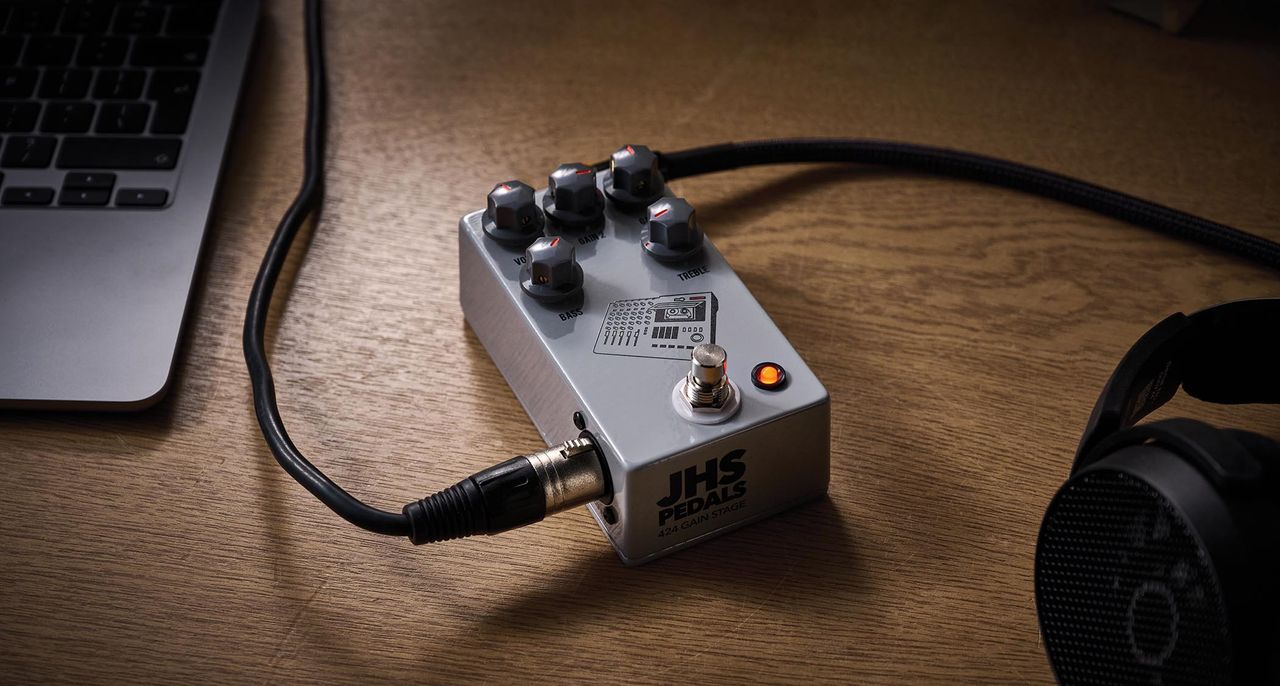
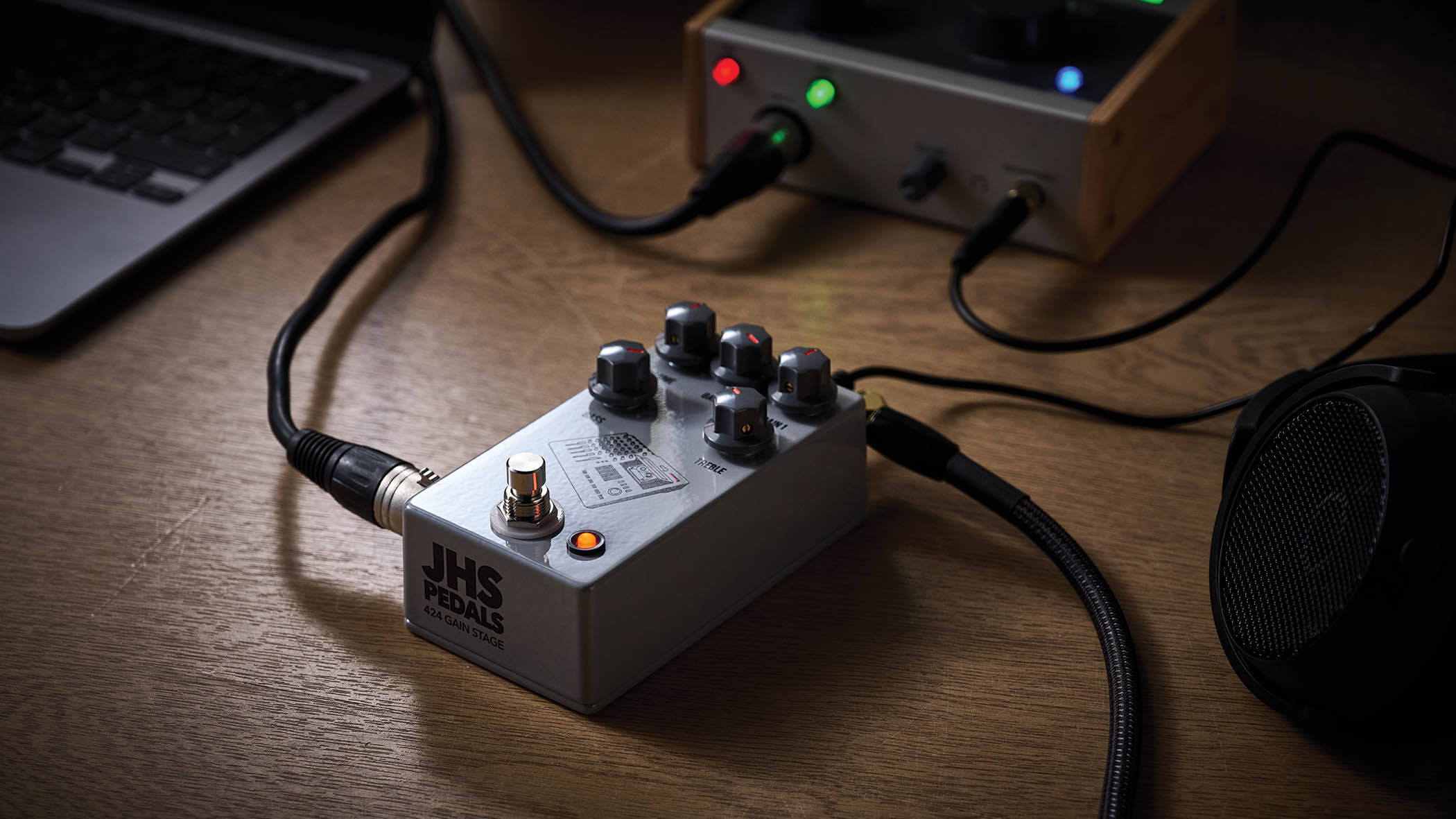
JHS Pedals 424 Gain Stage: this computer-gray stompbox is a preamp-cum-distortion that emulates the analogue mojo of the Tascam Portastudio.

What is it?

(Image credit: Future / Matt Lincoln)

Those of us who used a Portastudio multi-tracker back in the day might have thought we’d heard the last of it…

But now JHS Pedals has released the 424 Gain Stage, a new preamp/overdrive/distortion pedal that replicates a Tascam 424 MkI Portastudio’s signal path using its original op-amps.

The pedal is said to have been largely driven by artists such as US guitarist/producer Michael Todd Gordon – better known as Mk.gee – who employs a Tascam at the core of his rig. This musician was also name-checked by Eric Clapton, who said “[Mk.gee] has found things to do on the guitar that are like nobody else”.

Specs

(Image credit: Future / Matt Lincoln)
  • PRICE: $249 | £249 | €289
  • ORIGIN: USA
  • TYPE: Multi-gain stage preamp pedal 
  • FEATURES: Buffered bypass, 
  • CONTROLS: Volume, Gain 1, Gain 2, Bass, Treble, Ground Lift switch, Bypass footswitch
  • CONNECTIONS: Standard input, standard output, XLR output
  • POWER: 9V DC adaptor (not supplied), 50mA
  • DIMENSIONS: 66 (w) x 124 (d) x 55mm (h) 
  • CONTACT: JHS Pedals

Usability and sounds

(Image credit: Future / Matt Lincoln)

Gain 1 sets how much preamplification is added to the signal and is the equivalent of the Trim knob on the input of a 424. The original’s channel fader, providing a second gain stage, is represented by the Gain 2 knob. The signal can be tweaked by Bass and Treble knobs, and exits the pedal via a Volume knob, which equates to a Portastudio’s master fader.

It starts out delivering some clean but warm sounds, and when you experiment with various juxtapositions of the gain knobs you can start to add in grainy lo-fi grit until the whole sound is suffused with it. This can lead to some gnarly clipping distortions commensurate with pushing circuitry to its limits. Turned up full, it’s like a particularly snarky fuzz.

All of this is delivered with a degree of expressive dynamics that can see a cleanish sound transition into distortion with harder picking.

Verdict

Verdict: ★★★★½

Useful for flexibility, the 424 Gain Stagel has an output to an amp but also an XLR DI output that can be connected to a mixing desk or audio interface. The basic sound is arrived at via two gain knobs.

The 424 Gain Stage probably exists due to the success of Mk.gee, and anyone wanting to cop some of that flavour will find the pedal useful

Into an amp there’s plenty of output to use the pedal as a conventional boost with tonal options. And there’s a whole area of dirt to be explored by blending your amp sound with the 424’s dirtier tones.

The 424 Gain stage probably exists due to the success of Mk.gee, and anyone wanting to cop some of that flavour will find the pedal useful.

MusicRadar verdict: It’s a somewhat different take on a dirt pedal, and probably not designed for chasing what we generally think of as traditional guitar/amp tone. But it offers an alternative set of flavours and textures and is especially useful for anyone who records DI guitar. More colours in that paintbox is no bad thing.

Hands-on videos

R.J. Ronquillo

60 Cycle Hum

Guitar Guitar

Sign up to read this article
Read news from 100’s of titles, curated specifically for you.
Already a member? Sign in here
Related Stories
Top stories on inkl right now
One subscription that gives you access to news from hundreds of sites
Already a member? Sign in here
Our Picks
Fourteen days free
Download the app
One app. One membership.
100+ trusted global sources.