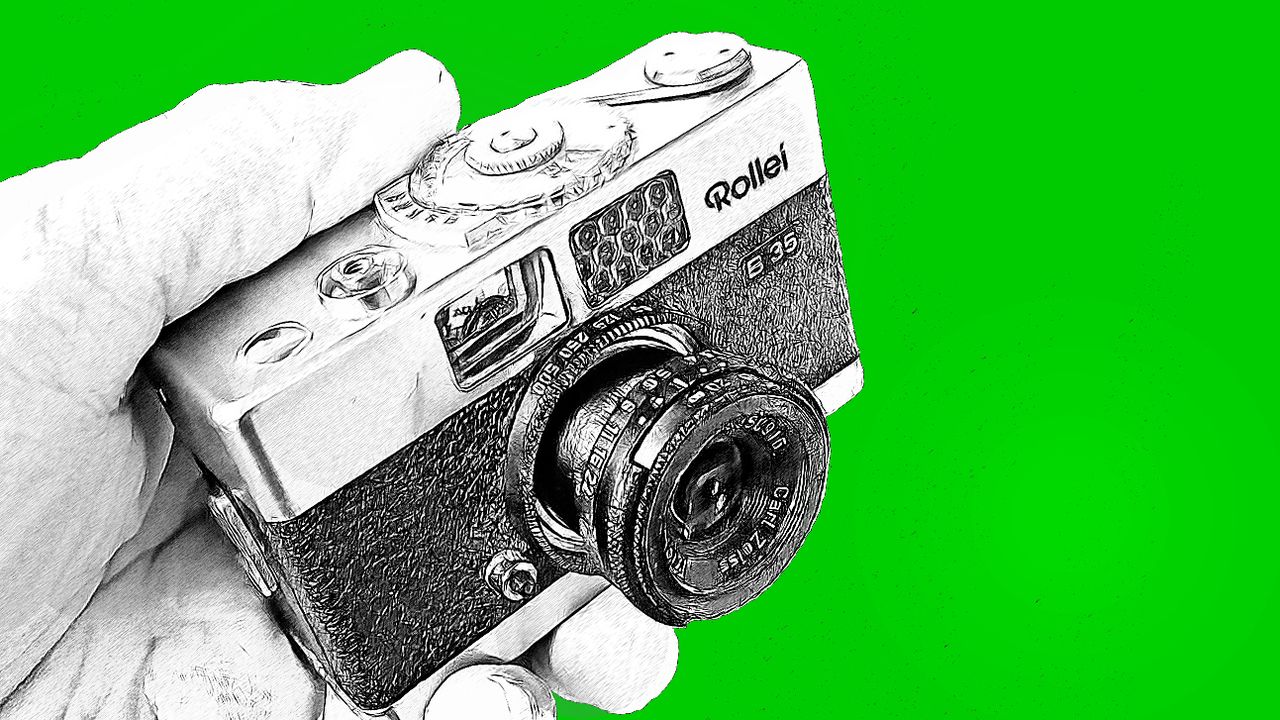
This is the story behind one of the greatest, and smallest, classic 35mm cameras... the Rollei 35. First, we need to know a little about its designer, Heinz Waaske.
Conscripted into the German Army during World War II, Heinz Waaske was severely wounded and taken prisoner. After the war, he worked as an apprentice precision mechanic for electronics firm Telefunken and then, in 1948, got a job at Wirgin, the makers of the Edixa cameras. He soon became head of the prototyping workshop there – quickly moving up the ranks to become its technical designer and, eventually, head designer, where he was responsible for many cameras but notably, the Edixa Reflex..
He saw the need for a small 35mm camera to compete with Yoshihisa Maitani's half-frame Olympus Pen. Waaske was convinced that buyers of 16mm sub-miniature and half-frame cameras chose them not because of the small film formats but because of the small size of the cameras. He thought the world needed a small, but full-frame 35mm camera. So on his own time, he designed and assembled one at home, having the mechanics in the Wirgin prototyping shop make the parts. One barely larger than a package of cigarettes.
In late 1964, Heinz finally presented the fully functional prototype to his employer, Heinrich Wirgin, who angrily asked, "So you have wasted time on your own construction in my prototyping workshop?" It was only then that Wirgin told his chief designer that he had already decided to end camera production, and Waaske was out of a job!
Waaske soon found new employment - this time at Franke & Heidecke, makers of the Rollieflex and Rolleicord 6x6 TLRs. When their managing director, Heinrich Peesel, accidentally got a glimpse of Waaske's tiny prototype, he quickly decided that the camera should be further developed for mass production, but using only parts from Rollei's suppliers.
Waaske's little camera was presented at Photokina in the fall of 1966 as the Rollei 35, with a Zeiss Tessar 40mm f/3.5 lens, and a precision-made diaphragm and shutter assembly made by Compur, using Waaske's patented design. Surprisingly, the early models did not have any form of built-in light-meter, though that was cured with the arrival of the Rollei B35 in 1969. The B35, which featured an uncoupled selenium cell meter (no battery required) sensitive from 25 to 1600 ASA. Later models would use the more sensitive CdS light meters. In case you were wondering, the “B” in B35 stands for “Belichtungsmesser”, or “exposure meter”.