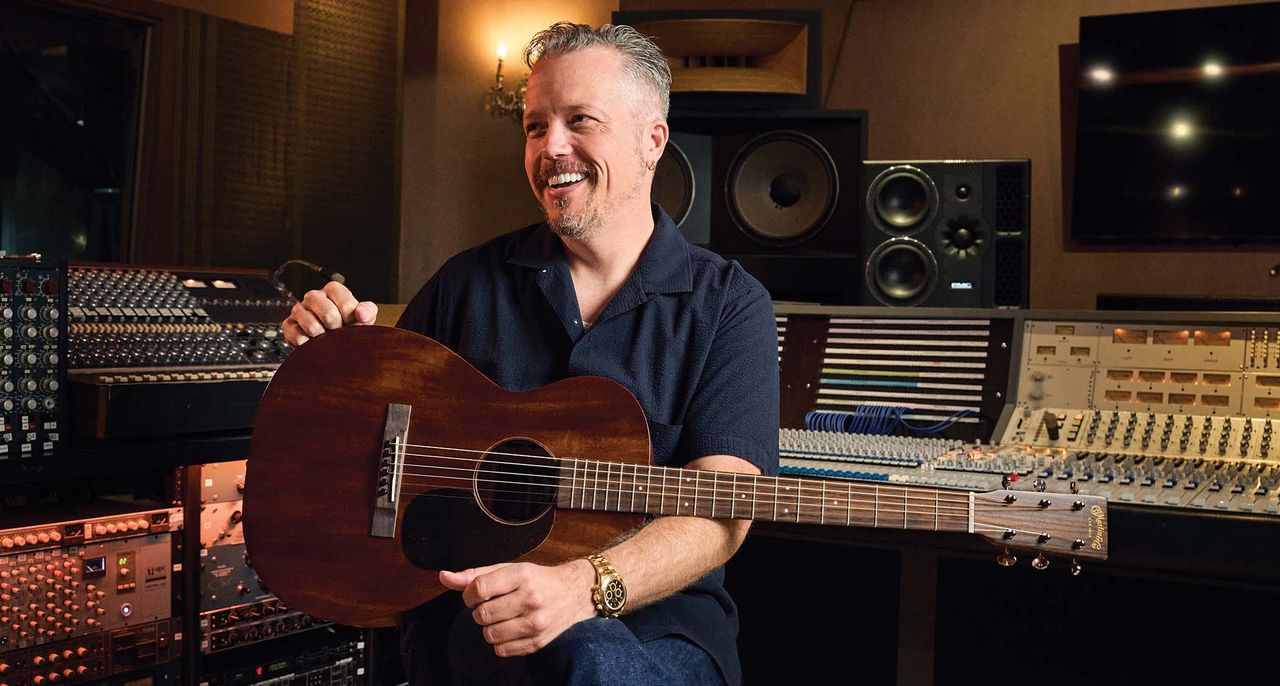
We always knew Jason Isbell could play. But even longstanding fans who remember the Alabama country star’s twisty fingerstyle on 2013’s Southeastern were stopped in their tracks by last year’s Foxes In The Snow.
Inspired by his divorce from former bandmate Amanda Shires and new relationship with artist Anna Weyant, this 10th album found Isbell relieving his trusty backing band, The 400 Unit, in favour of a virtuoso man-and-guitar format.

And as the 47-year-old tells us today, the model he chose proved pivotal, with Isbell not only tracking every song on a 1940 Martin 0-17 at Electric Lady Studios, but using that example as the jump-off for his two new signature acoustic guitars designed alongside the Pennsylvania luthier.
What can you tell us about the pre-war 0-17 you used on Foxes in the Snow?
I was spending a lot of time in New York, staying in my girlfriend’s apartment. Down here in Nashville, I’ve got a bunch of guitars. But up there, I just had space for something small. The shop that I love in Brooklyn – RetroFret – had this 1940 0-17. So I got that just to write and practise and have something to sit around and play.
When I went in to make the record, I took a few different acoustics – a pre-war D-18 and a couple other things – but pretty quickly figured out that the 0-17 did a better job than anything else.
I think it was partially because of the sonic space that guitar takes up. Y’know, it’s not big or boomy, and in a mix when it’s just guitar and vocal, I think sometimes that works better. The D-18 just sorta overpowered everything.
What was it about the 0-style shape – as opposed to a dreadnought – that you wanted to pursue for your signature model?
Well, I’m a pretty big guy – I’m 6ft 1in. And honestly, just from a logistical standpoint, playing a dreadnought on a recording while I’m singing is pretty difficult because that guitar takes up a whole lot of room.
If you’re making a guitar-focused record and doing a lot of instrumental stuff, the single-0 size works really well for me
If you’re making a guitar-focused record and doing a lot of instrumental stuff, the single-0 size works really well for me. I think this new signature guitar will be really good for singer-songwriters who go out and perform unaccompanied because it’s not dwarfing the vocal.
Let’s talk about your premium 0-17 signature model. The body is solid sinker mahogany, isn’t it?
Yeah. The wood was underwater for a long time – we’re talking thousands of years – and then I guess they pull the log out of whatever river bed it’s in and dry it over a period of time. It’s pretty shocking that it works as well as it does.
I’ve got a lot of old acoustics, but I don’t tour with them, so if I can find a new guitar that resembles them sonically, it’s very convenient. This 0-17 doesn’t have the harsh, brittle upper midrange of a new guitar; it retains the volume and punch of a newer piece of wood, but it sounds warmer.

Despite the compact size, it seems like your 0-17 has punchy projection.
Yeah, they scalloped the bracing on this one. It’s plenty loud enough. I mean, it’s one of those things where you look at the guitar and think, ‘This doesn’t look big enough to put out that much sound.’
But you can do pretty much anything with it. I’m sorta obsessed with guitars, so I try to have at least one really good example of every different type of tool I need. But if I was just going out by myself and playing solo acoustic shows, this would be a perfect guitar to take.
And the 0-17 neck is sinker mahogany, too?
Yeah, with the Brazilian rosewood ’board and bridge. The tough thing about the neck for Martin was getting the shape because on those pre-war guitars they were all hand-shaped.
My original 0-17 has a really interesting shape – the ‘V’ is more intense as you go further down the neck. So it took some work on the part of the folks at Martin to get that just right. But they got it. They nailed it.
That’s some pretty fluid fingerstyle on the Foxes in the Snow album. Do you think this acoustic will deal with more advanced picking?
Well, there’s enough space. The nut width is wide enough to where I can get my fingers in between. And it’s balanced. To me, that’s so important because if you’re strumming, you’re not hearing individual notes like when you’re playing fingerstyle, obviously.
So you don’t want the B to be quiet compared with the D. You need everything to have a uniform volume and intensity coming out of the instrument, almost like a piano.
Are there any differences between the original 1940 0-17 and your signature guitar?
The pickguard on my pre-war 0-17, apparently, somewhere within the first few years of that guitar’s life, somebody switched it out for one that was just a tiny bit larger. And so when they went to make this one, Fred Greene from Martin called and asked if I wanted my signature model to have the ‘proper’ pickguard. But I said, ‘No, let’s use the one that’s on the 0-17 that I own because I want it to be as close a replica as we can possibly get.’
The only other difference that I know of is the finish. It’s super-close, but it’s impossible to exactly replicate the lustre of a guitar that old. It’ll get there in time.

Was it important to you to offer a cheaper version of your signature in the form of the 0-10E Retro?
Yeah. I’ve played both of them a whole lot since they got finished and, truthfully, the less expensive model is a really great guitar and I’m not missing anything when I’m playing it. It intonates well. It plays well. The neck is a little bit smaller and faster – I think that’s probably because it was factory-made, rather than handmade.
When I put out my signature D-18 a few years ago, that was a really expensive guitar and made for a very limited run. And with these guitars, I don’t want to split the difference. I’d rather have one that’s more collectible and made in smaller numbers, then another that’s accessible to everybody, rather than just do something in the middle that doesn’t quite capture either of those categories.
So I’m very happy about the 0-10E Retro, too. Actually, I was shocked when I got it, at just how good it sounded acoustically. But it’s got the tuner and electronics, too, and sounds really good plugged in. It’s very, very usable.

Did it take a lot of meetings and prototypes to get these guitars over the line?
No, with just a handful of conversations, we were able to narrow it down. A lot of that is due to Fred. We’ve worked together on a lot of guitars in the past and he knows where the line is for me.
Y’know, if we’re going to replicate something, then I like it to be done as closely as possible. And he knows my preferences, as far as vintage guitars. He knows I like things that feel and sound old. So it didn’t take a whole lot of back and forth. Maybe part of it is also due to the fact that Martin’s just doing really, really good work right now.

You have a slightly quirky tradition of blasting your new acoustics with loud music. Does that actually help bed in the tone?
I mean, I don’t have any real way of quantifying it, but when I take a new acoustic guitar out of the case for the first time, it sounds new to me. So I leave it in front of the speakers and play some music – something with a lot of bass, like OutKast – just to keep the wood moving.
I think there are devices that do it now, where you can put them in the soundhole and they’ll just constantly keep the vibrations going. I used to set the guitar out on a table and prop an EBow up on either the D or G string and just leave it there until the battery ran out. I’ve done no scientific testing, but I think it helps to bring it in a little quicker.
Alongside the two acoustics, you’re releasing signature acoustic guitar strings in Martin’s new Era range.
The thing with acoustic strings is that they sound so different when they’re new on the guitar. That has sorta driven me crazy over the years. I hate that brand-new out-of-the-box sound. To me, it’s kind of like an avocado – you have five minutes when it’s perfect and then you’re either too early or you’re too late…
With the silk wrap on these strings, it helped make them sound a bit broken in. And that window – where the strings don’t sound too new and they’re not dead yet – has been extended because they’re treated.
You’ve also specified your usual 0.012 to 0.054 gauge.
Yeah. I do a bit of bending and I don’t hit it quite as hard as a real flatpicker, but I’m also not a soft-touch player. So 12s have just always worked for me on an acoustic, and I use 10s on electric. And it’s, like, the least exciting gauge because everybody wants to say, ‘Well, I use 13s,’ or if you’re a Billy Gibbons fan, then 7s or 8s or something. But I’m right in the middle of the road as far as the gauge goes.

Do you have a particular personal history with Martin guitars?
I’ve always held Martin in the highest regard. When I was a kid, I had a lawsuit guitar – y’know, one of those from the late ’70s when everybody was ripping Martin off
I’ve always held Martin in the highest regard. When I was a kid, I had a lawsuit guitar – y’know, one of those from the late ’70s when everybody was ripping Martin off. And then there was an uncle of mine who had a herringbone D-28 he would bring by, and everybody would pass it around and play it. I just remember feeling, like, ‘Oh, this is as good as it gets. This is the best possible guitar you could play.’
Do you remember the first Martin you actually owned yourself?
I sure do. Our van had gotten broken into in Dallas and my acoustic guitar was in the gear that got stolen. So I contacted Martin to see if they would send me a loaner, and they suggested we do an artist deal.
So the first Martin I had was a D-41 that I used on the road for a long time. It was just a little too much inlay for me. I’ve gone to D-18s since then because I like it to look a little more simple. But that was the first one. I think I paid half price for it – because I wasn’t helping Martin sell any guitars back then!
- For more on Martin’s Jason Isbell signature guitars and strings, see Martin Guitar.
- This article first appeared in Guitarist. Subscribe and save.