Get all your news in one place.
100’s of premium titles.
One app.
Start reading
MyLifeXP
MyLifeXP
Noopur Kumari

The Village Where People Still Leave Food for Hanuman at Night

High in the quiet mountains of Uttarakhand, where mist wraps the hills and silence feels sacred, lies a mysterious village with a tradition that surprises many visitors. Every night, after sunset, villagers place food outside their homes. Not for animals. Not for guests. But for Hanuman. In the village of Dronagiri, faith is not just remembered in temples. It is lived through quiet rituals that have survived for generations. And locals believe something extraordinary still happens after dark.

The Legend That Shaped the Village

Dronagiri Mountain Linked to Ramayana Legend
<p>The Himalayan region believed to be connected with Hanuman’s search for Sanjivani.</p>

The story begins in the epic Ramayana. During the great battle in Lanka, Lakshmana was severely injured. The only cure was a rare herb called Sanjivani that grew in the Himalayas. Sent on this mission, Hanuman reached the mountain near present-day Dronagiri. Unable to identify the herb, he lifted the entire mountain and carried it back. This legendary act transformed the region into a sacred landscape that devotees still associate with divine power.

The Night Ritual That Continues Today

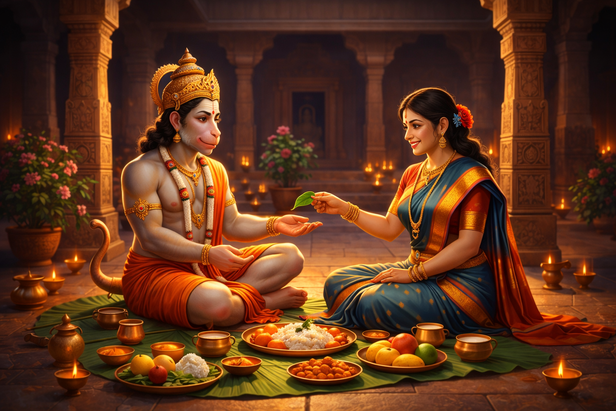
Food Offerings Placed Outside Homes at Night
<p>A quiet nightly tradition believed to honor Hanuman.</p>

In parts of Dronagiri, some families maintain a quiet ritual. After dinner, small portions of food are placed outside homes or near sacred spaces. The offering is simple. Often it includes roti, fruit, or prasad. Villagers do not treat this as a dramatic ceremony. Instead, it is a humble gesture of devotion toward Hanuman. Many believe the land itself remains blessed because of the ancient legend connected with the mountain. For them, the ritual symbolizes gratitude rather than expectation.

Why the Tradition Still Survives

Himalayan Village Preserving Ancient Beliefs
<p>Faith and folklore continue shaping daily life in remote regions.</p>

In many modern cities, traditions fade quickly. But remote Himalayan villages preserve customs for centuries. In Dunagiri, spiritual stories are part of daily life. Elders pass down legends from the Ramayana, reminding younger generations of their cultural roots. The ritual of leaving food symbolizes respect for the divine and for nature. Even villagers who interpret the practice symbolically continue it because it connects them to their history, identity, and community.

Visitors Who Come Seeking the Mystery

Over the years, curious travelers and spiritual seekers have visited Dronagiri. Some arrive after reading stories about Hanuman and the Sanjivani mountain. Others come simply to experience the peaceful spiritual atmosphere. Visitors often describe the place as unusually calm, surrounded by dense forests and ancient temples. Whether one believes the legends literally or symbolically, the experience leaves a lasting impression about the depth of faith preserved in Himalayan culture.

What This Tradition Teaches Us

The ritual in Dronagiri is not just about leaving food outside. It reflects something deeper. Faith does not always need grand temples or loud ceremonies. Sometimes it survives quietly through simple acts repeated over generations. The villagers believe that devotion toward Hanuman protects their land and brings blessings. Whether seen as myth, symbolism, or living tradition, the story reminds us that ancient beliefs still shape how many communities experience spirituality today.

Devotion and Faith in the Himalayan Mountains

In a world driven by technology and speed, the quiet ritual of Dronagiri feels almost timeless.Every night, food placed outside homes becomes more than an offering.It becomes a reminder of an ancient story, a sacred mountain, and a devotion that refuses to fade.Some may call it folklore.Others call it faith.But for the villagers living in the shadow of the Himalayas, one belief remains constant.Where the legend of Hanuman once unfolded, devotion still walks quietly through the night.

Unlock insightful tips and inspiration on personal growth, productivity, and well-being. Stay motivated and updated with the latest at My Life XP.

Frequently Asked Questions (FAQs)

1. Where is Dronagiri village located?

Dronagiri is a small Himalayan village located in the state of Uttarakhand. It lies in the Kumaon region near the higher Himalayan ranges and is known for its spiritual traditions and connection with ancient legends.

2. Why is Dronagiri connected to Hanuman?

According to the epic Ramayana, this region is believed to be linked with the story where Hanuman lifted a mountain while searching for the life-saving herb Sanjivani to save Lakshmana during the battle in Lanka.

3. Do villagers really leave food outside at night?

In some households and local traditions around Dronagiri, people place small food offerings outside as a gesture of devotion toward Hanuman. The practice is seen more as a symbol of faith and gratitude.

4. Is the story historically proven?

The connection between the village and the Ramayana legend is part of cultural and religious belief rather than confirmed historical evidence. However, the story remains deeply respected in local tradition and spiritual folklore.

5. Can tourists visit Dronagiri village?

Yes, travelers and pilgrims often visit the region of Dunagiri to explore temples, experience the peaceful Himalayan environment, and learn about the spiritual legends associated with the area.

Sign up to read this article
Read news from 100’s of titles, curated specifically for you.
Already a member? Sign in here
Related Stories
Top stories on inkl right now
One subscription that gives you access to news from hundreds of sites
Already a member? Sign in here
Our Picks
Fourteen days free
Download the app
One app. One membership.
100+ trusted global sources.