Few shows have proved quite as chillingly prescient as The Handmaid’s Tale.
The Hulu show – adapted in turn from Margaret Attwood’s 1985 book – has become a kind of terrifying shorthand for the real-life curtailing of women’s rights, the rise of the far right and even the tradwife trend.
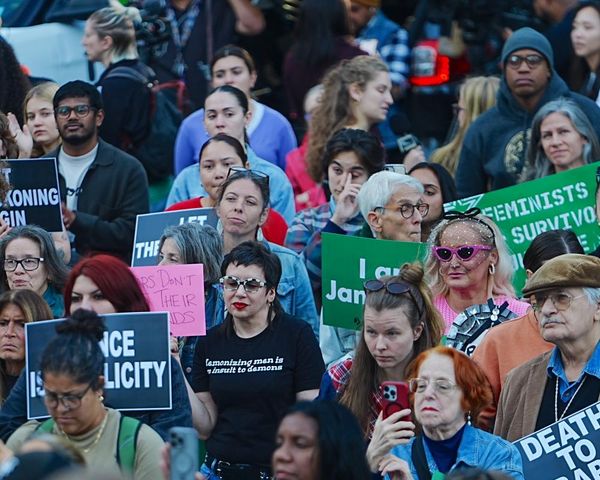
Women in red Handmaid’s cloaks have walked through Capitol Hill; its story of how America transformed into Gilead feels more like a warning tale, these days, than anything fictional. The show ended in 2025, but because society is still sliding further into the abyss, the arrival of a successor show still feels worryingly timely.
This is The Testaments. Also adapted from an Atwood book, the show takes us away from central character June (Elisabeth Moss), who ended her journey by liberating Boston from Gilead’s control and finding (some sort of) peace as the architect of its downfall.

Wisely, the show doesn’t linger on this, instead choosing to focus on the way regimes groom and brainwash their children. We’re back in Gilead, a few decades later, with Agnes (Chase Infiniti). She’s the daughter of a commander, who lives a life of gilded luxury: attending Aunt Lydia’s school, socialising with other elite girls and praying for the day her period arrives, so she can be married off and start procreating for the good of the nation.
She’s not quite happy, though. As Agnes puts it, sometimes she feels less like a precious flower and more like a “prized pig”. And into this arrives Daisy, a ‘Pearl Girl’ (aka, a reformed woman of sin from outside Gil’ead, played by Lucy Halliday) whom Agnes is instructed to watch over.
Of course, nothing is what it seems, and soon the stage is set for an awakening of sorts, as the girls slowly realise just what kind of world it is they’ve been doomed to live in, even as they attend tea parties, learn the art of sewing and gossip about which commander is interested in which girl – an aesthetic echoed by the show, which is all pristine lines, flowing dresses and gorgeous lighting, except when the real world intrudes in the form of hanged bodies and gunmen.
The Testaments excels in blending beauty and unease; in undercutting innocence with perversion. In one scene, the school is treated to an unexpected visitor – a man the Aunts say has ‘sinned’. Asked how to punish him, the girls immediately start screaming. As they howl for blood, and while Daisy looks on, horrified, the man’s hand is cut off via rotating saw.

In another, a trip to the dentist takes a dark turn when the dentist in question starts fondling one of the girls’ breasts while calling her a “big girl.” The examples keep coming, and it never gets less shocking to watch.
Fortunately, The Testaments not just about all the many ways men seek to exercise power over women. It’s also about the ways in which women become complicit in that abuse, and in the ways they try to break free from it.
As the series continues, the noose tightens around the necks of the young women at the show’s centre, and things become slowly, dizzyingly claustrophobic. In this, especially, Infiniti and Halliday are especially good – conveying their panic and fear with nothing more than a flicker of their eyes, even as their faces have to stay carefully blank.
There’s no case of sequel-itis here. The Testaments feels just as urgent as its predecessor – and just as darkly enjoyable.
The Testaments is streaming on Disney+ from April 8