Get all your news in one place.
100's of premium titles.
One app.
Start reading
LiveScience
LiveScience
Stephanie Pappas

'The system is likely to reach a breaking point': Major Italian volcano is speeding toward a transition, and a major eruption could be on the way

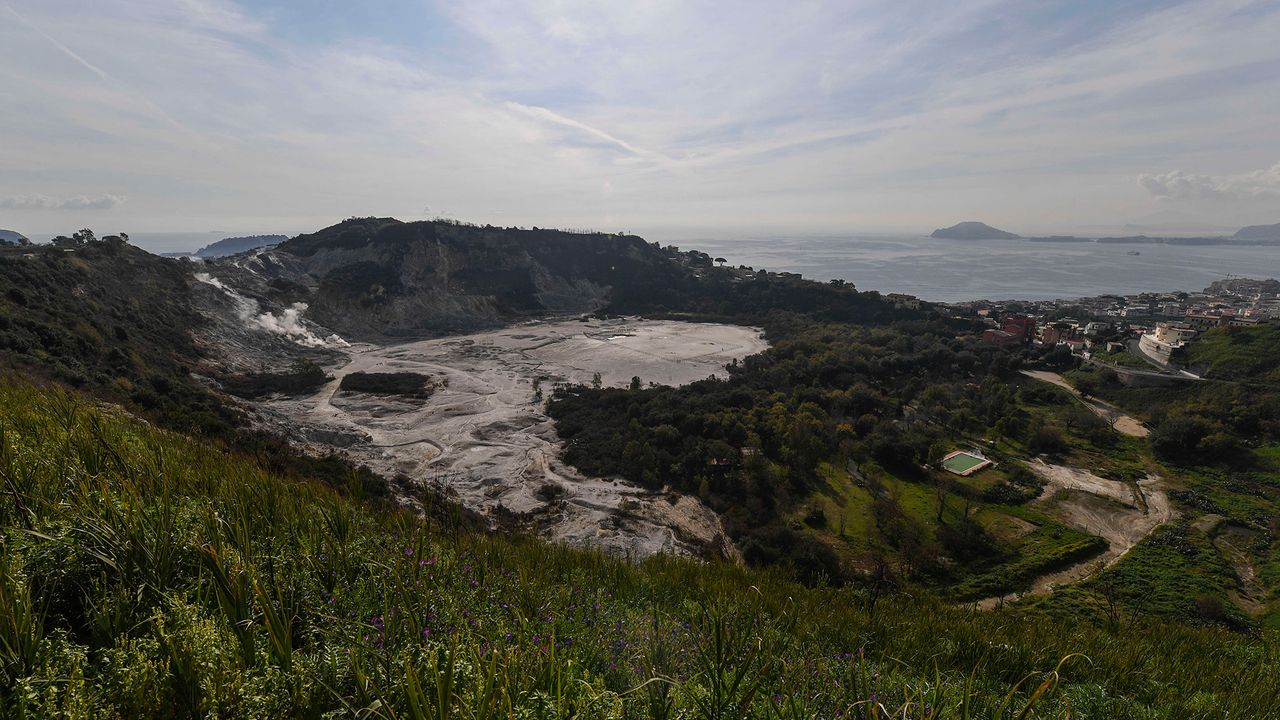
An aerial view of a caldera surrounded by lush countryside with the ocean in the background.

Campi Flegrei, a volcanic caldera west of Naples, is speeding toward a transition within the next decade, a new study suggests, but researchers can't yet say whether that transition will be an eruption or some other change in the volcano's internal plumbing.

The caldera, also known as the Phlegraean Fields, is home to about 500,000 people who would be at risk in the event of an eruption. The caldera stretches about 9 miles (15 kilometers) in diameter and formed in a massive eruption 40,000 years ago. Other, smaller eruptions have happened since, including an explosive one in 1528 that built Monte Nuovo, a 433-foot (132 meters) cinder cone.
In the past 75 years, Campi Flegrei has been restless, with periods of particularly frequent earthquakes and ground uplift in the 1950s, 1970s and 1980s, which weakened the caldera's crust. Since 2005, the volcano has been increasingly active, and the floor of the caldera has risen about 4.6 feet (1.4 m), possibly indicating the movement of volcanic gases below the surface. The new research suggests that this increased activity has reached a point where even its acceleration is accelerating, indicating that something will change soon. What that "something" is remains a question, however.

"Our paper identifies when the system is likely to reach a breaking point, but it cannot determine what will happen at that breaking point with the current data," said study first author Davide Zaccagnino, a postdoctoral researcher who studies geological hazards at the Southern University of Science and Technology in Guangdong, China.

The paper is currently under review for publication in a peer-reviewed journal but has yet to be formally published; Zaccagnino and his colleagues posted it ahead of publication on the preprint database arXiv.

The researchers used a physics-based model to determine whether Campi Flegrei's accelerating activity falls into one of two categories. One is exponential acceleration, in which the speed of activity increases at a fixed rate. The other is called finite-time singularity, which means the acceleration itself is accelerating. Like a car with a stuck brake, the faster you go, the faster your rate of speed picks up.

This is important because it's not just an uptick in activity that determines whether a volcano will blow its top. The key, Zaccagnino told Live Science, is whether the crust has reached the point that it can no longer support the accumulating stress. It's like an athlete at the end of a marathon: A single step they could have taken with ease at the starting point might be the one that leads them to collapse at the finish line.

In other words, those previous periods of unrest in the 20th century matter, said Christopher Kilburn, a volcanologist at University College London who was not involved in the research.

"At each emergency, the crust is being stretched just that bit further, so the later emergencies are building on the previous ones," Kilburn told Live Science. .

What Zaccagnino and his colleagues found was that at Campi Flegrei, the pattern of seismicity fits a pattern of accelerating-accelerating change. That means the process feeding this change is self-feeding. Both ground uplift data and earthquake data indicate that this increasing rate of acceleration can self-sustain until around 2030 to 2034. At that point, something's got to give.

The movement of deep magmatic fluids are driving this process, fracturing and uplifting the brittle crust of the caldera, Zaccagnino said. What isn't clear is what happens when that process hits its end point. The nature of that transition could be an eruption, or it could be some other geological change that shifts the activity or settles it down. Nor does the research say what size or kind of eruption might occur, if one does, Kilburn noted.

Related stories

Zaccagnino and his team are working to build a system that updates this activity prediction every few months based on the latest earthquakes and uplift from Campi Flegrei. The idea is to have a continuous, time-stamped record of forecasts for use by emergency management agencies, he said.

Kilburn warned that he would be leery of putting a potential date on an upcoming eruption, but he said the paper was an important additional piece of information pointing to fundamental shifts in how Campi Flegrei is behaving.

"Things are changing," he said, "and, therefore, past experience is not necessarily a good guide to the future."

What do you know about volcanos? Test your knowledge with our volcano quiz!

Sign up to read this article
Read news from 100's of titles, curated specifically for you.
Already a member? Sign in here
Related Stories
Top stories on inkl right now
One subscription that gives you access to news from hundreds of sites
Already a member? Sign in here
Our Picks
Fourteen days free
Download the app
One app. One membership.
100+ trusted global sources.