
Get all your news in one place.
100's of premium titles.
One app.
Start reading
TechRadar
TechRadar
Desire Athow

'The storm is here': Why you and your neighbors may be paying multibillion-dollar bill for AI data centers right now — but that may not last long as more US states join revolt against unjust 'socialist' approach to electricity bills

You and your neighbors may be paying multibillion-dollar bill for AI data centers right now .

Your electricity bill may soon carry hidden costs tied to a technology boom you never asked for — and in some states, utilities are already spending billions to support it.

Across the United States, the rapid expansion of AI data centers is forcing major grid upgrades at a pace rarely seen before.

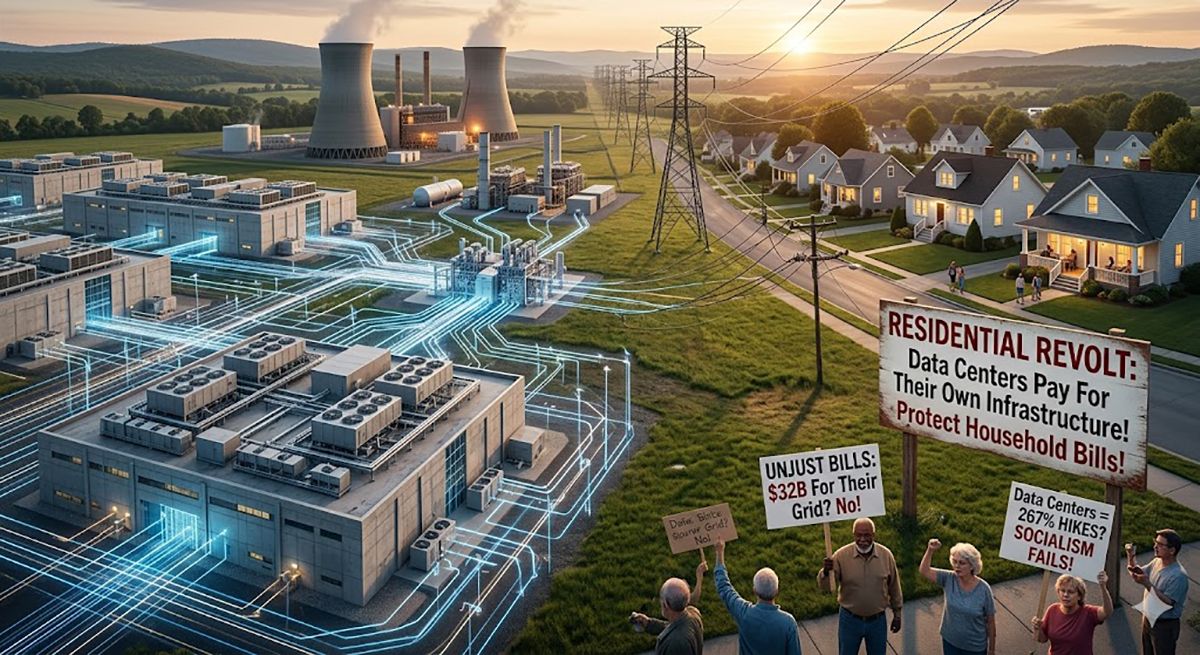
These hyperscale facilities, built to train and run artificial intelligence models, can consume as much electricity as entire towns, but in many cases, the cost of building the new infrastructure needed to support them is not being paid by the companies driving the demand. Instead, it is spread across residential customers through higher rates.

That practice is now under growing scrutiny from lawmakers, regulators, and grid operators who warn that households are being asked to subsidize private infrastructure.

Not shifting costs onto other customers

On April 24, regulators in Wisconsin issued a ruling requiring data centers to cover the full cost of the power infrastructure they require, explicitly stating that utilities “must not shift those costs onto other customers.”

The decision, issued by the Wisconsin Public Service Commission, marked a shift from policy debate to enforceable regulation built around the beneficiary-pays principle.

Similar legislation has already passed in states including Florida and Pennsylvania during the current session, suggesting the approach is spreading quickly as more states move to prevent residential customers from absorbing the cost of private infrastructure.

At the same time, questions are being asked about whether projected data center demand will materialize at the scale utilities once expected.

The Electric Reliability Council of Texas (ERCOT), which manages electricity for roughly 90% of the state, recently acknowledged that its long-term demand forecasts are “likely overstated,” raising concerns that consumers could end up funding infrastructure built for growth that never fully arrives.

I wanted to know more, so I spoke with Dr. Mark McNees, a Florida State University Jim Moran College of Entrepreneurship professor and author of the policy brief Who Pays for the AI Grid? [PDF]

He explained how AI data center expansion is driving electricity costs onto households, why utilities risk overbuilding infrastructure based on uncertain demand, and what states can do right now to ensure companies pay for the grid capacity they require.

  • A storm is brewing when it comes to the real cost associated with AI data centers. How big is this storm, and what are the risks if left unchecked?

The storm is not coming. It is here, and it arrived faster than most policymakers expected.

The U.S. Energy Information Administration projects that electricity demand from data centers will double by 2030. That number sounds abstract until you translate it into consequences on the ground.

Pennsylvania residential electricity rates rose 21.7% in 2025. West Virginia utility bills are now exceeding the average monthly mortgage payment in some households. Maryland electric bills are set to rise this summer as PJM, the grid operator serving 65 million people, struggles to handle data center demand it wasn't built to handle.

This week, CNBC reported that the data center issue is threatening incumbent politicians in four competitive Pennsylvania congressional races. This is no longer an energy policy debate. It is a kitchen table economic issue in swing districts across the country.

The structural problem is straightforward. A data center connecting to the existing grid triggers infrastructure upgrades: transformer upgrades, new transmission lines, and substation expansions.

Those costs get socialized through the rate base, meaning every household and small business in the utility's territory pays a share of infrastructure they never asked for and will never directly use. The data center captures all of the commercial benefits. The ratepayer absorbs the capital cost.

The risk of being left unchecked is not just high electricity bills. It is a stranded infrastructure. If a utility overbuilds to serve demand projections that later prove inflated, and data center demand shrinks because AI efficiency improves or contracts expire, those capital costs do not disappear. They sit in the rate base for decades, paid by ratepayers.

That is cost externalization at one remove, and current policy frameworks in most states do not require regulators to stress-test demand projections before approving the infrastructure investment.

  • Do you see a parallel in which some of the same hyperscalers leveraged telco infrastructure to build their empires? Remember the whole Net Neutrality debate from early 2000?

The parallel is almost exact, which is worth noting.

In the Net Neutrality era, the same companies now building data centers successfully argued that they should not be required to pay for the bandwidth their platforms consumed. Telecom companies had built the pipes.

Tech companies rode those pipes to trillion-dollar valuations. When telecom providers argued they should be able to charge heavy users more to recover infrastructure costs, the tech industry responded with a coordinated campaign: charging heavy users more would stifle innovation, hurt consumers, and concentrate power in the hands of incumbent carriers.

The argument now is identical, just one layer deeper in the infrastructure stack. Instead of pipes, it is the physical grid. And the response from the tech industry follows the same script: requiring data centers to fund the infrastructure, their load demands will slow AI development, cost jobs, and hurt the communities that host these facilities.

The difference this time is that the cost of physical infrastructure is harder to obscure. You cannot download more transmission capacity. You have to build it, and it costs real money, and someone has to pay for it.

The question is simply whether the entity creating the demand is the households and small businesses on the same grid, who had no say in the matter.

There is also a timing dimension that did not exist in the Net Neutrality debate. The telecom infrastructure was already built before the dispute.

The grid infrastructure for AI data centers is being decided right now, in state legislatures and regulatory proceedings across the country.

The policy window is open and moving fast. That is different from a Net Neutrality fight over infrastructure that had already been paid for.

  • Given how quickly things are evolving, can anything be done right now to eliminate the problem of socializing the cost of private grid infrastructure?

Yes, and three states have already proved it this year.

Florida passed SB 484 this legislative session. Pennsylvania passed HB 2606. This week, the Wisconsin Public Service Commission issued a ruling requiring data centers to cover the full cost of their energy needs, with explicit language that those costs must not be shifted to other customers.

The policy fix is not a complicated concept. The entity that creates the load funds the infrastructure it demands. The implementation question is harder because utilities and data center developers will argue over how to calculate the attributable cost of a connection and what to do when demand fluctuates.

Those are solvable technical problems. The harder work is political, because the same companies building these data centers are also significant for employers and political donors in the communities where they operate.

Practically, what you can do right now: require data centers to fund the capital costs of any transmission or distribution upgrades needed to serve their connection. Require them to post a bond or performance guarantee against the demand they project. And require utilities to submit demand durability analysis before regulators approve major infrastructure investments, so that projections are scrutinized rather than accepted at face value.

I am also in direct conversations with Florida state regulators on the implementation side of SB 484, so I have visibility into how the enforcement piece is actually taking shape on the ground.

The White House extracted a pledge from major tech hyperscalers to voluntarily fund grid upgrades. That is a start, but a pledge without an enforcement mechanism is a press release. The states writing enforceable law are ahead of the federal posture on this.

  • It's not a secret that the US grid is almost at breaking point, thanks partly to a lack of investment and long-term vision. Could it be that the grid itself becomes the hard upper ceiling on how fast and how far data centers are built?

In some markets, it already is.

Northern Virginia is the largest data center market in the world. Dominion Energy has been telling developers for two years that available substation capacity in parts of that market is exhausted. Some developers are waiting years in interconnection queues.

High-voltage transformers currently have delivery timelines of 24 to 30 months, with some specialty equipment at four years. You cannot build a grid at the pace Big Tech wants to build data centers. The physics and the manufacturing supply chain do not cooperate with the investment timeline.

The smarter operators have already figured this out and are building on-site generation specifically to bypass the interconnection queue. Meta's facility in Aiken, South Carolina, installed 100 megawatts of on-site solar to reduce its reliance on the grid.

Google's Project Pegasus in Georgia includes a dedicated on-site substation. This is not altruism. It is a faster path to capacity than waiting for a utility to upgrade infrastructure for years.

The risk is that operators who cannot or will not fund their own generation continue to rely on the existing grid, exhaust available capacity, and force utilities to request rate cases to fund expensive upgrades.

That cycle is already running in Michigan, Maryland, and elsewhere. The grid is not breaking, but it is bending under load it was not designed to carry, and the repair bill is landing on ratepayers.

  • Isn't there a risk that many of the clients using the power-hungry AI data centers are just buying time until something better comes up, therefore removing, in their views, the need to invest sustainably in the grid?

This is the most underreported risk in the entire debate, and almost no one is discussing it at the policy level.

Some of these buildouts are not driven by measured demand projections. It is driven by competitive fear. Companies are reserving capacity not because they know they will use it, but because they cannot afford to let a competitor have it first.

That is not a durable, long-term electricity demand. It is fear-driven capital expenditure, and fear-driven capex tends to correct when the fear subsides or the competitive dynamics shift.

AI efficiency is also improving at a rate that electricity demand projections do not fully account for. The DeepSeek announcement earlier this year demonstrated that models can produce comparable output at dramatically lower cost.

If the energy footprint per inference drops by 70 or 80 percent over the next four to five years, a significant portion of the grid infrastructure currently being built will not be needed at the projected scale.

The infrastructure, however, will already be built, and the cost will already be in the rate base.

ERCOT's admission this week that its long-term Texas demand forecast is "likely overstated" is the most important sentence published in the energy industry in months.

The organization responsible for keeping the lights on for 90% of Texas is publicly saying it may have been oversold on data center demand projections. That is the durability problem with demand made explicit and on the record.

The policy fix is a demand stress-test requirement. Before a utility can get regulatory approval to build major new infrastructure to serve data center demand, it should be required to demonstrate that the demand is contractually committed, not just projected.

Regulated utilities should not be allowed to build speculative infrastructure on the backs of ratepayers, even when a tech company is doing the speculation. In most states right now, they can.

  • Based on your research, is it feasible for these companies to become energy-independent, or is the reliance on the public grid an unavoidable feature of the current AI gold rush?

Partial energy independence is feasible right now. Full independence is a longer-horizon question.

Solar paired with battery storage can realistically cover 30 to 60 percent of a large data center's energy load at current economics, depending on location, land availability, and storage capacity. It is now the cheapest and fastest way to deploy new generation capacity, faster to build than gas turbines, and cheaper per megawatt-hour over a 20-year horizon.

When Meta built its Aiken, South Carolina, facility, it partnered with a solar developer to install 100 megawatts of on-site generation. That was not a sustainability statement. It was the fastest path to the capacity it needed.

For baseload power at hyperscale, 24 hours a day, seven days a week, the current technology stack hits a ceiling. Battery storage at the scale required to power a one-gigawatt data center for extended periods remains cost-prohibitive.

Small modular nuclear reactors are the most credible path to full energy independence for large facilities, but commercial deployment at scale is eight to ten years away under optimistic scenarios.

The grid as a backstop is unavoidable in the near term. Which is exactly why the accountability argument matters. If you are going to rely on the public grid as your emergency capacity, you should fund the infrastructure that capacity requires.

The companies making the largest AI infrastructure investments in history can afford to pay for the grid upgrades their facilities demand. The question is whether they will be required to, or whether they will continue to externalize that cost while internalizing the commercial benefit.

The states that have answered that question clearly are ahead. The rest are still deciding.

Sign up to read this article
Read news from 100's of titles, curated specifically for you.
Already a member? Sign in here
Related Stories
Top stories on inkl right now
One subscription that gives you access to news from hundreds of sites
Already a member? Sign in here
Our Picks
Fourteen days free
Download the app
One app. One membership.
100+ trusted global sources.