
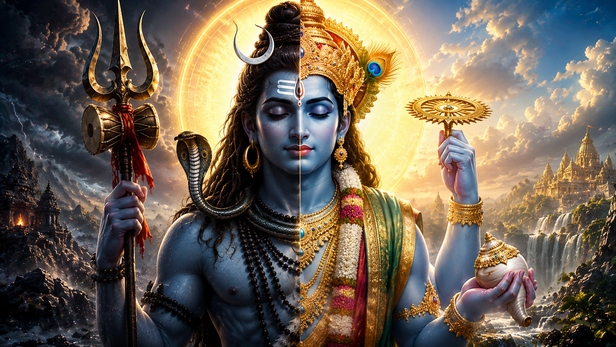
At the heart of the form known as Harihara lies a powerful and often overlooked reality about ancient Hindu spirituality, which is that devotion was not always harmonious. In early periods, followers of Shiva and Vishnu sometimes engaged in intense theological debates over supremacy, each side believing their chosen deity to be the ultimate source of creation and liberation. These divisions were not merely philosophical but deeply emotional, shaping identities and practices across regions.
According to Puranic traditions, especially narratives connected to the Skanda Purana, these disputes reached a point where divine intervention became necessary, and the resolution was not through victory of one over the other but through a profound revelation, where Shiva and Vishnu merged into a single form to demonstrate that their essence was never separate to begin with. This was not just mythology meant to entertain. It was a spiritual correction aimed at dissolving ego driven divisions among devotees, reminding them that the divine cannot be confined within human categories of superiority.