
It’s fair to say that the arrival of the Kemper Profiler amplifier in 2011 was a disruptive event in the digital amp modeling niche market. Up until that point, we’d been happy to take the software and hardware we’d been given by manufacturers and use it with varying degrees of success.
Christoph Kemper’s radical approach was to use his proprietary software to extract the DNA of any amplifier’s sound and save it as a unique model (the Profile) that could then be tweaked with EQ, effects and so on.

From the start, the Kemper polarised opinions – there were players who got it and others who didn’t – but over time the all-important software has been vastly developed and improved.
Consequently, Kemper has kept up with the competition and continues to be relevant, with new concepts such as Liquid Profiles and seriously powerful new products including the Profiler Stage floorboard and Kabinet. We’ve also seen Kemper’s Rig Manager software extended to mobile devices running Android and iOS.

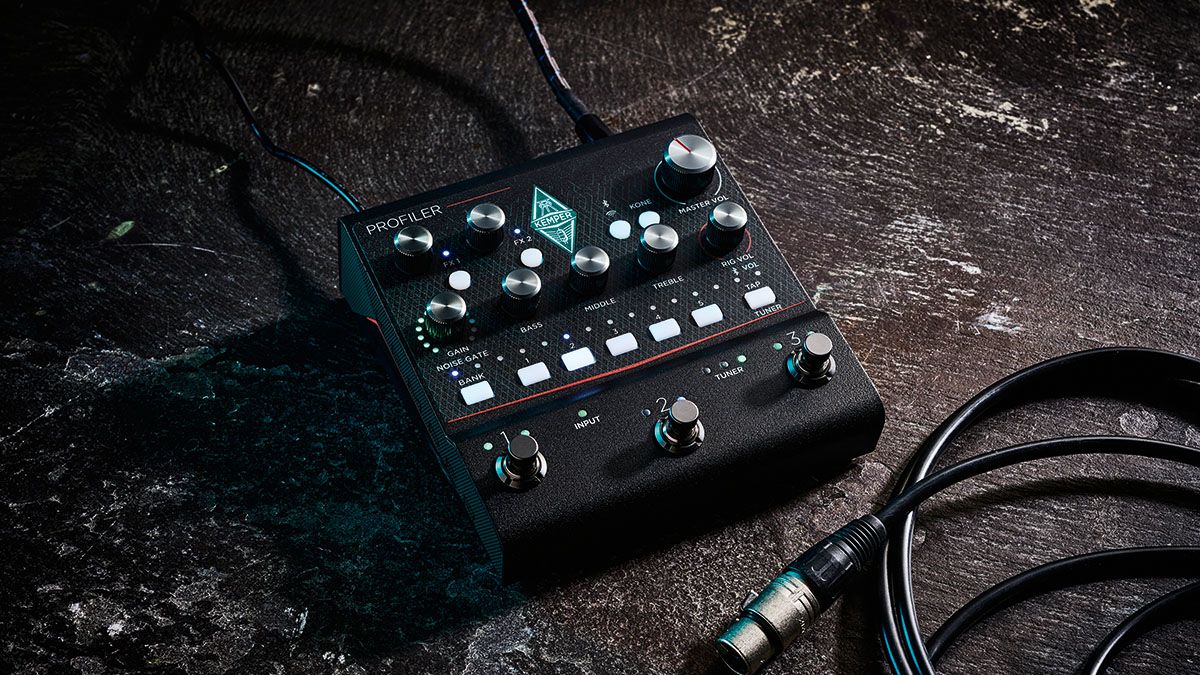
Now there’s another hardware addition that’s going to be of particular interest to pedalboard users, the Profiler Player. As the name suggests, this is a compact Kemper that focuses on playing your favourite selections from the many thousands of Kemper Rigs out there, within the limitations of its four effect slots.
The rugged, stage-ready construction has a similar look to the Profiler Stage but with a graphite-painted steel case and green/grey overlays. The folded construction is complex yet perfectly executed, with a neat perforated panel on the underside for ventilation purposes.
On the top panel are rotary controls with integrated push-button switches for FX, Master Volume, Gain, Bass, Middle and Treble, and Rig Volume level. Illuminated button switches select and edit various features including the Player’s Bluetooth and Wi-Fi functions, with three assignable heavy duty footswitches.

You’ll find the essential connectivity on the unit’s rear panel, including a single instrument input jack, a stereo pair of output jacks, an expression pedal jack and a headphones socket, together with a single balanced XLR.
There are two USB sockets: a Type A that’s used for firmware updates and backups, with a Type B for USB recording, MIDI and connection to a desktop Rig Manager.
Finally, on the far right of the rear panel is a socket for the external DC power supply and a slot for a Kensington lock. The Profiler Player looks the part and behind the attractive outer shell it’s reassuringly tough, ready for professional pedalboard life.
In use & sounds

We tried out the Profiler Player with our regular Les Paul and Strat plugged into a budget PC guitar audio interface, using the USB and balanced XLR outputs. There’s about a 12-second wait for the Kemper to power up, with a visual indication from the bank and patch LEDs lighting up in white to form a progress ladder. Once the boot process is complete, the LEDs change to indicate the Kemper is in active mode and ready for use.
The pre-loaded Rig sounds are mostly very impressive, covering a wide range of American and British-influenced guitar amp tones. They sit well in live and recorded mixes, usually with little or no tweaking. The effects vary from very good to superb, with highlights including the rotary speaker emulator and some of the hall reverbs.
There’s no text display, so at first glance you’re reliant on knowing what the Profiler Player’s various multi-coloured LEDs are telling you. For detailed information, you need to connect the Profiler Player to Kemper’s Rig Manager app, either via USB or by using the Player’s built-in Wi-Fi interface.
Connecting a smartphone is quick and easy, providing instant control and feedback, although the smaller screen means a fair amount of swiping and tapping. It’s much easier on a large desktop display.

By now, it should be clear that a thorough read of the 165-page manual is not an option; to be fair to Kemper, as you become used to its way of doing things, the workflows are logical and get easier with practice.
The Profiler Player can store 50 Rigs in 10 banks of five, (more available upon purchase of the Level III upgrade) with multi-coloured LEDs changing from red, green, violet, blue and yellow, to let you know which bank you’re in. The three footswitches can be set to work in a number of different ways. However, the default mode is the most useful, with the outer two buttons stepping up and down through Rigs and banks, while the centre button toggles the effects on and off.
Most of the rotary controls have extra functions available from pressing them; for example, push-dialling the Gain control operates the input noise gate. The Profile Player’s noise gate is excellent, making it easy to squash the extra hum when using single coils in a high-gain patch, and it takes external pedals quite well, though there’s no built-in loop.
Verdict

As increasing numbers of people are now saying, digital technology has finally come of age where guitar amplification is concerned. The professionally recorded Profiles loaded in Kemper’s Profiler Player are highly authentic and augmented with quality effects.
Out of the box, there’s something to suit any genre, from acoustic folk to jazz, country to classic rock, and every sub‑faction of metal you can think of. If you still can’t find anything that works for you, then you can always browse the thousands of Kemper Rigs available online, within the Profile Player’s limitation of four effects modules, two before and two after the amp Rig.
In a studio, with Rig Manager hooked up on a widescreen display, it’s a powerful tool and great fun to use
The Profiler Player’s compact dimensions mean it will fit on most pedalboards, but pay attention to the power supply, which has to provide a hefty 2.5 amps at start-up, considerably reducing your third-party power supply choice. The Player’s lack of display and reliance on multi-coloured LEDs also mean it’s perhaps not quite as accessible for live use.
However, in a studio, with Rig Manager hooked up on a widescreen display, it’s a powerful tool and great fun to use. Aimed at dedicated amateurs and professionals, while perhaps best-suited to existing Kemper users, we think it’s good value for money and well worth a look.
Level II and III Upgrades

From originating amp capture technology to the Kemper Profiler’s unique aesthetic, Kemper is a company unafraid to do things differently. And as of September 2024, Kemper has launched additional tiers of paid upgrades for the Kemper Profiler Player.
To be clear, Kemper is still rolling out the usual free updates, but the paid upgrades allow the Player to run effects and features that were previously reserved for its bigger brothers - the Kemper Profiler and Stage.
The upgrades come in two packages - Level II and Level III (Level I being the stock Player). Level II at $129/£109 adds the rest of the effects available in the flagship Kemper Profiler, which takes the number of effect types from 38 to 91. There are functionality enhancements too, with the addition of seamless preset switching via Rig X-Fade Time, automatic tempo detection with Beat Scanner, and the inclusion of Output EQs.
Level III at $149/£125, which also requires the purchasing of Level II (both available as a bundle for $278/£230), adds a parallel signal path, another four effects modules, a looper, and raises the number of banks to 125, meaning we can store 625 rigs in total compared to 50 in total at Level I.

Getting them installed on the hardware is delightfully easy, and, via Rig Manager, is similar to just about any other software purchase. Buy the upgrades, collect your code, connect your Kemper Player, input said code into Rig Manager when prompted, and then Rig Manager does the rest.
Like the effects available at Level I, the additional effects included at Level II also run the gamut from very good to superb. The Rhythm Delay and Quad Delay, for example, offer huge, infinitely tweakable soundscapes with north of 20 adjustable parameters, and the Hyper Chorus can be utilized for all-out wobble, or a subtle widening of your tone.
The Kemper Fuzz and Kemper Drive effects are interesting as they are single effects that can imitate classic pedals or be used to create your own sounds through a surprisingly small suite of simple but powerful controls.
Some of the presets for the Kemper Fuzz and Drive do not quite replicate the target pedal in the way that the dedicated clones do. For example, I find the mid hump on Kemper’s Green Scream model to be a more accurate Tube Screamer tone than the 808 setting within Kemper Drive.

But, there is enough here that it is incredibly good fun getting stuck into creating something unique of your own, with controls like Definition having a big impact on how the drive/fuzz sounds and feels.
Utilities such as the Rig X-Fade time are a welcome addition, abolishing the gap when switching rigs by quickly crossfading between them. I was sceptical of this, thinking that the fade would feel a little strange, but it is surprisingly effective at imitating a gapless switch. Not quite to the level of something like Snapshots on the Line 6 Helix, which is literally gapless, but enough that the switching feels fluid, rendering the gap a non-issue.
I was equally sceptical of the Beat Scanner that is said to set the tempo for your Rig by detecting it from your playing. However, for the most part, it just works. In playing simple rhythms, it detected the beat flawlessly, only tripping up slightly with more complicated patterns.
Level III brings things right up to the flagship Profiler level, with four extra effects blocks, the ability to use a parallel path, a looper that is utilized by assigning looper functions to the footswitches, and an extra 575 slots to store your rigs in, all adding a lot more functionality to the Player.

These are significant additions that turn the Profiler Player into an incredibly powerful bit of gear. However, the elephant in the room is the fact that we are paying extra for the upgrades, having already bought the hardware itself.
Charging for new effects and sounds is one thing, but paying extra for functionality like access to additional slots to store your rigs in and an increased number of effects modules is much harder to swallow.
It feels like the full capability of the hardware is hidden behind a further paywall
It feels like the full capability of the hardware is hidden behind a further paywall, and it's a significant one too, at around $278/£230 at the time of writing. This is compounded by the fact that the effects added by the upgrades are freely available on the flagship devices.
However, unaware that these upgrade options were coming when we originally reviewed the Profiler Player, we were happy with what was available then. The upgrades don’t change what you get at Level I, and therefore don’t change that opinion.

Furthermore, after buying the upgrades, the Kemper Profiler Player is still significantly cheaper than the Kemper Profiler and Kemper Stage, yet it sports almost the same functionality, albeit in a smaller package.
And, it is important to reiterate that there are still meaningful, free updates. The recent 14.0 firmware, adding Profiling 2.0 to the profiler Player, as well as the ability to create Profiles, is a prime example.
So, is the Kemper Profiler Player worth it when we add the cost of the current upgrades to the hardware itself? Despite the aforementioned reservations about the nature of the upgrades, I would argue yes.
14.0 Firmware Update

In step with updates from the likes of Neural DSP, IK Multimedia, and Line 6, Kemper has revitalized their Profiling technology with the launch of Profiling 2.0 in the 14.0 firmware update.
Kemper states that this new profiling analyzes over 100,000 individual frequency points for more accurate profiling, with other highlights including Cabinet Resonance detection and control, Smart D.I profiling to automatically detect when the user is profiling an amp without a cabinet, an expansion of the morphing feature to Cabinet Morphing, and automatic matching of the Gain and Definition controls.
To make full use of all this, you will need to be using an MK 2 Kemper; happily, the Profiler Player is MK 2 ready.
So, updating the firmware will grant access to this new and improved profiling for Profiler Player users, but more than that, it will also allow it to create profiles of its own. A pretty big step up.

Installing the update is easy, as Rig Manager does the work for you when it detects the Profiler Player connected over USB.
Less straightforward is creating a profile via the Profiler Player. The Kemper’s right monitor output goes to the amplifier's input, then mic up the amp and connect the mic to the Profiler Player’s guitar input via an XLR to ¼” jack adapter, and use the Player’s left output or headphone output to monitor.
It’s not an obvious setup, but after doing it once, it’s not difficult to repeat.
impressively accurate, with a touch sensitivity that feels truly amp-like
Utilising a Shure SM58 (not the perfect mic for this, but one that I had to hand), I create a profile of a 30th Anniversary Hot Rod Deluxe, set to a nice, resonant clean. The result is impressively accurate, with a touch sensitivity that feels truly amp-like.

Compared to a recording of the amp with the mic, there’s a little more brightness in the profile, which results in slightly increased harmonic richness that I actually prefer to the mic’d amp sound.
But, in the name of trying to get as accurate a picture of the amp as possible, I find that dialing down the Definition control to around 3 has the tone pretty much spot on.
Having this functionality in such a small unit does have one drawback in that there are not enough inputs to have your guitar plugged in while profiling, meaning we can’t switch between the real amp and the Kemper Profile for instant comparison, like we can on the flagship Kemper Profiler.
But this is a small compromise, and totally worth it in order to have profiling capability on a device of a pedalboard-friendly size.

Listening to my freshly squeezed 2.0 profile and some other examples I find on the Rig Exchange, the new 2.0 profiles are a little less cluttered in the low mids, and as a result are slightly clearer than the Classic profiles. They also feel subtly more reactive to my picking attack, making them more amp-like under the fingers.
These differences are small and would be difficult for most to pick up if you were not purposefully listening for them, but they are there.

The Cabinet Resonance feature is another interesting tweak. The profiling process detects the cabinet's resonant frequency, then gives the user control over it via Frequency and Intensity controls.
To my ears, dialing in some of this frequency helps the tone sound a little more like an amp in a room rather than an amp with a mic. Not that latter is a bad thing, personally I quite like a bit of a produced sheen on the tone that I send straight to a desk, but it is not for everyone.
Careful, though, this is a powerful control. Use it wrong, and you can easily ruin a good profile. Thankfully, Kemper has included a Restore Resonance button for those of us who get a bit overzealous with it.
So, the 2.0 profiling is certainly a step up, but a subtle one. The real win for Profiler Player owners is the new ability to create profiles of their own, turning what was already a capable bit of gear into a serious proposition for those who want the full Kemper experience in a smaller package.
Specs

- PRICE: $698 / £619 (in-store; also available direct from Kemper)
- ORIGIN: Germany
- TYPE: Digital profiling amplifier and multi-effects
- DIMENSIONS: 145 (w) x 166 (d) x 68mm (h)
- WEIGHT (kg/lb): 1.1/2.4
- CABINET: Steel
- CONNECTIONS: Single instrument input, stereo unbalanced output jack, stereo headphones jack, expression pedal jack, mono balanced XLR. USB-A socket for firmware backups and updates, USB-B socket for Rig Manager desktop connection, MIDI and recording
- CHANNELS: 50 Kemper Rigs, organised in 10 banks of 5, with more available upon separate upgrade purchases
- CONTROLS: Gain, bass, middle, treble, rig volume, master volume, FX1 level, FX2 level. 6x bank select and store buttons, tap/tuner button, FX1 and FX2 select/edit buttons, Bluetooth Wi-Fi control button, Kemper Kone select button
- FOOTSWITCH: 3x integral custom-assignable footswitches
- ADDITIONAL FEATURES: Bluetooth audio streaming, Wi-Fi or USB connection to Kemper Rig Manager, USB audio recording, integral tuner. Kensington security lock slot
- POWER: 9-12V DC from external adaptor (supplied). NB: Initial start-up current draw needs a minimum 2,500mA supply
- OPTIONS: Kemper-optimised Mission EP1-KP expression pedal is £169; powered Kemper Kabinet is £489
- RANGE OPTIONS: The full-sized, fully featured Kemper Profiler Stage MK 2 floorboard is $1,649 / £1,499
- CONTACT: Kemper Amps