Get all your news in one place.
100's of premium titles.
One app.
Start reading
Bangkok Post
Bangkok Post
Comment

The practice of forced labour hides in plain sight

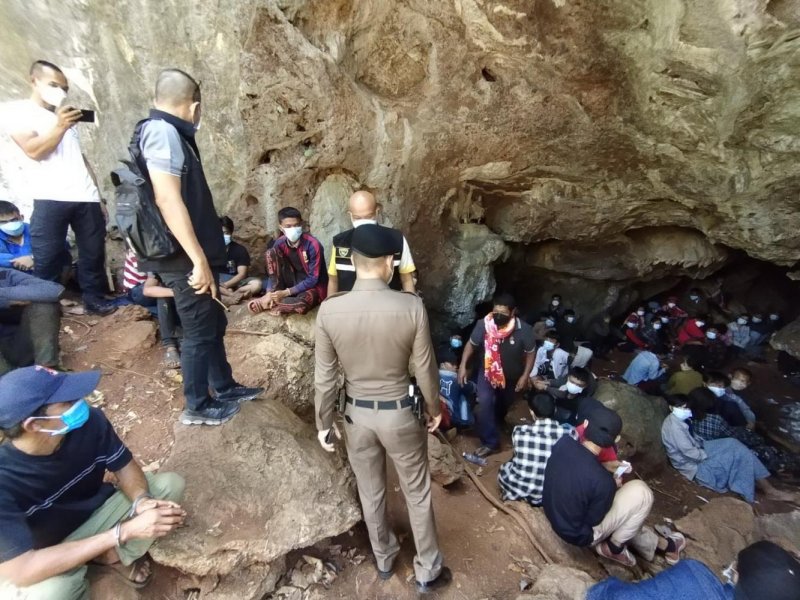
This file photo, dated Jan 20, 2022, shows 60 men and 23 women hiding in a cave near the Vajiralongkorn Dam. They were arrested after crossing the border illegally from Myanmar into Thong Pha Phum district of Kanchanaburi.  (Photo: Piyarach Chongcharoen)

Thailand hosts about 4.1 million migrant workers, registered and unregistered alike. They build buildings, staff factories, harvest fields, crew fishing boats and tend homes. They keep labour costs competitive and fill shortages that no domestic workforce can. Without them, Thailand's economy would falter.

Last month, the Thai private sector, through the Joint Standing Committee on Commerce, Industry and Banking, identified severe shortages of migrant workers as one of the most serious challenges facing business productivity and competitiveness. Yet the very workers who fill these gaps are also among the most vulnerable to forced labour.

Thailand has made progress in protecting them. Nearly a decade ago, it amended its Anti-Trafficking in Persons Act to include forced labour. It built a National Referral Mechanism, a framework for assisting trafficking and forced labour victims that assigned clear roles to government officers at every step, from frontline officers and victim screening to victim identification and social services for survivors.

Over the past eight years, Thailand has integrated trauma-informed, victim-centred approaches across its anti-trafficking policy framework. Four years ago, government agencies adopted the Forced Labour Standard Operating Procedure together with a screening form to help officials more consistently identify potential victims.

The structure exists. But is it working? A 2022 survey by International Justice Mission (IJM) and the Ministry of Labour found that 17% to 18% of semi- to low-skilled migrant workers likely experienced forced labour, based on the International Labour Organization (ILO) indicators combining the menace of penalty and involuntariness. Yet, many provinces report only zero to one identified case per year.

The gap points to compounding shortcomings. Screening for forced labour may not be as effective as it could be, and the bar for victim identification may be set too high for most cases to move forward. Many migrant workers are unaware of their rights, and many others see little reason to come forward.

Forced labour often hides in plain sight. It involves work or services obtained under the threat of a penalty and without a worker's free, informed and continued consent. The ILO identifies key indicators: abuse of vulnerability, deception, restriction of movement, isolation, physical and sexual violence, intimidation and threats, retention of identity documents, withholding of wages, debt bondage, abusive working and living conditions and excessive overtime.

Officers tend to recognise the most extreme cases: workers locked in rooms or subjected to obvious physical abuse, but they may miss subtler forms, such as documents held under false pretences, wages withheld over time or debts that are manipulated or impossible to repay. More often, forced labour is sustained through a pattern of coercion, control and vulnerability that strips workers of their ability to refuse or leave.

Thailand's immigration and police records show the problem lies not in policy but in practice. In one province, only a small number of more than 1,000 returnees from cyber scamming compounds in Myanmar in late 2025 were identified as victims of forced labour or trafficking.

While not every individual in an online scamming compound is a victim, this raises questions over the implementation of screening approaches and the application of victim-centred, trauma-informed practices.

For migrant workers, several factors, including a lack of documentation due to trafficking, drive isolation and fear of reporting exploitation. Workers who have taken on debt to migrate, support families or face fewer opportunities at home are unlikely to risk deportation for uncertain outcomes.

Many who come forward are never identified as victims and leave without protection or recourse, often more vulnerable than before. When cases do reach the courts, the justice system has yet to fully grasp a critical distinction: initial consent, often shaped by deception, does not cover consent to coercion after.

Combining low trust in government protection with gaps in awareness of rights and reporting channels, language barriers and immigration statuses tied to their current employment, they stay silent because the benefits often do not outweigh the costs.

Closing that gap is what IJM, known in Thailand as IJM Foundation, is committed to. Working with government partners, IJM focuses on strengthening the justice system, improving victim identification, protecting those most vulnerable and holding abusers accountable. It includes community engagement with safe, accessible reporting channels that allow migrants to report concerns without fear of legal consequences or reprisals from employers, alongside training and mentoring for frontline officials to better recognise and handle cases.

The approach also expands collaborative casework with law enforcement to increase investigations, prosecutions and compensation outcomes, while enhancing survivor protection through trauma-informed care, stronger case management and cross-border support.

Thailand marks a National Anti-Human Trafficking Day each year on June 5. The date highlights both the progress made in strengthening legal and policy frameworks and the work that remains to ensure that workers who keep Thailand's economy running can do so with dignity.

Andrew Wasuwongse is Country Director for IJM Thailand. He wrote this article to mark Thailand's National Anti-Human Trafficking Day, which falls on June 5.

Sign up to read this article
Read news from 100's of titles, curated specifically for you.
Already a member? Sign in here
Related Stories
Top stories on inkl right now
One subscription that gives you access to news from hundreds of sites
Already a member? Sign in here
Our Picks
Fourteen days free
Download the app
One app. One membership.
100+ trusted global sources.