
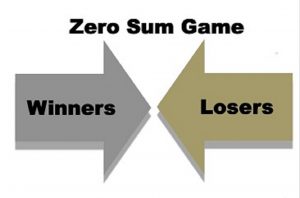
A new study just published by the prestigious American Economic Review may be the most important recent social science article most nonexperts have never heard of. It's entitled "Zero-Sum Thinking and the Roots of US Political Differences" and the authors are Sahil Chinoy, Nathan Nunn, Sandra Sequeira, and Stefanie Stantcheva. Here is the abstract:
We investigate the origins and implications of zero-sum thinking: the belief that gains for one individual or group tend to come at the cost of others. Using a new survey of 20,400 US residents, we measure zero-sum thinking, political preferences, policy views, and a rich array of ancestral information spanning four generations. We find that a more zero-sum mindset is strongly associated with more support for government redistribution, race- and gender-based affirmative action, and more restrictive immigration policies. Zero-sum thinking can be traced back to the experiences of both the individual and their ancestors, encompassing factors such as the degree of intergenerational upward mobility they experienced, whether they immigrated to the United States or lived in a location with more immigrants, and whether they were enslaved or lived in a location with more enslavement.













