Get all your news in one place.
100's of premium titles.
One app.
Start reading
Cycling News
Cycling News
Sport
Owen Rogers

'The number of smaller races I've been to where there's traffic on the course is unreal' – Jonathan Vaughters calls for calendar reform following death of Finlay Tarling

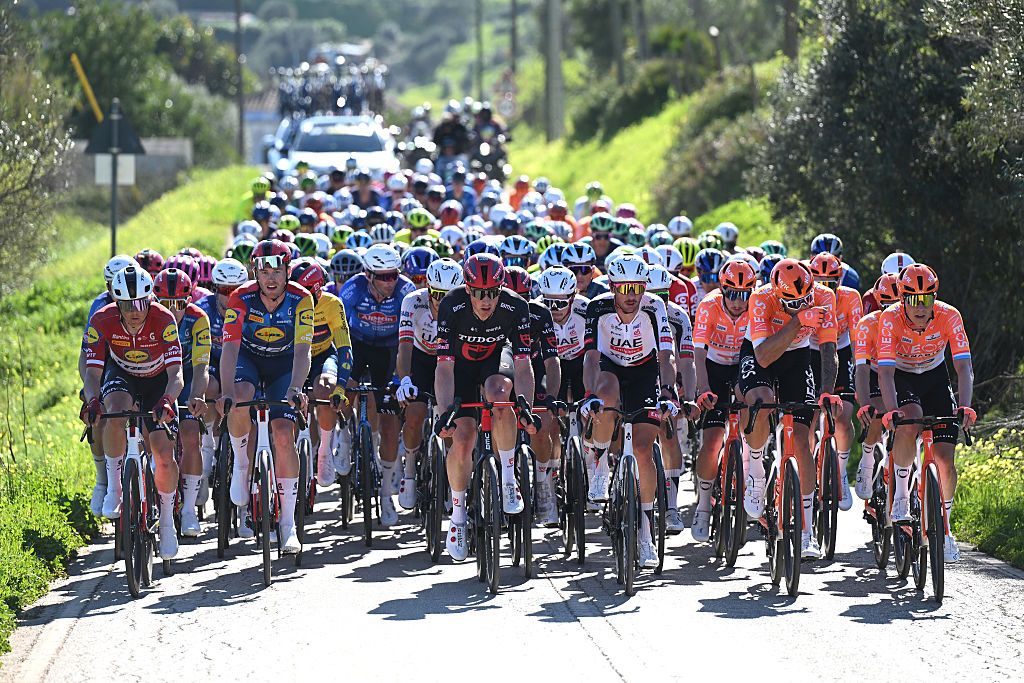
The pelton during stage 4 of the 2026 Volta ao Algarve em Bicicleta in Lagos, Portugal. (Photo by Dario Belingheri/Getty Images).

Jonathan Vaughters has called for better governance of the sport in order to prevent tragedies like the death of Finlay Tarling.

Speaking to the BBC, the EF Education-EasyPost CEO highlighted issues as varied as rolling road closures and the pressure of racing for UCI ranking points as highlights impacting safety in the bunch.

One thing he was clear about was that inaction must never be an option.

"What I'm really not enjoying is this sentiment that's coming from very powerful people in cycling, that says: 'What can you do? Sometimes cars just end up on the road - this is just part of doing competitive sport on the open road.' That is not true. This is preventable," he told the BBC.

The sport was rocked last week by the death of Finlay Tarling. Riding for the NSN Development Team, the young Welsh rider died when he was hit by a car during stage 8 of the Volta a Portugal. His death added to the tragic toll of deaths in the sport, with six riders dying in the last three years.

"People look at the Tour de France and see a bunch of riders going through the beautiful French countryside, but fundamentally it's a very dangerous sport. From the start of my career I can't tell you how many people we've lost."

'We trust the Tour de France, but we don't trust smaller races'

One of the issues Vaughters addressed was the different type of road closure seen across the calendar.

The bigger events are run under a full closure where the route is more or less sealed, while less high-profile races, like the Volta a Portugal and both women’s and men’s Tours of Britain, have a rolling closure where a secure bubble is created around the race as it runs.

"The number of smaller races I've been to where there's traffic on the course is unreal," Vaughters continued.

"There have been too many races at this level that have exactly the same problem. This [Fin Tarling's death] just happened to be terribly unlucky. It could have been any of the other races.

"The costs are enormous, organisers are really struggling and hoofing it financially and I sympathise with that.

"As a team, we trust races like the Tour de France, but we don't trust smaller races. Rolling enclosures become a problem when the peloton splits into groups and you don't have every T-junction blocked, and people think: 'The race is done - I'm free to go on the road.' As soon as they turn on the road, they're going 100kph and the opposite way is the peloton at 50km/h - that's a combined 150kph. I mean, it's horrible.

"Rolling enclosures I don't think work that well."

'Why do we need 700 race days around the world?'

On the face of it these issues sit with organisers, but Vaughters believes that the true responsibility lies with cycling's governing body, the UCI.

"I’m not blaming anyone other than the ultimate authority which needs to do a better job of governing the sport," he said.

Vaughters made reference to the battle for UCI rankings points, which has taken on added importance with the introduction of the WorldTour relegation and promotion system and the influence of rankings on race invitations.

"If you are forcing teams to fight for ranking points at this event then you damn well better make sure the event is up to standard," Vaughters said.

"They're [riders] being pressured by team managers like me saying: 'We've got to get points - hurry up.' There's millions at stake so athletes feel that pressure. They start to take risks on the course – if they do that when it's not properly managed and doesn't have good enough traffic control, it's a recipe for disaster.

"We have way too many events on the calendar – it's just too much. It needs to be more selective and the governance needs to look at each race with a much higher degree of scepticism.

"Why do we need 700 race days around the world? It's fine if those events occur, but not as [UCI] sanctioned events with riders fighting for points. What's wrong with 100 days on the race calendar?"

All UCI registered events pay a registration fee to the UCI that is commensurate with the level of the event, a WorldTour race paying more than a 2.1 race like the Volta a Portugal. As a result, any reduction in UCI race days would reduce the governing body’s income, though Vaughters believes that is a price worth paying.

"In the modern world the price of a young athlete dying far outweighs all the other problems."

For unbeatable coverage across road, gravel and tech, subscribe to Cyclingnews. You'll get comprehensive race coverage of La Vuelta a España, subscriber-exclusive analysis from our expert columnists, in-depth features and industry-leading tech insight. Plus, the Cyclingnews app lets you follow the action wherever you go! Join today.

Sign up to read this article
Read news from 100's of titles, curated specifically for you.
Already a member? Sign in here
Related Stories
Top stories on inkl right now
One subscription that gives you access to news from hundreds of sites
Already a member? Sign in here
Our Picks
Fourteen days free
Download the app
One app. One membership.
100+ trusted global sources.