Get all your news in one place.
100's of premium titles.
One app.
Start reading
The Conversation
The Conversation
Environment
William J. Kinsella, Professor Emeritus of Communication, North Carolina State University

The nuclear arms race's legacy at home: Toxic contamination, staggering cleanup costs and a culture of government secrecy

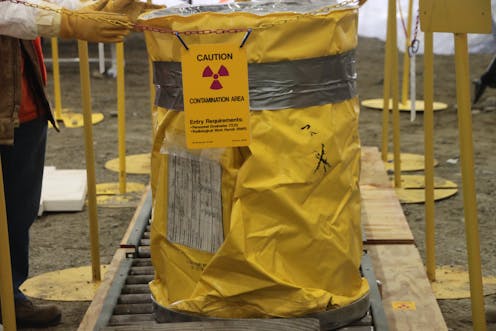
Packaging excavated radioactive materials at the Hanford site in Washington state. USDOE

Christopher Nolan’s film “Oppenheimer” has focused new attention on the legacies of the Manhattan Project – the World War II program to develop nuclear weapons. As the anniversaries of the bombings of Hiroshima and Nagasaki on Aug. 6 and Aug. 9, 1945, approach, it’s a timely moment to look further at dilemmas wrought by the creation of the atomic bomb.

The Manhattan Project spawned a trinity of interconnected legacies. It initiated a global arms race that threatens the survival of humanity and the planet as we know it. It also led to widespread public health and environmental damage from nuclear weapons production and testing. And it generated a culture of governmental secrecy with troubling political consequences.
Sign up to read this article
Read news from 100's of titles, curated specifically for you.
Already a member? Sign in here
Related Stories
Top stories on inkl right now
One subscription that gives you access to news from hundreds of sites
Already a member? Sign in here
Our Picks
Fourteen days free
Download the app
One app. One membership.
100+ trusted global sources.