
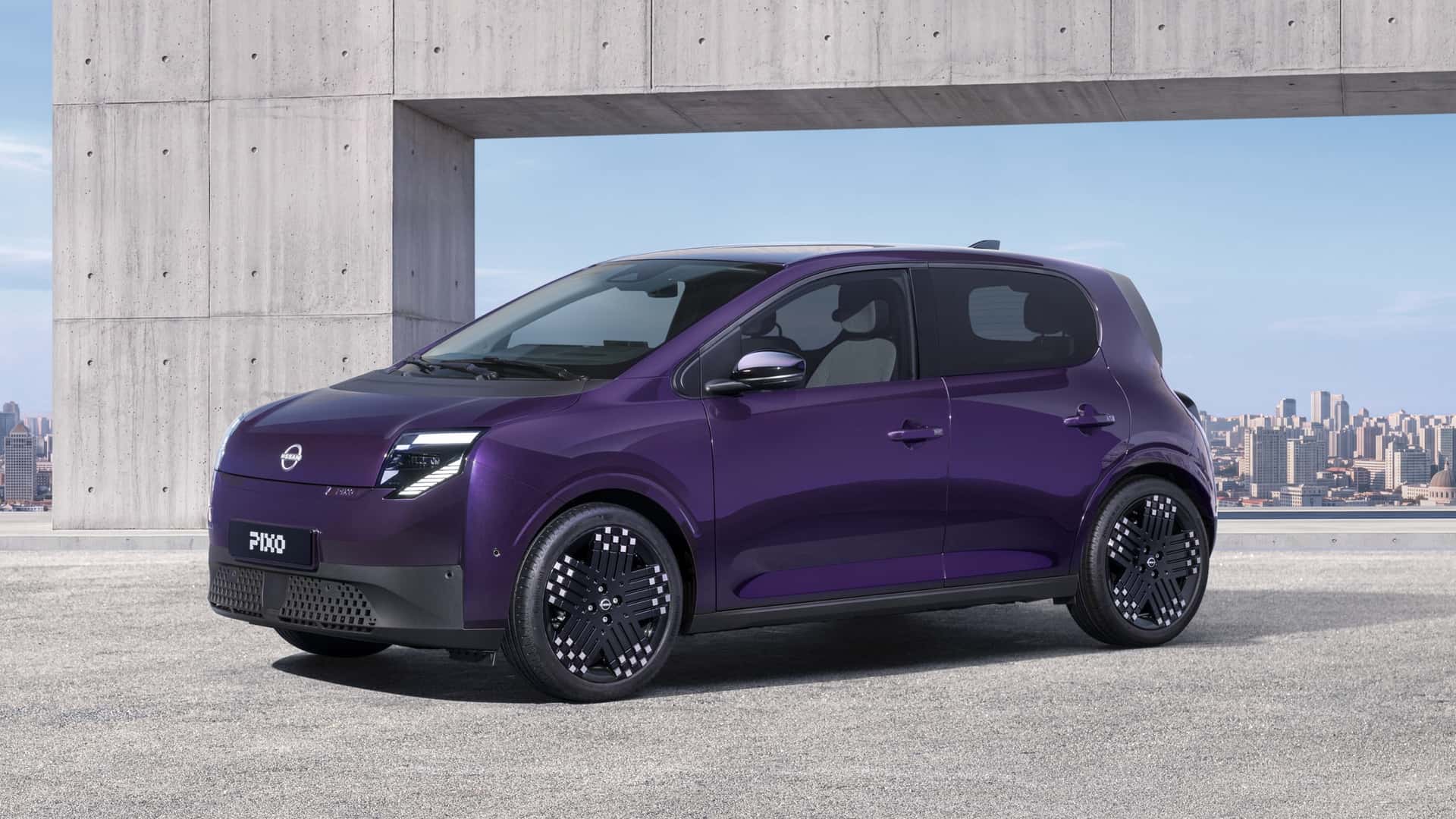
- The Pixo revives Nissan’s small-car nameplate with a city-focused EV.
- It gets a 27.5-kWh LFP battery with 161 miles (259 kilometers) of range.
- Charging at 50 kW, the battery takes 28 minutes to go from 15 to 80 percent.
The Twingo is proving that good things really do come in small packages. The new electric city car has already served as the basis for the second-generation Dacia Spring, and now Nissan is getting its own version. Say hello to the reborn Pixo, now a tiny EV that slots below another badge-engineered product, the Renault 5-based Micra.

It’s not even the first time Nissan has used the Pixo name for a car that’s joined at the hip with a model from a different brand. The original was essentially a rebadged Suzuki Alto made in India, while its successor is a Twingo in disguise, assembled in Slovenia. Predictably, production will take place at Renault's plant in Novo Mesto, where the new Spring also comes to life.
Nissan has made some effort to give the Pixo its own visual identity, with Hyundai Ioniq-esque pixel accents front and rear, but the profile immediately betrays its French roots. While not as playful as the Twingo or as boxy as the Spring, Nissan’s version has some charm, provided you can get past its immediate connection to Renault’s entry-level EV.
No Surprises Underneath The Skin
Nissan hasn't reinvented the technical recipe, either. The Pixo uses the same basic platform underneath the Twingo and Spring. It gets a 27.5-kWh LFP battery good for 161 miles (259 kilometers) of range in the WLTP cycle. This lithium iron phosphate pack supports DC charging at 50 kW, which takes around 28 minutes to go from 15 to 80 percent. Energy can flow both ways, as bidirectional charging at 11 kW is also possible.
Power comes from a front-mounted electric motor rated at a mighty 80 horsepower and 129 lb-ft (175 Nm), enabling a 0-to-62 mph (0-to-100 km/h) run in 12.1 seconds. It’s hardly quick, but it doesn’t need to be, given how it’ll spend most of its time tackling the urban jungle.
Its petite proportions make it ideal for the city, with the Pixo measuring only 149.5 inches (3,796 millimeters) long. Its tight 32.5-foot (9.9-meter) turning circle should make it right at home on Europe’s roundabouts.
Instantly Familiar Interior
As if the similarities on the outside weren’t already evident, a quick look inside shows the Pixo is essentially a Twingo without Renault’s diamond logo. It shares the same 98.1-in (2,492-mm) wheelbase and is fairly practical for its size, with 12.6 cubic feet (356 liters) of space behind the rear seats. Fold the independent rear sliding seats, which the Spring doesn't get, and volume jumps to 43.1 cu ft (1,221 liters). But unlike the Spring, there's no front trunk.
Not that we’re surprised, but it’s great to see physical controls making their way into the Pixo. Nissan has kept the old-school buttons and knobs instead of burying everything in the touchscreen, while still bringing in plenty of new-school tech. The cabin gets features such as Google’s Gemini AI assistant and even Face ID, which can recognize the driver and load personalized settings.
It’s a nice mix of traditional controls and modern tech, proving that a small, affordable EV doesn’t have to turn the entire dashboard into a giant tablet. Speaking of which, the new Spring’s entry-level trim doesn’t even have a central screen. Instead, you plug in your smartphone and use it as the infotainment system.
Nissan will kick off deliveries in Europe early next year, with pricing to be announced this December. Echoing its Renault and Dacia sisters, it should cost less than €20,000 in its most basic form. Its main external competitors will be cars like the resurrected Citroën 2CV and Volkswagen’s production version of the ID.Every1 concept, presumably the ID. up! Of course, we mustn't omit the growing number of Chinese rivals, but most of them are bigger.
2027 Nissan Pixo
Motor1's Take: Once again, the Renault Group has found a way to squeeze multiple cars out of the same basic ingredients. The Twingo gets the cheerful retro treatment, Dacia turns the formula into a bargain-focused EV, and Nissan adds its own design formula. The Pixo also reminds us that affordable EVs don't necessarily need to be complicated.
The funny thing is that Nissan's smallest EV may actually be one of the clearest examples of how the Renault-Nissan-Mitsubishi alliance can still make sense. Instead of spending years and billions developing three separate tiny electric cars, the partners can share the expensive stuff underneath and let each brand do its own thing where customers actually see it.