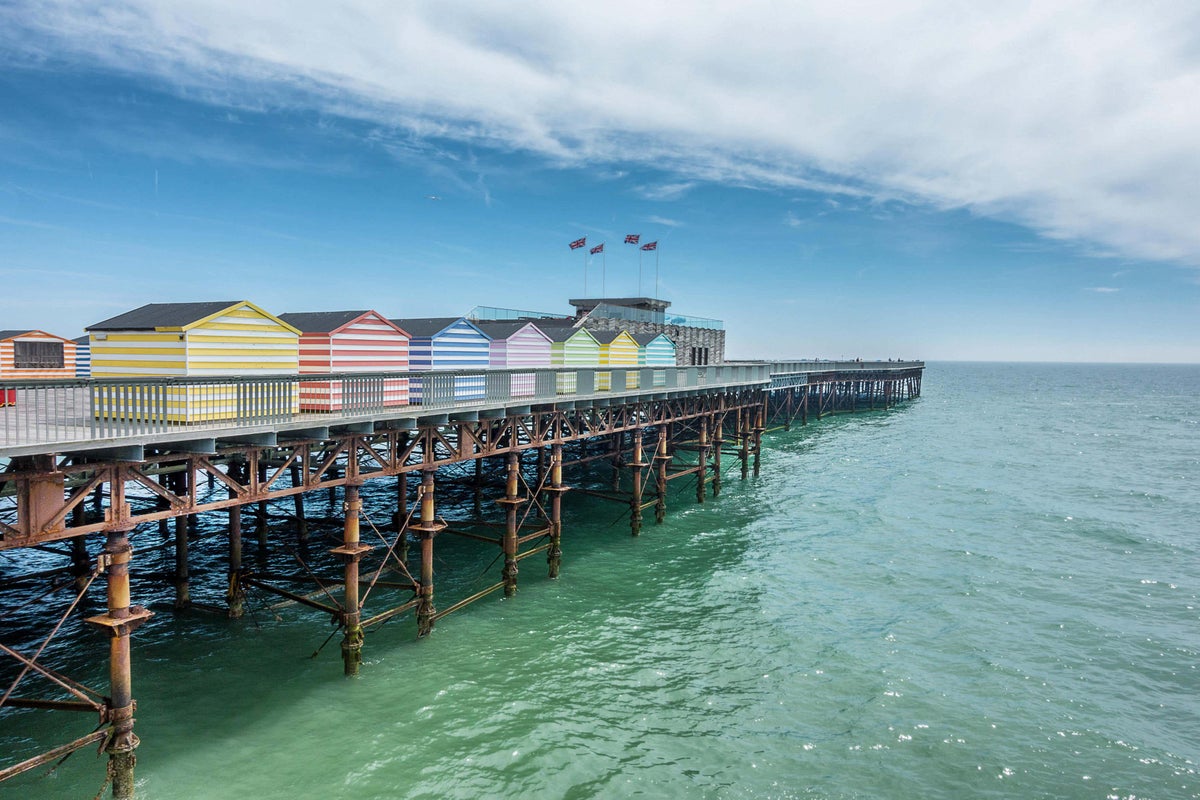
It has survived fires, bankruptcy and scandal, not to mention 153 years of lashing British weather, but now Hastings’ “peerless pier”, as it was hailed at its grand opening, faces a new twist in its turbulent tale: it is being put up for sale.
Ahead of a £150,000 fraud trial, the controversial current owner of the pier, the self-styled Sheikh Abid Gulzar, is planning to “dispose of” the landmark, the council says, sparking a rush to bring the Victorian structure back into public ownership.
Hastings Borough Council confirmed it had received formal notification from Mr Gulzar that he intends to sell the pier, and had notified the Friends of Hastings Pier, which nominated it as an asset of community value, to see if it was interested in submitting a bid.
The group has told The Independent it is “optimistic”, it can succeed in bringing the pier back under community control.
“It’s early days at the moment,” Friends spokesperson James Chang said this week. “I only got the email from the council on Friday afternoon.”

Conceding that the pier in its current state could “have a liability of several million”, Mr Chang said that, nevertheless, “at the moment we’re optimistic, because before, [Mr Gulzar] owned it and that was it.
“He’s said he wants to pass it on, which is why it should belong to the community. It shouldn’t be for one person to keep on running it until they’re tired of it.”
Mr Gulzar has owned numerous hotels in Sussex and also owns Eastbourne Pier. He is scheduled to face trial by jury at Lewes Crown Court in September 2026 on 10 charges of fraud. He and his business partner Manasdeep Singh are alleged to have defrauded a water company out of £150,000. The two men deny all charges.
Mr Gulzar took ownership of Hastings pier in 2018 in highly controversial circumstances, two years after the pier was overhauled with £12.4m of Lottery funding, after the charity running it went into administration.

The expected bid by Friends of Hastings Pier will be the second attempt the group has made at bringing the landmark under community control, after losing out to Mr Gulzar in 2018, who bought the pier from administrators for a reported £50,000, despite the community group raising more than £477,000 to buy the pier and keep it open to the public free of charge.
At the time, frustrated locals gathered on the pier to offer to immediately buy it back off Mr Gulzar for £65,000, but he refused the offer.
Sources have told The Independent he is now seeking £3.5m for the pier. According to a recent article in The Times, Mr Gulzar has an estimated net worth of around £5m.
Helena Dollimore, the Labour MP for Hastings and Rye, told The Independent that simmering resentment over the sale of the pier in 2018 remained a major consideration.

“Our town is still deeply angry about what happened in 2018,” said Ms Dollimore. “I would urge Mr Gulzar to work with the people of Hastings now. The pier belongs to Hastings, and as the local MP, I would support efforts to bring it back under community control and protect the pier.”
She added that the Friends of Hastings Pier Group had consistently highlighted maintenance issues and other concerns about the state of the pier.
“Hastings Pier is an integral part of our identity as a town and our heritage. Everyone in Hastings wants to see the pier protected and see it thriving. As well as being a Labour MP, I’m a co-operative MP, which means I support the principle that communities should have control over things that are important to them.
“Many people in Hastings are not happy with how the pier has been run in recent years. They don’t feel it’s been reaching its full potential and now we have an opportunity to change that.”
.jpeg)
Built in 1872 and opening on the UK’s first bank holiday weekend, the pier survived its first serious fire in 1917 and went on to become a leading music venue, hosting acts in the 1960s including The Rolling Stones, The Hollies, Suzi Quatro and Jimi Hendrix. Pink Floyd’s Syd Barrett is said to have played his last gig with the band there, and was reportedly restrained from flinging himself over the railings and into the sea.
Long past its Victorian heyday and its brief role in pop history, Hastings Pier has nevertheless clung on over the decades, its slow cycles of wear and repair often reflecting the fluctuating fortunes of the town.
The pier’s nadir came in 2010 when, four years after it had closed down in a sorry state, a massive fire tore through the structure, destroying the ballroom and 95 per cent of the rest of the structure. Two men were arrested on suspicion of arson, but were never charged.
A twisted skeleton of charred metalwork sticking out over the sea was all that remained for several years, but behind the scenes, a major push by the community was underway to rebuild.
In 2011, £8.75m was secured from Heritage Lottery, and work to rebuild got underway. It was officially completed in March 2016 when Suggs, the lead singer of Madness, who was born in Hastings, officially finished the restoration by screwing in the final plank of some 50 miles of decking.

The following year, the pier won the Stirling Prize for architecture and was heralded as “a phoenix risen from the ashes”. But despite the huge success in resurrecting the landmark, the sleek, modernised, minimalist pier faced almost immediate headwinds.
Nicknamed “The Plank”, due to the largely uninterrupted expanse of decking sticking out over the waves, owners have struggled to make it profitable. Two small indoor areas provide minimal shelter when the weather is bad, while significant maintenance costs, due to the constant battering of the sea, mean margins are tight.
When Mr Gulzar took the keys in 2018, the first thing he did was shut it down for several months, citing essential maintenance on the structure. At the same time, locals noticed the arrival of a growing menagerie of golden animals and objects accumulating behind the locked gates. Fibreglass golden lions were followed by a hippopotamus and a bull on a marble plinth. When the pier eventually reopened, little more had been done to make it a destination in its own right.
Since then, a succession of events and attractions including concerts, DJ sets, a pop-up bar billed as the UK’s largest beer garden, football screenings, and various attempts to overhaul the restaurant and hatch on the top deck have been and gone with little fanfare.

Reports filed with Companies House show that the liquidation of the company running Hastings pier – of which Mr Gulzar was the sole director – was accompanied by more than £300,000 of unpaid debts, including £74,000 owed to suppliers and £77,000 in employment tribunal awards. While company has been wound down, Mr Gulzar still retains personal ownership of the pier itself.
According to the Sussex Express, Mr Gulzar said: “I tried my hardest and put all my love and money into the pier and have decided at my age of 81 to let someone else take it on.”
Former “pier master” Lord Brett McLean (whose title, like his associate’s, is also self-styled) told The Independent the upcoming fraud trial had nothing to do with Mr Gulzar’s desire to sell Hastings Pier.
Mr McLean, who said he managed the pier for two years after Mr Gulzar bought it, said: “The reason why he wants to reduce his property portfolio is so he can start enjoying a more leisurely life and at the age of 81 he should reduce some of his hours like other senior citizens who spend their time on social and leisure activities.”
But he suggested Mr Gulzar would not be keen to sell the pier to the Friends of Hastings Pier.

Whether the structure represents a viable business opportunity is yet to be proven. It would hardly be the first to descend into “end of the pier show”-style headlines.
John Bownas, business improvement district manager at Love Hastings, a local non-profit, told The Independent he was concerned there could be a gulf between the millions the pier is supposedly valued at, and what it could actually be worth to an organisation once repair and maintenance work was factored in.
"Valuations on things like piers are complex and often very subjective,” he said. “On the one hand, they have huge community value, but on the other, they are money pits in terms of ongoing maintenance.
“Cash values are ultimately what someone is prepared to pay. So, with essential repair works potentially running into millions, my worry is that unless a sale can somehow be forced at a viable price, there will be a stalemate between the current owner’s expectations and the amount that anyone with a realistic business plan would be willing to offer in terms of realising a return on investment.”
The Independent has contacted representatives of Mr Gulzar for comment.
Scottish prison population hits record high
Lacking community resilience centers, Houston neighbors opt for solar-powered 'hub homes'
PM announces £10m additional funding to protect British Muslims from hate crime
Police on misconduct charges over use of force to face ‘more consistent’ rules
Britain faces cold snap after weekend snow warning
Child abuse inquiry was meant to move the dial. Three years on, nothing has changed