Get all your news in one place.
100's of premium titles.
One app.
Start reading
The Times of India
The Times of India
World
TOI World Desk

The Netherlands built a floating forest in Rotterdam because the crowded city lacked space for trees, so designers planted them on recycled sea buoys instead of land

A new challenge exists for cities all over the globe. Cities are becoming more crowded, concrete is spreading, and space for greenery is shrinking. Rather than focusing on the roads and rooftops, the planners are now focusing on the open waters.

Get breaking news anytime, anywhere. Download the TOI app now!

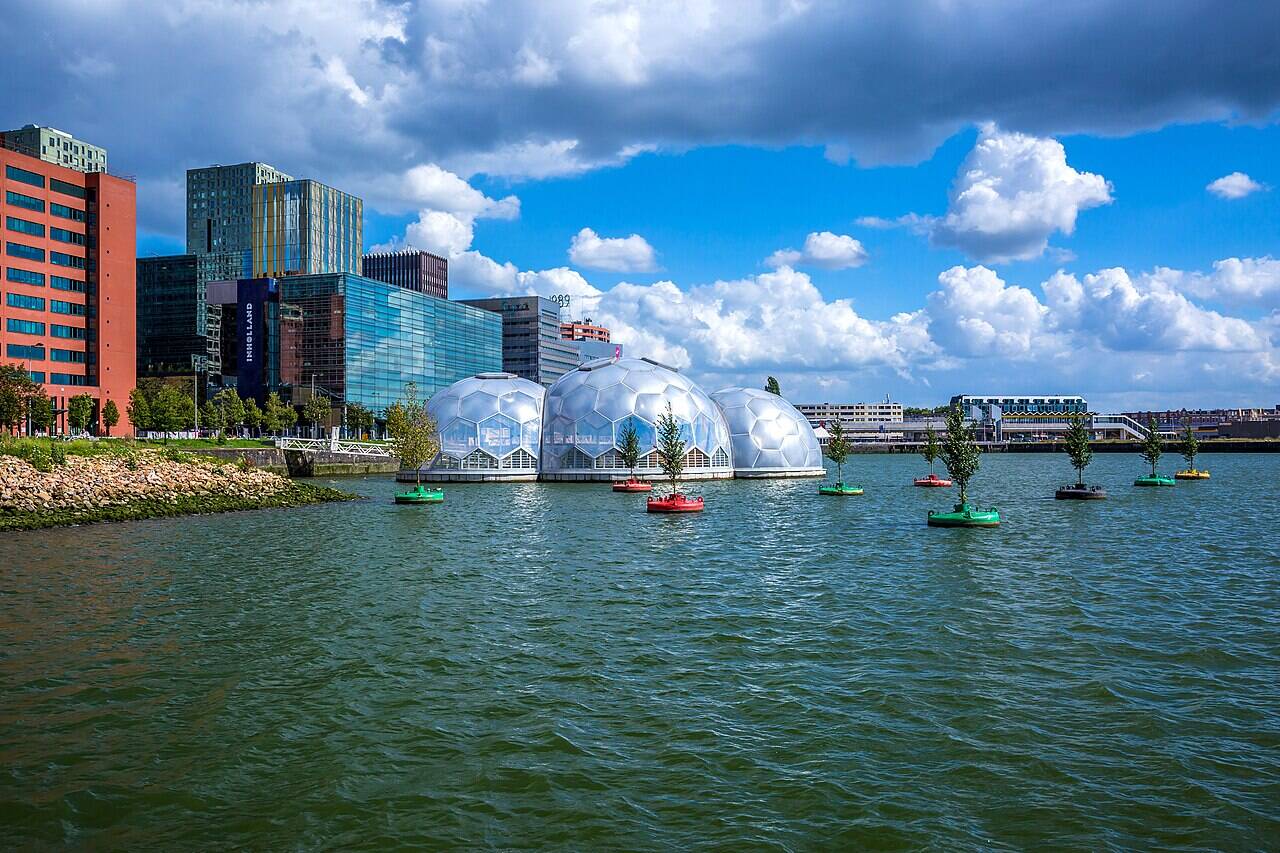
The bustling Dutch port city of Rotterdam faced that challenge. With little public land left after housing and transport needs, a traditional park seemed nearly impossible. The creative solution was to build a floating forest in the historic harbour basin. By planting mature trees on recycled sea buoys, designers added green canopy to an industrial area without using scarce land.

This floating woodland is more than a design installation for passing tourists. It reflects a broader effort by coastal cities to adapt to environmental change. To understand the project, it helps to look at the environmental history of Rotterdam’s waters. In a study titled Ecological studies in a man-made estuarine environment, the port of Rotterdam , researcher Peter Paalvast explores how centuries of human engineering transformed this region. The study describes how the Rhine-Meuse delta was transformed into a heavily modified industrial shipping area. Over the decades, massive land reclamation, river training, and the creation of deep artificial waterways caused more than 99 per cent of the original soft-sediment ecotopes to vanish from the area. By replacing natural muddy shores with concrete quays and deep shipping lanes, the historical ecosystem was almost entirely lost to development.

The figures show that in about 1835 there were 4,745 hectares of soft-substrate ecotopes in the Noordrand estuary, but only 17 hectares remained in 1970, while hard intertidal substrate increased to 338 hectares. According to Paalvast, years of land reclamation, river training, and harbour enlargement have left the shore almost “petrified,” with 344 km of hard substrate compared with just 1 km of soft substrate by 2008.

Engineering life back into industrial waters

Replacing natural banks with artificial ones has reduced habitat for urban wildlife. According to Peter Paalvast’s work, the modern underwater environment was built for heavy harbour activity, leaving marine life without suitable surfaces for attachment and growth. To address this problem, researchers tested artificial hanging structures made of ropes and strings. In particular, the artificial rope installation, built as pole-and-pontoon structures, provided an attachment surface for native blue mussels and other mobile species.

The floating forest applies a similar ecological-engineering idea at the water's surface. The miniature aquatic woodland consists of twenty mature Dutch elm trees, each secured inside a brightly coloured decommissioned marine buoy. These buoys once guided cargo ships through North Sea channels, but now serve as buoyant, self-contained planters.

Survival in water becomes a unique problem for the tree. The elm tree is susceptible to salt water, which is dangerous for its roots and can harm its growth. To solve this problem, each recycled buoy will have built-in fresh-water storage and an automatic irrigation system for the tree. Thus, the tree will stay watered without absorbing the salty harbour water around it. The chosen trees will be flexible and robust enough to move safely with the tide.

The new look at urban health

As the population of cities increases and space becomes scarcer, issues related to nature have become more important in both urban development and public health. A connection to nature is widely linked to better health and well-being. When space is limited or costs too much, floating parks become a solution.

For locals and visitors on the waterfront, the drifting woodland offers a brief escape from city life. The green leaves reflected in the water soften the waterfront scene.

These floating plantings add beauty to the city, provide habitat for migratory birds and native insects, and may help cool the nearby harbour area in summer. The project could offer a model for other crowded port cities.

Sign up to read this article
Read news from 100's of titles, curated specifically for you.
Already a member? Sign in here
Related Stories
Top stories on inkl right now
One subscription that gives you access to news from hundreds of sites
Already a member? Sign in here
Our Picks
Fourteen days free
Download the app
One app. One membership.
100+ trusted global sources.