Get all your news in one place.
100's of premium titles.
One app.
Start reading
Guitar World
Guitar World
Entertainment
Richard Barrett

“The name can be distracting – what’s important is the sound. Jimmy Page thought so”: How recycling chord shapes can unlock new and surprising sounds

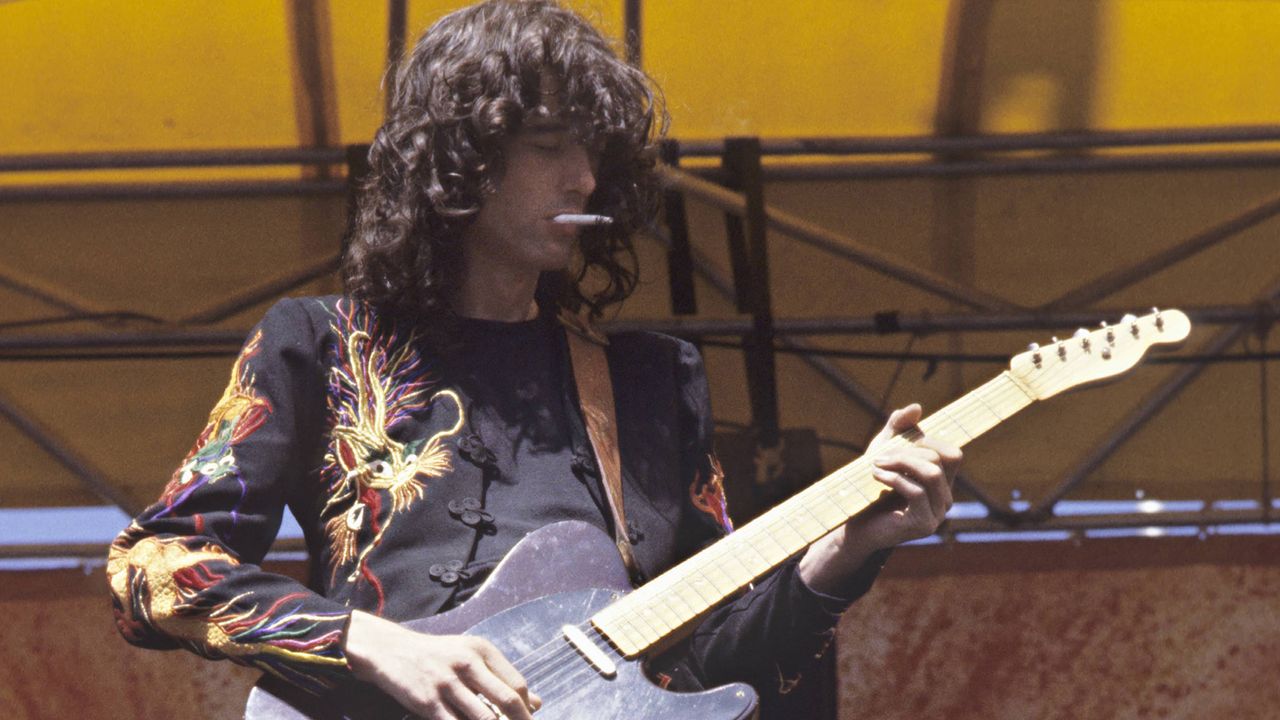
Jimmy Page performing on stage at Oakland Coliseum 1977.

As guitar players, we rely on shapes and patterns – consciously or not. This includes both scales and chords. Some chord shapes are described as ‘movable’, meaning they can be relocated to anywhere on the fretboard with predictable results.

Conversely, others – usually shapes including open strings – are not described in this way, implying that they only work in one position.

Regular readers will know that we frequently test this imaginary boundary by taking such shapes and moving them to different positions, often with surprising and pleasing results.

In this case, rather than starting in a conventional position then moving the shape, we’ve gone straight to a non-standard position – hence the term ‘recycled’.

The shape looks familiar, but the sound is not. Sometimes this can result in a complex-sounding name, but if we’re inspired by the sound this is just a detail. Coincidentally, three of these are add2 chords, so clearly this isn’t always the case.

Example 1. Fmaj7add6/A

(Image credit: Future)

By moving an Amaj7 up a fret/semitone, we get this jazzy Fmaj7add6/A chord. The name can be distracting – and there are other ways this could be approached, perhaps A with an augmented 5th and a sus4?

But what’s important is the sound: Jimmy Page appears to have thought so when he used this chord in Ten Years Gone.

Example 2. Fadd2

(Image credit: Future)

By recycling a C major shape and moving it to the 8th position, we get this Fadd2 courtesy of the G on the open third string.

If we were to allow the high E/first string to sound, this could add a maj7, too, but we’ve opted to keep things a little more concise for this example.

Example 3. Fadd2

(Image credit: Future)

Another take on Example 2, this is also an Fadd2 but with an extra high C (the 5th) added on the first string. We’ve sacrificed the sixth string for this, but we get a chord with extra detail in the high end.

Steve Howe moves this shape around to great effect during the ‘Würm’ section of Starship Trooper by Yes.

Example 4. Cadd2

(Image credit: Future)

This recycled G shape gives us this Cadd2 when moved to the 8th position. This chord has found its way into the songs of Supergrass, The Pretenders and Rush.

For clarity on the name, an add2 means that the 3rd of the chord (in this case E) is present. In sus2 chords, the 3rd is replaced by the sus note.

Example 5. E7

(Image credit: Future)

Taking a B7 chord and shifting it to the 7th position gives us this jangly E7. While we can’t think of an obvious example of this one in use, there will be a song out there somewhere…

The open second string (B) fits in here perfectly, giving us the 5th of the chord.

Sign up to read this article
Read news from 100's of titles, curated specifically for you.
Already a member? Sign in here
Related Stories
Top stories on inkl right now
One subscription that gives you access to news from hundreds of sites
Already a member? Sign in here
Our Picks
Fourteen days free
Download the app
One app. One membership.
100+ trusted global sources.