
Get all your news in one place.
100's of premium titles.
One app.
Start reading
Space
Space
Science
Joe Rao

The moon and Venus take a morning stroll through the sky on Oct. 19

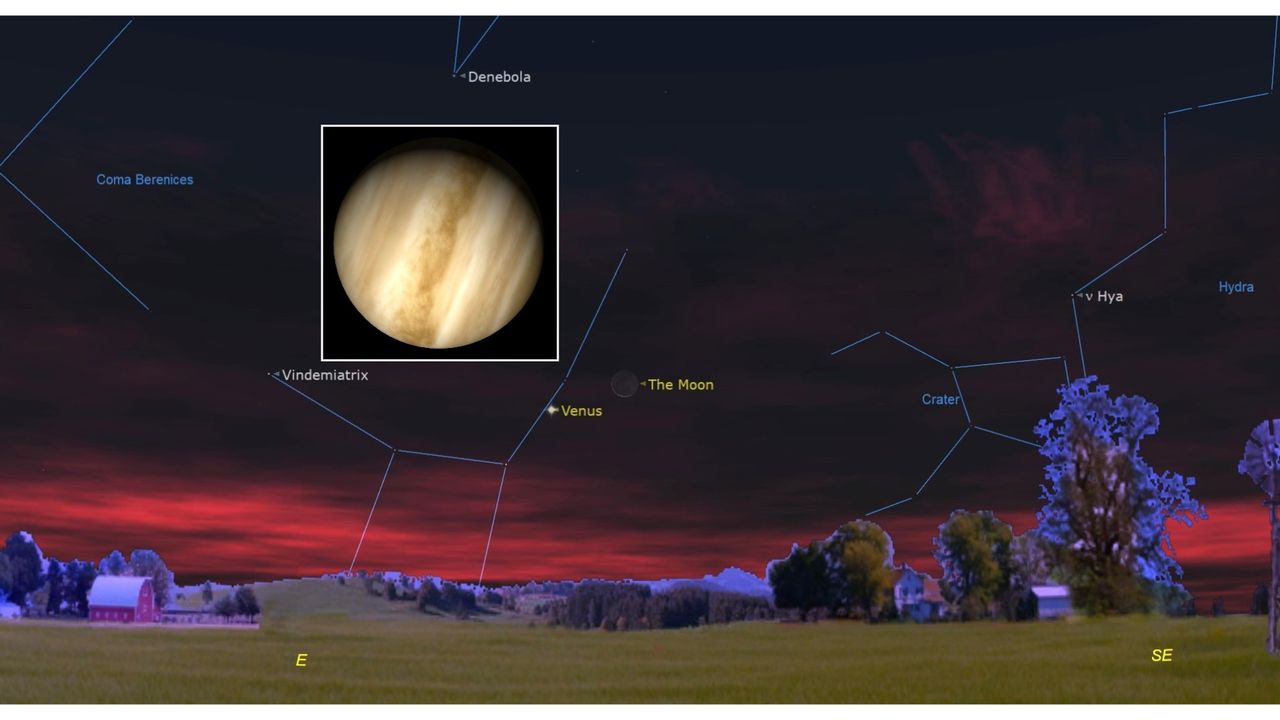
A night sky map with various constellations where in the center is a moon icon for the moon and slightly below to the left is a dot labeled Venus. Next to this is a large white box with a close up image of the planet Venus.

A pairing-off of the brightest planet and a slender crescent moon will be the chief celestial attraction in the dawn sky early on Sunday morning.

If you look low toward the eastern horizon about 60 to 75 minutes before sunrise (make sure there aren't any trees or buildings to obstruct your view) you should readily catch sight of the very narrow (4 percent illuminated) crescent moon. And situated only 4 degrees to its left will blaze Venus. Of course, what you will be seeing is merely an illusion of perspective. The moon — our nearest neighbor in space — will be situated about 247,000 miles (398,000 km) from Earth, while Venus is nearly 600 times more distant at 147 million miles (236 million km) away.

Sign up to read this article
Read news from 100's of titles, curated specifically for you.
Already a member? Sign in here
Related Stories
Top stories on inkl right now
One subscription that gives you access to news from hundreds of sites
Already a member? Sign in here
Our Picks
Fourteen days free
Download the app
One app. One membership.
100+ trusted global sources.







